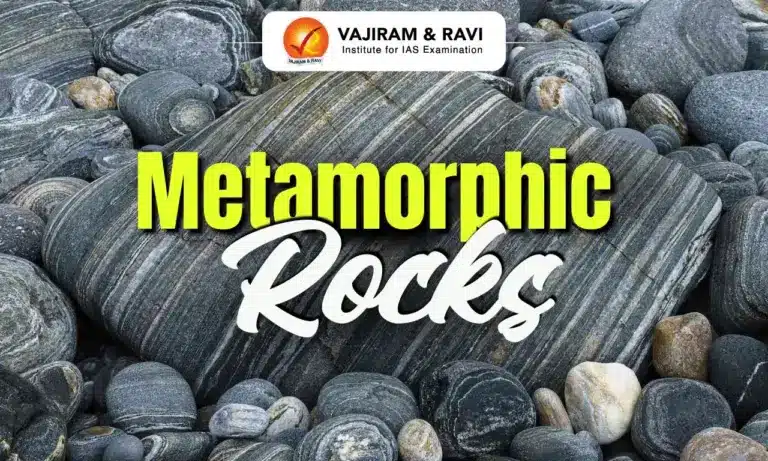
Metamorphic rocks are one of the three major types of rocks found on Earth. They are formed when existing rocks are transformed due to high temperature, pressure, and chemically active fluids without melting completely. This process changes the mineral composition, texture, and structure of the original rock, creating a new rock with different physical and chemical properties.
What are Metamorphic Rocks?
The term “metamorphic” comes from the Greek words meta meaning “change” and morphe meaning “form,” together meaning “change in form.” These rocks are created when pre-existing rocks undergo physical and chemical changes deep within the Earth’s crust due to extreme geological conditions. During this process, the minerals recrystallize and the texture of the rock changes while it remains in a solid state. Common examples include marble, slate, quartzite, gneiss, and schist.
Formation of Metamorphic Rocks
Metamorphic rocks are formed when pre-existing rocks undergo physical and chemical changes under extreme conditions deep inside the Earth’s crust.
- Existing igneous, sedimentary, or older metamorphic rocks act as the parent rocks (protoliths).
- High temperature causes minerals to recrystallize and form new mineral combinations.
- High pressure from tectonic movements and overlying rock layers changes the rock’s texture and structure.
- Chemically active (mineral-rich) fluids alter the mineral composition by adding or removing elements.
- The transformation takes place without melting the parent rock.
- Tectonic plate collisions, mountain-building processes, and magma intrusions are the main causes of metamorphism.
- The process occurs over millions of years, producing harder, denser, and more stable rocks.


Characteristics of Metamorphic Rocks
Metamorphic rocks have distinct physical and mineralogical features that develop due to changes in temperature, pressure, and chemical conditions inside the Earth.
- Formed from pre-existing igneous, sedimentary, or metamorphic rocks.
- Produced under high temperature and pressure without melting.
- Generally harder, denser, and more compact than the parent rock.
- Minerals recrystallize, forming new mineral structures.
- May show foliation (layering) or banding due to directed pressure.
- Usually do not contain fossils, as they are destroyed during metamorphism.
- Have interlocking mineral crystals, making them strong and durable.
- Can be foliated (e.g., slate, gneiss) or non-foliated (e.g., marble, quartzite).
- Commonly found in mountain belts, continental collision zones, and deep crustal regions.
- Often resistant to weathering and erosion, making them suitable for construction.
Categories of Metamorphism
Metamorphism is classified into different categories based on the geological conditions, such as temperature, pressure, and tectonic forces, under which rocks are transformed.
Dynamic Metamorphism
- Occurs mainly along fault zones and thrust boundaries.
- Caused by high pressure and intense shearing forces.
- Rocks are crushed, deformed, and recrystallized.
- Common rock formed: Mylonite.
Thermal Metamorphism
- Caused primarily by high temperatures from nearby magma.
- Also known as contact metamorphism when caused by magma intrusion.
- Recrystallizes minerals without significant pressure.
- Common examples: Marble and Quartzite.
Contact Metamorphism
- Occurs when rocks come into direct contact with hot magma or lava.
- Limited to areas surrounding magma bodies.
- High temperature but relatively low pressure.
- Produces mostly non-foliated rocks such as marble and hornfels.
Regional Metamorphism
- Affects large areas of the Earth’s crust.
- Occurs during continental collisions and mountain-building processes.
- Involves both high temperature and high pressure.
- Produces foliated rocks like slate, schist, and gneiss.
Metamorphic Rocks Uses
Metamorphic rocks are widely used in construction, industry, architecture, and art because of their strength, durability, and attractive appearance.
- Marble is used for flooring, wall cladding, monuments, sculptures, and decorative items.
- Quartzite is used as a building stone, road aggregate, railway ballast, and flooring material.
- Slate is used for roofing tiles, flooring, blackboards, and paving stones.
- Gneiss is used in construction, road building, and as dimension stone.
- Schist is sometimes used as a decorative stone in landscaping and wall facades.
- Marble powder is used in the manufacture of cement, paints, paper, plastics, cosmetics, and toothpaste.
- Some metamorphic rocks contain valuable minerals such as graphite, garnet, talc, and asbestos, which are used in various industries.
- Their hardness and durability make metamorphic rocks suitable for bridges, buildings, countertops, and public monuments.
Difference Between Metamorphic, Igneous, and Sedimentary Rocks
Metamorphic, igneous, and sedimentary rocks differ in their origin, formation process, texture, and characteristics, with each type representing a distinct stage in the rock cycle and contributing to the Earth’s geological structure.
| Difference Between Metamorphic, Igneous, and Sedimentary Rocks | ||
|
Metamorphic Rocks |
Igneous Rocks |
Sedimentary Rocks |
|
Formed by the transformation of existing rocks due to high heat and pressure. |
Formed by the cooling and solidification of magma or lava. |
Formed by the deposition, compaction, and cementation of sediments. |
|
Parent rock can be igneous, sedimentary, or older metamorphic rocks. |
Originate from magma or lava. |
Originate from weathered rock fragments, minerals, and organic matter. |
|
Have foliated or non-foliated textures with recrystallized minerals. |
Usually have crystalline or glassy textures. |
Generally have layered (stratified) structures. |
|
Fossils are usually absent due to intense heat and pressure. |
Fossils are absent. |
Fossils are commonly present. |
|
Form deep inside the Earth’s crust under high temperature and pressure. |
Form below the Earth’s surface or after volcanic eruptions. |
Form mainly on the Earth’s surface or in rivers, lakes, and seas. |
|
Generally hard, dense, and compact. |
Generally hard and compact. |
Comparatively softer and less dense. |
|
Examples: Marble, Slate, Gneiss, Quartzite. |
Examples: Granite, Basalt, Diorite. |
Examples: Sandstone, Limestone, Shale. |

 Last updated on Oct, 2026
→ UPSC 2027 Notification will be released on 13 January 2027 at upsconline.nic.in.
→ Asian Games 2026 are being held in Aichi-Nagoya, Japan, from 19 September to 4 October.
→ Check Nobel Prize 2026 Winners List here.
→ Download PIB PRiSM Monthly Magazine 2026 here.
→ Check UPSC Monthly Current Affairs Magazine The Recitals here.
→ Check out the latest UPSC Syllabus here.
→ Download UPSC Model Answers for Mains 2026
→ UPSC Mains Question Paper 2026 is out now for Essay & GS Paper 1, 2, 3 & 4.
→ UPSC Calendar 2027 has been released.
→ Enroll in Vajiram & Ravi’s UPSC Mains Test Series 2027 for structured answer writing practice, expert evaluation, and exam-oriented feedback.
→ Join Vajiram & Ravi’s UPSC Mentorship Program 2027 for personalized guidance, strategy planning, and one-to-one support from experienced mentors.
→ Go through the UPSC Mains Previous Year Papers to enhance your preparation.
→ UPSC has released UPSC Toppers List 2025 with the Civil Services final result on its official website.
→ Also check Best UPSC Coaching in India
Metamorphic Rocks FAQs
Q1. What are metamorphic rocks?+
Q2. What is the parent rock of a metamorphic rock?+
Q3. What are the main types of metamorphism?+
Q4. What is foliation?+
Q5. Give examples of metamorphic rocks.+
Q6. How is marble formed?+
Q7. How is quartzite formed?+
Q8. Why are metamorphic rocks important?+
Tags: metamorphic metamorphic rocks