About Midges:
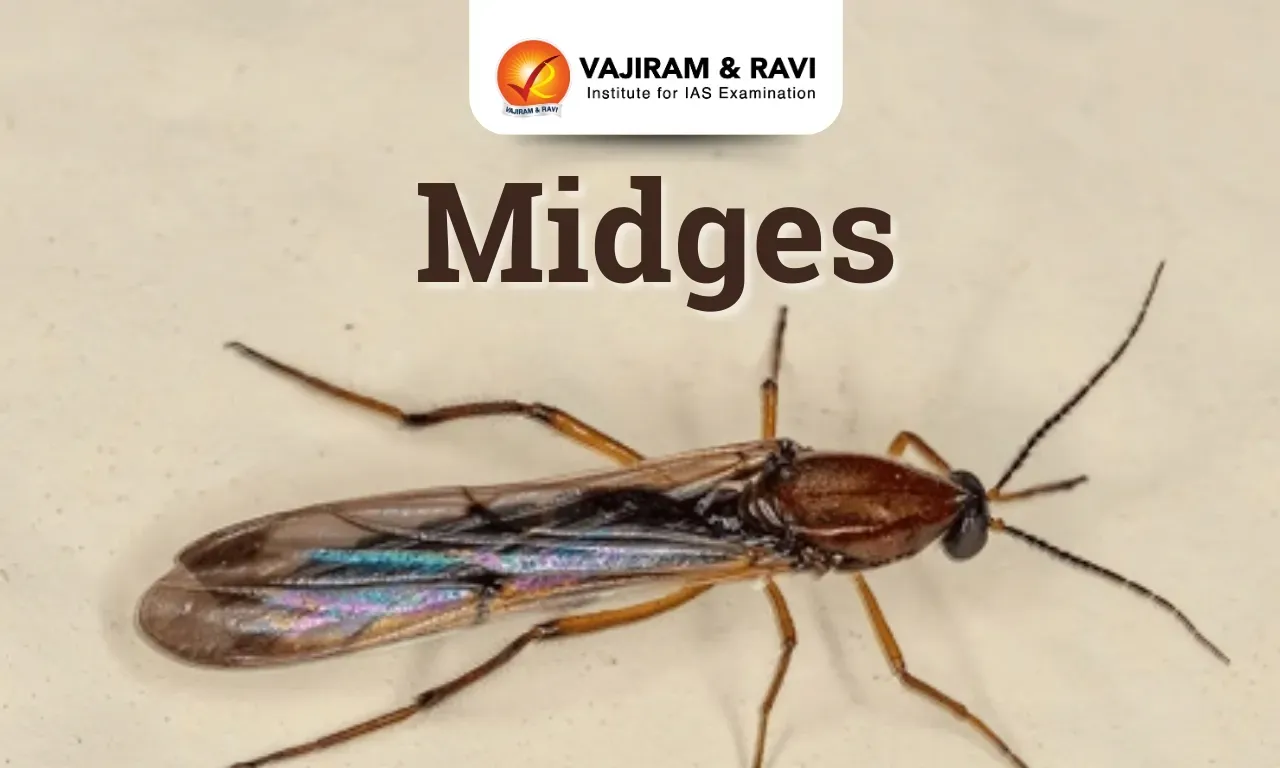
- These are tiny insects which are similar in appearance to flies but are more closely related to mosquitoes in their feeding habits.
- They belong to the Culicoides genus and are locally called bhusi files.
- Food habit: These flies feed on the blood of livestock such as sheep, goats, and cattle, as well as wild animals like deer.
- Amongst them five species are known to transmit the bluetongue disease virus which is a condition that can be fatal to livestock.
- Bluetongue disease manifests through symptoms including blue discolouration of the tongue, fever, facial swelling, and excessive salivation.
- It can potentially lead to death in affected animals and poses a significant threat to livestock farming and the agricultural economy.
- The study, conducted in 2022 and 2023, revealed that 17 of the 23 species identified are known to bite humans, although no human disease transmission has been reported.
- The 13 new species recorded for India are C. barnetti, C. gouldi, C. flaviscutellaris, C. flavipunctatus, C. hui, C. histrio, C. guttifer, C. perornatus, C. okinawensis, C. quatei, C. obscurus, C. coronalis, and C. kusaiensis.
- The Indian Culicoides fauna now includes 93 valid species, many of which are recognised as confirmed or potential vectors of important pathogens of animal health.
Key facts about Culicoides
- Distribution: It isa large genus of the family Ceratopogonidae with cosmopolitan distribution excluding New Zealand and Antarctica, includes species that are among the smallest haematophagous members of the order Diptera.
- The midges of this family are gaining significant attention due to their role as vectors of almost 60 viruses, 40 protozoans, and 24 filarial nematodes, impacting not only livestock and wildlife but also humans.
Q1: What disease is transmitted by midges?
Bluetongue virus is spread by biting midges and causes severe disease in ruminants. Bluetongue virus (BTV) is responsible for causing the severe haemorrhagic disease, bluetongue (BT). It can infect domestic ruminants including cattle, sheep and goats, along with wild animals such as buffalo, deer, antelope and camels.
Source: TH


 Last updated on Oct, 2026
→ UPSC 2027 Notification will be released on 13 January 2027 at upsconline.nic.in.
→ Check Nobel Prize 2026 Winners List here.
→ Download PIB PRiSM Monthly Magazine 2026 here.
→ Check UPSC Monthly Current Affairs Magazine The Recitals here.
→ Check out the latest UPSC Syllabus here.
→ Download UPSC Model Answers for Mains 2026
→ UPSC Mains Question Paper 2026 is out now for Essay & GS Paper 1, 2, 3 & 4.
→ UPSC Calendar 2027 has been released.
→ Enroll in Vajiram & Ravi’s UPSC Mains Test Series 2027 for structured answer writing practice, expert evaluation, and exam-oriented feedback.
→ Join Vajiram & Ravi’s UPSC Mentorship Program 2027 for personalized guidance, strategy planning, and one-to-one support from experienced mentors.
→ Go through the UPSC Mains Previous Year Papers to enhance your preparation.
→ UPSC has released UPSC Toppers List 2025 with the Civil Services final result on its official website.
→ Also check Best UPSC Coaching in India