About Midnight Zone:
- The ocean water column is made up of five zones: the sunlight zone (epipelagic), the twilight zone (mesopelagic), the midnight zone (bathypelagic), the abyssal zone (abyssopelagic), and the hadal zone (trenches).
- Sunlight is rapidly absorbed as it travels through water. Red, orange, and yellow are absorbed quickly, leaving water a brilliant blue, but even these wavelengths disappear as light travels deeper.
- By about 1,000 meters (about 3,300 feet) depth, even the faintest light has been extinguished, leaving these deep ocean waters in perpetual darkness.
- The resulting bathypelagic, or midnight, zone extends to about 4,000 meters (about 13,100 feet), which reaches the ocean floor in many places.
- The midnight zone is the single largest habitat on the planet, accounting for 70% of all seawater.
- In addition to the lack of light, the midnight zone is characterized by a steady temperature of around 4° Celsius (39° Fahrenheit).
- Life that exists in this zone must be able to function in cold temperatures and withstand extreme hydrostatic pressure.
- Pressure varies with depth, and in this zone, it ranges from 100 to 400 atmospheres.
- Organisms here have special adaptations including well-developed visual systems, bioluminescence used both to lure prey and attract mates, and well-developed auditory systems that allow them to hear other animals moving nearby.
Key Facts about Bathydevius Caudactylus:
- It is a new species of mollusk discovered within the ocean’s midnight zone.
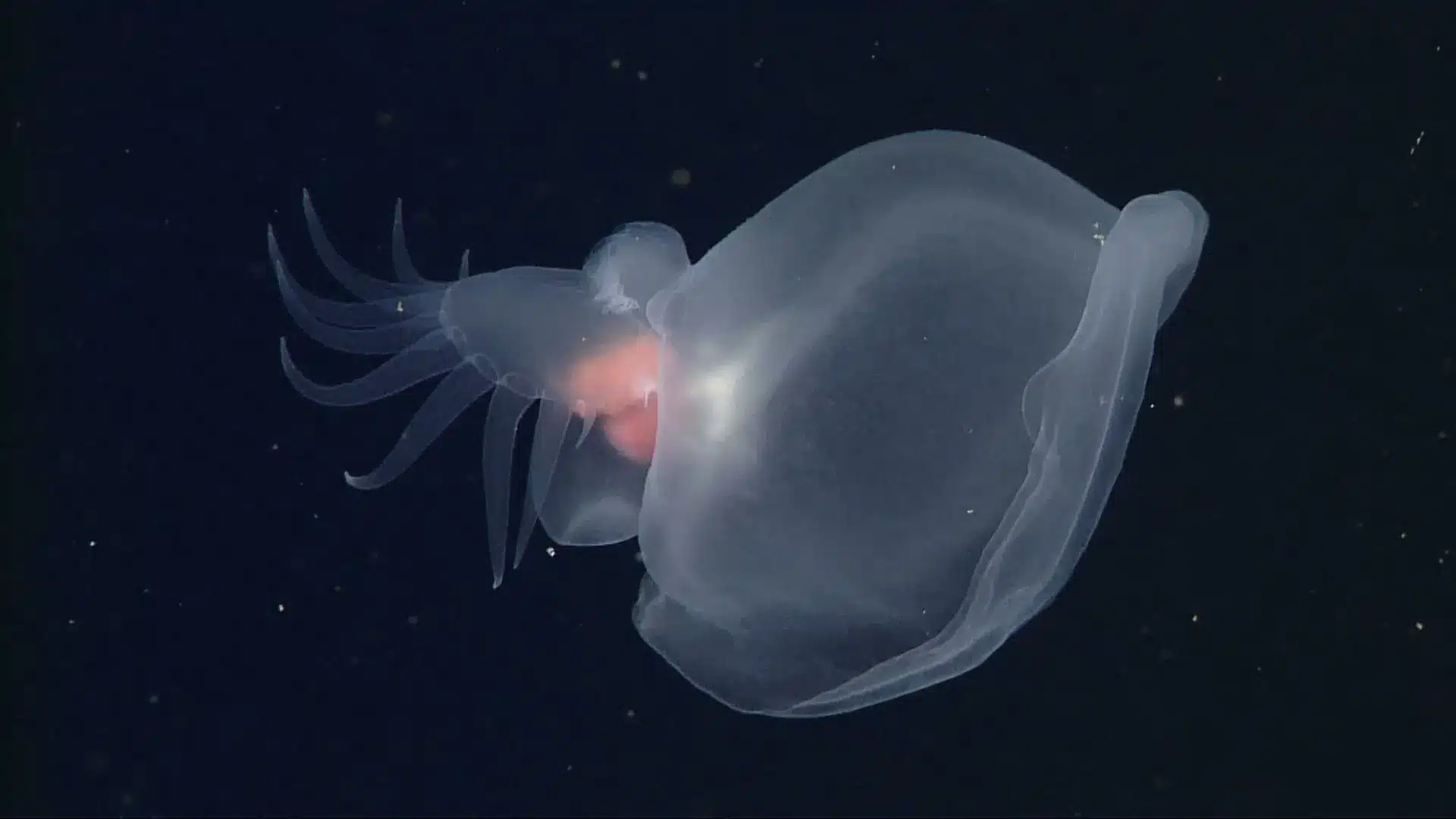
- Although the apple-size species is classified as a sea slug, the marine animal is unlike any sea slug scientists have seen before.
- It is a swimming sea slug that glows with bioluminescence and has a body with a paddle-like tail and a large gelatinous hood, and it’s the first sea slug found to live in the deep ocean.
- Typically, sea slugs live on the seafloor or in coastal environments like tide pools, while only a few are known to live in open water near the surface.
- Bathydevius moves up and down the water column by flexing its body or drifting in the currents.
- It is hermaphrodite, which includes both male and female reproductive organs.
Q1: What is bioluminescence?
Bioluminescence is the production and emission of light by a living organism. Bioluminescent creatures are found throughout marine habitats, from the ocean surface to the deep seafloor.
News: Apple-Sized “Mystery Mollusk” Discovered In Ocean’s Midnight Zone


 Last updated on Oct, 2026
→ UPSC 2027 Notification will be released on 13 January 2027 at upsconline.nic.in.
→ Check Nobel Prize 2026 Winners List here.
→ Download PIB PRiSM Monthly Magazine 2026 here.
→ Check UPSC Monthly Current Affairs Magazine The Recitals here.
→ Check out the latest UPSC Syllabus here.
→ Download UPSC Model Answers for Mains 2026
→ UPSC Mains Question Paper 2026 is out now for Essay & GS Paper 1, 2, 3 & 4.
→ UPSC Calendar 2027 has been released.
→ Enroll in Vajiram & Ravi’s UPSC Mains Test Series 2027 for structured answer writing practice, expert evaluation, and exam-oriented feedback.
→ Join Vajiram & Ravi’s UPSC Mentorship Program 2027 for personalized guidance, strategy planning, and one-to-one support from experienced mentors.
→ Go through the UPSC Mains Previous Year Papers to enhance your preparation.
→ UPSC has released UPSC Toppers List 2025 with the Civil Services final result on its official website.
→ Also check Best UPSC Coaching in India