About Millimeter Wave:
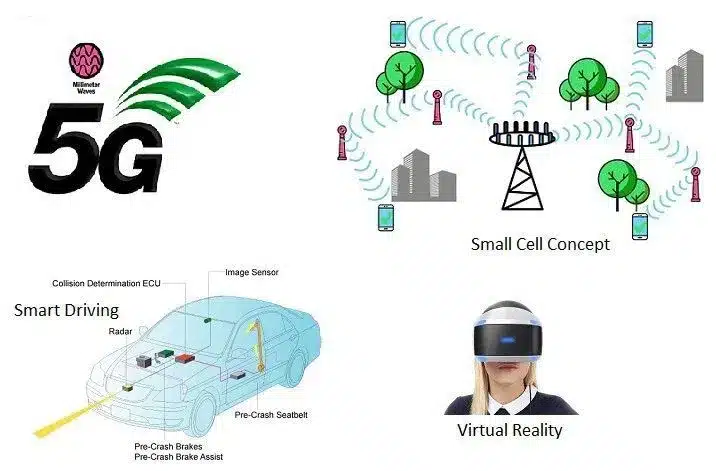
- It refers to electromagnetic waves with frequency between 30-300 GHz and wavelength between 10 mm and 1 mm.
- Its frequency spectrum is used for wireless high-speed communications. It is also known as the extremely high frequency, or EHF, band by the International Telecommunication Union.
- Advantages
- It enables higher data rates compared with lower frequencies when used in telecommunications, such as those used for Wi-Fi and current cellular networks.
- The higher frequency range has a high tolerance for bandwidth.
- It offers less latency due to its higher speeds and bandwidth.
- There is less interference, as mmWaves don’t propagate and interfere with other neighboring cellular systems.
Significance of recent agreement
- It will also encourage small and medium scale industries to setup their manufacturing units in India which will create job opportunities to our own engineering graduates, due to the use of polymer-based structure in conjunction with metals.
- This will also reduce our over dependence on semiconductor fabrication industries. The proposed cost for the development of technology is extremely small as against the opportunities it would create.
- Additionally, the project also aims to contribute to generate Intellectual Property Rights (IPRs) and develop a skilled workforce to support the emerging millimetre wave/Sub-THz technology for 5G/6G.
Q1: What are Electromagnetic waves?
Electromagnetic waves such as light are generated by the vibration (energy transformation) of electrically charged particles. These waves are characterised by their oscillating electric and magnetic fields, which move perpendicular to each other and the direction of wave propagation.
News: C-DOT, IIT-Roorkee tie-up to develop millimeter wave transceiver for 5G rural connectivity


 Last updated on Oct, 2026
→ UPSC 2027 Notification will be released on 13 January 2027 at upsconline.nic.in.
→ Asian Games 2026 are being held in Aichi-Nagoya, Japan, from 19 September to 4 October.
→ Check out the latest UPSC Syllabus here.
→ Download UPSC Model Answers for Mains 2026
→ UPSC Mains Question Paper 2026 is out now for Essay & GS Paper 1, 2, 3 & 4.
→ UPSC Calendar 2027 has been released.
→ Enroll in Vajiram & Ravi’s UPSC Mains Test Series 2027 for structured answer writing practice, expert evaluation, and exam-oriented feedback.
→ Join Vajiram & Ravi’s UPSC Mentorship Program 2027 for personalized guidance, strategy planning, and one-to-one support from experienced mentors.
→ Go through the UPSC Mains Previous Year Papers to enhance your preparation.
→ UPSC has released UPSC Toppers List 2025 with the Civil Services final result on its official website.
→ Download PIB PRiSM Monthly Magazine 2026 here.
→ Also check Best UPSC Coaching in India