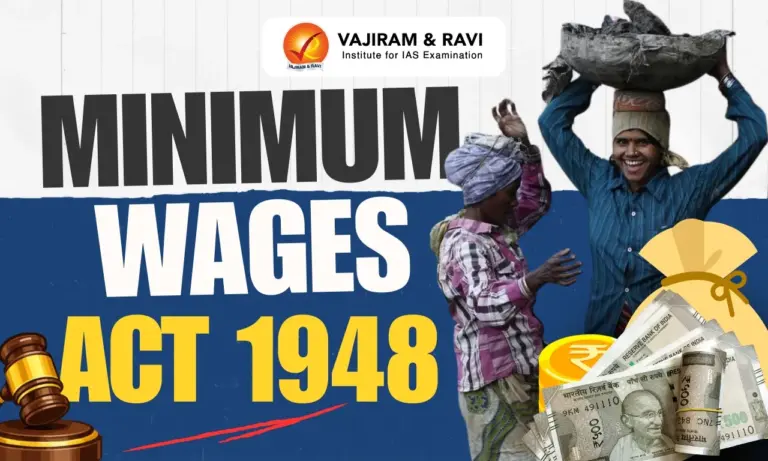
The Minimum Wages Act, 1948 is an important labour law in India that provides a legal framework for ensuring workers receive fair and adequate wages. The Act aims to protect workers from unduly low wages and exploitation, particularly in employment where workers may be more vulnerable. It empowers the appropriate government to fix and revise minimum wage rates by considering factors such as the nature of work, skill level, and prevailing economic conditions.
Minimum Wages Act 1948 Key Features
- The Minimum Wages Act, 1948 is an important labour law in India that ensures workers receive a minimum level of wages for their work, whether they are skilled, semi-skilled, or unskilled. It was introduced to prevent exploitation of workers and guarantee a basic standard of living.
- The Act makes it legally compulsory for employers to pay wages not less than the fixed minimum rate, and no agreement or contract can reduce this amount.
- It empowers both the Central and State Governments to fix and revise minimum wages depending on factors like nature of work, skill level, and location.
- The Act provides for different types of wages, such as time rate, piece rate, overtime rate, and guaranteed time rate, ensuring flexibility across industries.
- It also lays down rules regarding working hours, limiting work to 9 hours per day and 48 hours per week, with extra wages (overtime) for additional work.
- A system of inspection and enforcement is created where inspectors are appointed to ensure compliance and penalise violations.
- The Act introduced the concept of Tripartite Committees (government, employers, workers) to make wage determination more balanced and fair.
Objectives of the Minimum Wages Act 1948
- The primary objective is to protect workers from exploitation, especially those in low-paying and unorganised sectors, where bargaining power is weak.
- It aims to ensure a minimum standard of living, covering basic needs like food, shelter, clothing, and health.
- The Act seeks to promote social justice and economic equality by reducing income disparities between workers.
- It ensures that workers receive fair compensation for their labour, thereby improving their quality of life and dignity.
- Another key goal is to bring uniformity and regulation in wage structure, which earlier varied widely and led to unfair practices.
- It also encourages industrial peace and stability, as fair wages reduce labour disputes and dissatisfaction.


Scope and Applicability of the Minimum Wages Act 1948
- The Act applies to scheduled employment, which include industries or sectors identified by the government where workers are vulnerable to low wages.
- Over time, the scope has expanded, and governments can add new employment during revision cycles to cover more workers.
- It covers factories, businesses, and various enterprises, especially in sectors like construction, agriculture, manufacturing, and services.
- However, many workers in the informal and unorganised sector (like domestic workers, gig workers) still face limited coverage, which remains a challenge.
- The Act gives power to both Central and State Governments:
- The Central Government fixes wages for sectors under its authority (e.g., railways, mines).
- State Governments fix wages for other employment within their jurisdiction.
- It also mandates that employers must maintain records of wages, work hours, and payments, ensuring transparency.
Minimum Wage Determination and Revision under Minimum Wages Act 1948
- The government fixes minimum wages based on factors like cost of living, inflation, nature of work, and region.
- Wages can be different for:
- Different skills (unskilled, semi-skilled, skilled)
- Different regions (urban, rural, difficult areas)
- Different industries
- The Act provides for two methods:
- Committee Method: Expert committees study and recommend wage rates.
- Notification Method: Government publishes proposals and invites public feedback.
- Minimum wages must be revised at least every 5 years, but Dearness Allowance (DA) may be adjusted more frequently to match inflation.
- The concept of National Floor Level Minimum Wage (NFLMW) ensures that no state fixes wages below a certain level, though it is non-statutory.
- Wage fixation is linked to the Cost of Living Index, ensuring wages remain relevant over time.
Important Provisions and Benefits of the Minimum Wages Act 1948
- The Act ensures minimum wages are paid in cash, though in some cases payment in kind is allowed if approved by the government.
- Workers are entitled to:
- Overtime wages for extra work
- Weekly rest day with pay
- Fair wage for multiple types of work if engaged in different tasks
- Employers are required to:
- Maintain proper records of wages and working hours
- Follow prescribed working conditions
- Pay wages on time and as per law
- The Act provides penalties for violations:
- Fine up to ₹10,000
- Imprisonment up to 5 years (as per Section 22)
- In cases of underpayment, workers may receive up to 10 times the wage difference as compensation.
- It helps in reducing poverty, improving living standards, and ensuring economic security for workers.
- Despite its importance, challenges remain such as:
- Low wage levels in some states
- Poor enforcement
- Lack of awareness among workers
- Irregular revisions
- The Act laid the foundation for modern wage laws and has now been subsumed under the Code on Wages, 2019, which aims to universalise wage protection.
Minimum Wages Act 1948 Challenges
- In India, the minimum wage is often too low compared to the rising cost of living, especially in cities, making it difficult for workers to afford basic needs like food, housing, healthcare, and education, which leads to financial stress and sometimes forces them to continue working under poor conditions.
- The variation in minimum wages across states and industries creates inequality, where workers doing similar work may receive very different wages depending on their location, leading to unfair treatment and confusion.
- A large number of workers in the informal and unorganised sector, such as domestic workers, construction labourers, and gig workers, are not properly covered under minimum wage laws, making them more vulnerable to exploitation.
- Many workers are not aware of their legal rights regarding minimum wages, which allows employers to sometimes pay less than the prescribed amount, and workers are unable to question or demand fair wages.
- The process of fixing minimum wages is often not transparent, and there is limited involvement of workers or their representatives, which raises doubts about whether the wages truly reflect the real cost of living.
- Even when minimum wages are paid, workers often do not receive basic benefits like social security, health insurance, or paid leave, which increases their economic insecurity during emergencies or unemployment.
- There is weak enforcement of the law in many areas, and inspections are not always effective, allowing some employers to violate wage rules without facing strict penalties.
- Minimum wages are not revised regularly in line with inflation, so over time their real value decreases, reducing the purchasing power of workers and affecting their standard of living.
Measures for better implementation of Minimum Wage Laws in India
- There is a need to strictly enforce minimum wage laws by improving monitoring systems and increasing penalties for employers who do not comply, while also encouraging the active involvement of labour unions and civil society to ensure workers actually receive fair wages.
- The coverage of minimum wage laws should be expanded to include all types of workers, especially those in the informal sector, gig economy, and other vulnerable jobs, so that no worker is left without protection.
- India should move towards a more uniform and structured wage system across states, which can reduce confusion and inequality while ensuring that workers across the country receive a fair and basic level of income.
- The process of fixing minimum wages should be made more transparent and inclusive, with participation from workers, employers, and other stakeholders, so that wage decisions are fair and reflect real economic conditions.
- Workers must be educated and made aware of their rights, including the minimum wage they are entitled to, so they can demand fair treatment and avoid being exploited.
- Minimum wages should be revised regularly based on inflation, cost of living, and productivity, so that their real value does not decline over time and workers can maintain a decent standard of living.
- Along with wages, workers should also be provided with basic benefits and social security, such as health insurance, paid leave, and financial protection, to improve their overall well-being and reduce economic vulnerability.

 Last updated on Oct, 2026
→ UPSC 2027 Notification will be released on 13 January 2027 at upsconline.nic.in.
→ Check Nobel Prize 2026 Winners List here.
→ Download PIB PRiSM Monthly Magazine 2026 here.
→ Check UPSC Monthly Current Affairs Magazine The Recitals here.
→ Check out the latest UPSC Syllabus here.
→ Download UPSC Model Answers for Mains 2026
→ UPSC Mains Question Paper 2026 is out now for Essay & GS Paper 1, 2, 3 & 4.
→ UPSC Calendar 2027 has been released.
→ Enroll in Vajiram & Ravi’s UPSC Mains Test Series 2027 for structured answer writing practice, expert evaluation, and exam-oriented feedback.
→ Join Vajiram & Ravi’s UPSC Mentorship Program 2027 for personalized guidance, strategy planning, and one-to-one support from experienced mentors.
→ Go through the UPSC Mains Previous Year Papers to enhance your preparation.
→ UPSC has released UPSC Toppers List 2025 with the Civil Services final result on its official website.
→ Also check Best UPSC Coaching in India
Minimum Wages Act 1948 FAQs
Q1. What is the Minimum Wages Act, 1948?+
Q2. Who is covered under the Minimum Wages Act?+
Q3. Who fixes minimum wages in India?+
Q4. What factors are considered while fixing minimum wages?+
Q5. How often are minimum wages revised?+
Q6. Can an employer pay less than minimum wages?+
Q7. What happens if minimum wages are not paid?+
Q8. What are the different types of minimum wage rates?+
Q9. Does the Act cover informal sector workers?+
Q10. What is the National Floor Level Minimum Wage (NFLMW)?+
Tags: governance governance notes minimum wages act minimum wages act 1948