Mithun Latest News
Over 200 mithuns have died in a foot-and-mouth disease (FMD) outbreak in Dibang Valley district of Arunachal Pradesh in the last one month.
About Mithun
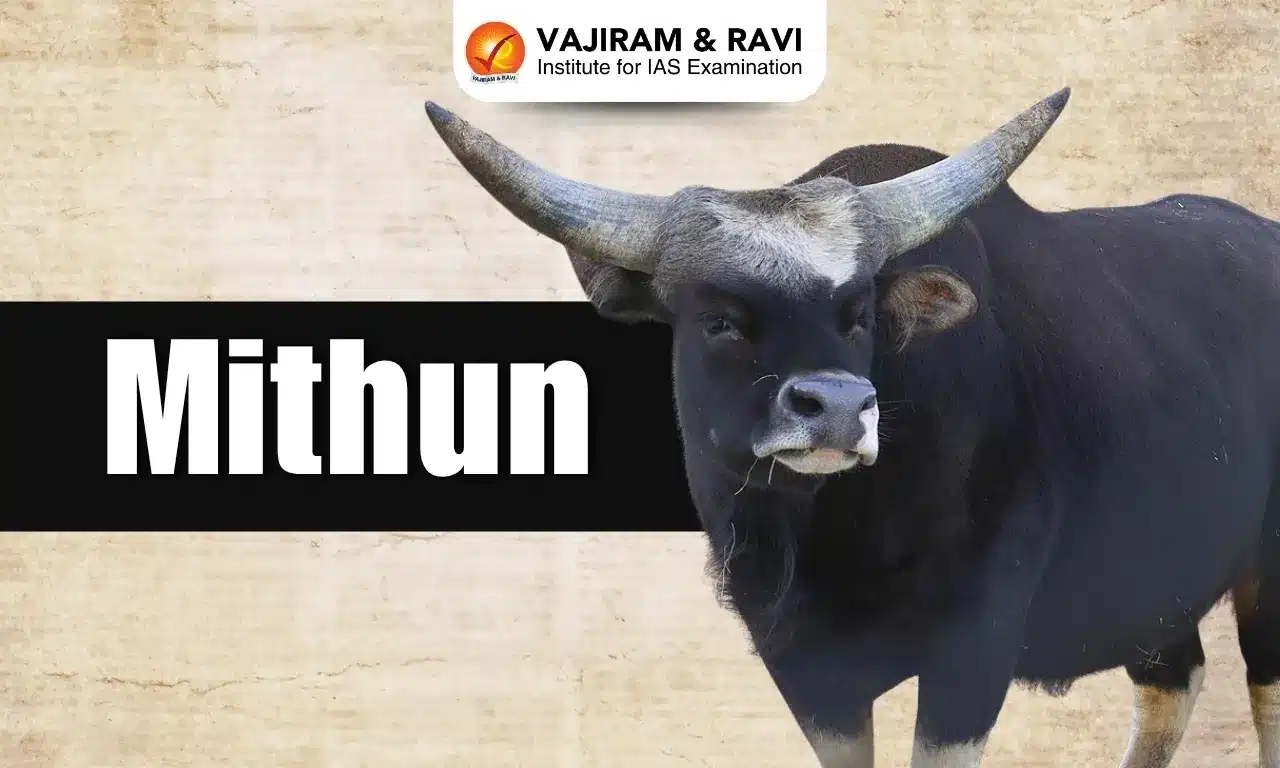
- The Mithun, or gayal, is a heavily built, semi-domesticated bovine species.
- Scientific Name: Bos frontalis
- Mithun is believed to have originated more than 8000 years ago and is considered to be a descendent of wild Indian gaur, or bison.
- It is also known as the ‘cattle of the mountain’.


Mithun Distribution
- The highest concentration of mithuns in the world is spread over the North Eastern (NE) region of India, with Arunachal Pradesh having the highest population.
- It is also found in China and parts of Southeast Asia, viz., Bangladesh, Myanmar, and Bhutan.
- The geographic zone is covered with tropical evergreen rain forests.
- It is the state animal of Arunachal Pradesh and Nagaland.
- The ‘Soulung’ festival is observed annually by the Adi tribes of Arunachal Pradesh to commemorate the birth and arrival of Mithun on this earth.
Mithun Features
- It appears somewhat similar to that of Gaur but are distinctly smaller in size.
- The characteristic feature lies in the head, which has a well-developed, broad frontal bone with a flat-shaped face.
- From the front view, it appears like an inverted triangle from where two horns emerge from the lateral sides.
- Horn colour varies from whitish yellow to salty black in most animals.
- The skin color of the head and body is blackish-brown in both sexes, and the forehead is creamy white or yellowish in color.
- The other distinguishing features are a small and double dewlap and white stockings.
- They move in small groups with one or two males and several females and calves.
Mithun Conservation Status
It is classified as ‘Vulnerable ‘ under the IUCN Red List.
What is Foot and Mouth Disease (FMD)?
- It is a severe, highly contagious viral disease that affects all cloven-hoofed animals, including cattle, sheep, goats, camelids, deer, and pigs.
- Cloven-hoofed animals are those with divided hooves. It does not affect horses or zebras.
- Cause: It is caused by an Aphthovirus of the family Picornaviridae.
- It is a transboundary animal disease (TAD) that deeply affects the production of livestock and disrupts regional and international trade in animals and animal products.
- Intensively reared animals are more susceptible to the disease than traditional breeds.
- FMD is a disease of animals, not humans, and is a different disease than hand, foot, and mouth disease which is common in young children.
- FMD is not transmitted to humans by eating affected meat.
- Transmission:
- The virus is transmitted through direct contact between healthy and infected animals.
- Indirect contact with contaminated objects (fomites) such as vehicles, clothing, footwear, and bedding can also spread FMDV.
- Additionally, consuming contaminated feed or milk can transmit the virus as well as through respiratory aerosols.
- Symptoms:
- FMD is characterised by fever and blister-like sores on the tongue and lips, in the mouth, on the teats and between the hooves.
- The disease is rarely fatal in adult animals, but there is often high mortality in young animals due to myocarditis.
- Treatment: Vaccination is the only effective preventive measure against FMD.
News: DC

 Last updated on Oct, 2026
→ UPSC 2027 Notification will be released on 13 January 2027 at upsconline.nic.in.
→ Check Nobel Prize 2026 Winners List here.
→ Download PIB PRiSM Monthly Magazine 2026 here.
→ Check UPSC Monthly Current Affairs Magazine The Recitals here.
→ Check out the latest UPSC Syllabus here.
→ Download UPSC Model Answers for Mains 2026
→ UPSC Mains Question Paper 2026 is out now for Essay & GS Paper 1, 2, 3 & 4.
→ UPSC Calendar 2027 has been released.
→ Enroll in Vajiram & Ravi’s UPSC Mains Test Series 2027 for structured answer writing practice, expert evaluation, and exam-oriented feedback.
→ Join Vajiram & Ravi’s UPSC Mentorship Program 2027 for personalized guidance, strategy planning, and one-to-one support from experienced mentors.
→ Go through the UPSC Mains Previous Year Papers to enhance your preparation.
→ UPSC has released UPSC Toppers List 2025 with the Civil Services final result on its official website.
→ Also check Best UPSC Coaching in India
Mithun FAQ's
Q1. What is Mithun?+
Q2. Which region of India has the highest concentration of Mithun?+
Q3. What type of habitat is associated with the geographic distribution of Mithun?+
Q4. Which states of India have declared Mithun as their state animal?+
Q5. What is the IUCN Red List status of Mithun?+
Tags: mithun prelims pointers upsc current affairs upsc prelims current affairs