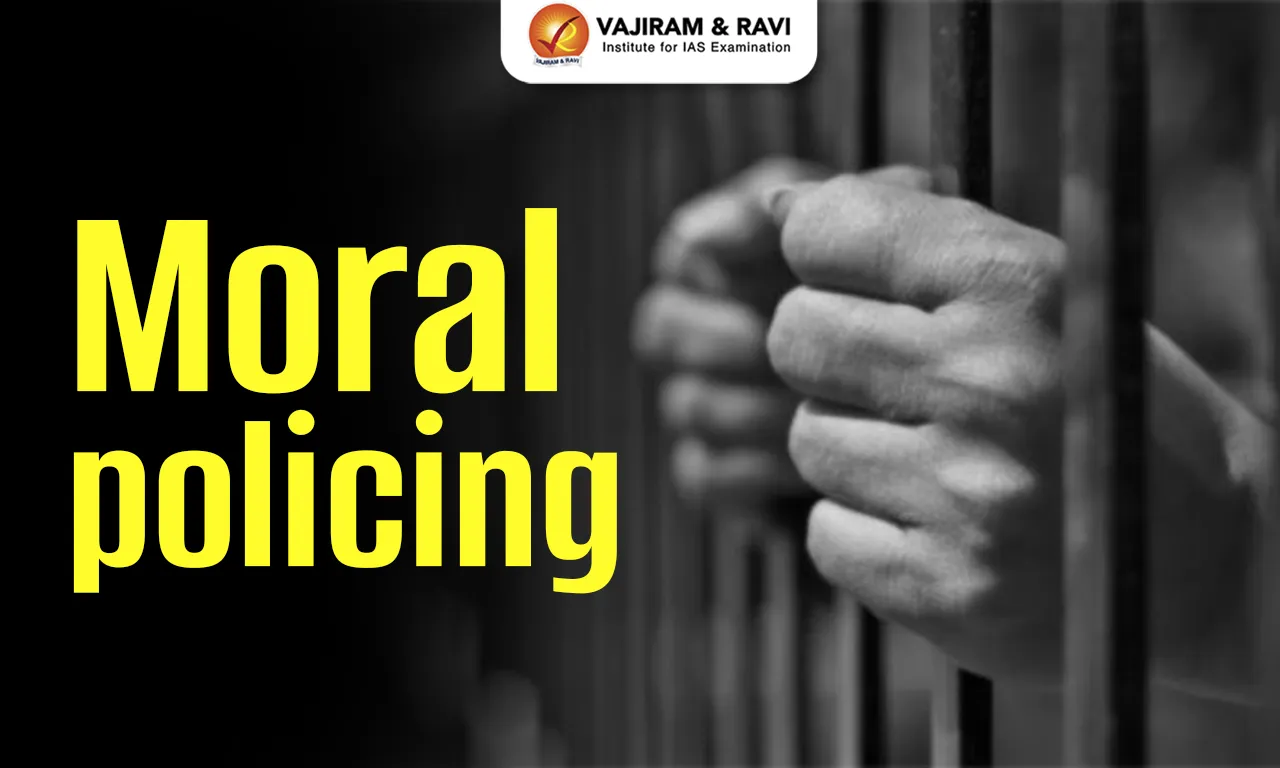
Moral Policing refers to actions by individuals, groups, or institutions that monitor, judge, or punish behaviour considered immoral according to prevailing social, cultural, or religious norms. In India, moral policing has emerged as a significant social and governance concern, involving vigilante groups, police authorities, and sometimes state institutions. It often targets personal choices related to clothing, relationships, food habits, expression, and lifestyle. Empirical evidence shows that moral policing frequently intersects with constitutional freedoms, public order, and misuse of legal provisions.
Moral Policing
Moral Policing involves monitoring and controlling behaviour perceived as violating cultural, religious, or social norms. It operates through vigilante groups, community pressure, and sometimes law enforcement overreach. Acts include harassment of couples, censorship of art, targeting women’s clothing, attacks on minorities, and policing of sexuality. Data from NCRB and court records show moral policing disproportionately affects women, LGBTQIA+ persons, interfaith couples, and youth. Its justification often invokes tradition, culture, or public decency rather than codified law.
Moral Policing History
Moral Policing in India evolved alongside colonial-era obscenity laws and post-independence socio-cultural anxieties about modernity and western influence.
- Colonial obscenity laws: British-era penal provisions regulated morality through vague public decency norms.
- Post-independence continuity: Sections 292-294 IPC continued regulating obscenity after 1950.
- 1990s cultural anxieties: Liberalisation intensified resistance to western lifestyles.
- Punjab insurgency era: Vigilantism justified as cultural protection.
- Rise of vigilante groups: Right-wing and religious outfits gained prominence.
- Media amplification: Television and print expanded public shaming incidents.
- Digital age escalation: Social media accelerated mobilisation and misinformation.


Moral Policing Features
Moral Policing displays identifiable operational and social characteristics across regions and actors.
- Vigilante Enforcement: Non-state actors administer punishment without legal authority.
- Gendered Targeting: Women face disproportionate scrutiny over clothing, relationships, and mobility.
- Cultural Justification: Actions justified as protection of tradition or social values.
- Public Shaming: Victims are humiliated publicly through violence or media exposure.
- Mob Mobilisation: Groups act collectively, reducing individual accountability.
- Legal Ambiguity: Exploits vague legal terms like obscenity or public indecency.
- Selective Morality: Moral standards applied inconsistently across communities and classes.
- Political Patronage: Some groups receive indirect political support or silence.
- Fear Enforcement: Deterrence achieved through intimidation rather than lawful process.
- Rights Erosion: Individual autonomy and privacy are systematically undermined.
Moral Policing Laws
India lacks a specific anti-moral policing law, but existing statutes are frequently misused.
- BNS Section 294 and 296: Criminalises obscene material using undefined moral standards, Restricts sale of allegedly obscene material to persons below 20, Penalises obscene acts in public without clear legal definition.
- Immoral Traffic Prevention Act: Intended for trafficking, misused against consenting adults.
- Bombay Police Act Section 110: Used to harass couples for alleged indecent behaviour.
- Cinematograph Act 1952: CBFC accused of enforcing moral censorship beyond certification.
- IT Act Section 67A: Applied against online expression labelled sexually explicit.
- Cable TV Rules 1994: Invoked to suspend channels for moral content violations.
- State Excise Laws: Used to restrict nightlife under moral pretexts.
- Judicial Clarifications: Supreme Court ruled in 2022 police cannot morally police citizens.
Moral Policing in India Recent Developments
Recent years show judicial pushback and continued societal challenges regarding Moral Policing.
- Supreme Court 2022 ruling: Police barred from engaging in moral policing.
- Anti-Romeo Squads scrutiny: Allegations of harassment and extortion surfaced.
- Hotel raid backlash: Mumbai Police restricted misuse of public indecency laws.
- LGBTQIA+ rights expansion: Courts intervened against harassment of same-sex couples.
- Digital moral policing: Influencers targeted for attire and lifestyle choices.
- Valentine’s Day incidents: Continued resistance to perceived western customs.
- CBFC criticism: Filmmakers allege excessive moral oversight.
- Nightlife restrictions: State-imposed curbs justified through moral arguments.
- Educational content opposition: Sex education programs diluted or banned.
- Judicial compensation orders: Courts penalised police for wrongful moral action.

 Last updated on Oct, 2026
→ UPSC 2027 Notification will be released on 13 January 2027 at upsconline.nic.in.
→ Check Nobel Prize 2026 Winners List here.
→ Download PIB PRiSM Monthly Magazine 2026 here.
→ Check UPSC Monthly Current Affairs Magazine The Recitals here.
→ Check out the latest UPSC Syllabus here.
→ Download UPSC Model Answers for Mains 2026
→ UPSC Mains Question Paper 2026 is out now for Essay & GS Paper 1, 2, 3 & 4.
→ UPSC Calendar 2027 has been released.
→ Enroll in Vajiram & Ravi’s UPSC Mains Test Series 2027 for structured answer writing practice, expert evaluation, and exam-oriented feedback.
→ Join Vajiram & Ravi’s UPSC Mentorship Program 2027 for personalized guidance, strategy planning, and one-to-one support from experienced mentors.
→ Go through the UPSC Mains Previous Year Papers to enhance your preparation.
→ UPSC has released UPSC Toppers List 2025 with the Civil Services final result on its official website.
→ Also check Best UPSC Coaching in India
Moral Policing FAQs
Q1. What is Moral Policing?+
Q2. Is Moral Policing legal in India?+
Q3. Who are the common victims of Moral Policing?+
Q4. Which laws are misused for Moral Policing?+
Q5. How has the judiciary responded to Moral Policing?+
Tags: moral policing