Mushk Budji Latest News
Kashmir’s indigenous aromatic rice variety, ‘Mushk Budji’, which was granted the GI tag three years ago, is facing the problem of plenty with the government’s crop expansion to “unsuitable” areas hitting prices, farmers said recently.
About Mushk Budji
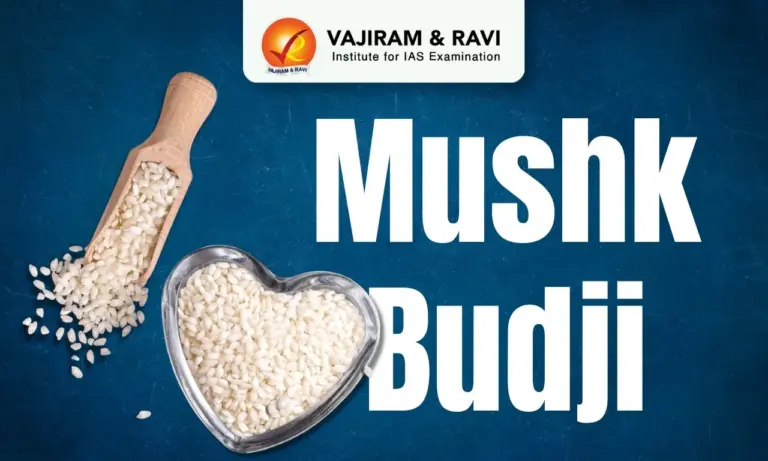
- It is a highly aromatic short-grain rice variety native to Kashmir.
- It is usually grown at an altitude ranging from 5000 to 7000 ft above mean sea level in the Highland Himalayas in the higher reaches of the Kashmir Valley.
- It is often used on special occasions and festivals.
- It received a Geographical Indication (GI) tag on 31 July 2023.


Mushk Budji Features
- Grain & Appearance: It has a light, ivory colour and a slightly translucent appearance.
- Cooked grains remain slightly sticky, somewhat chewy, and imbued with fragrance.
- It has a delicate, nutty flavour.
- It is rich in carbohydrates, fiber, and select B‑vitamins.
- It’s light on fat and easy to digest, making it suitable even for fasting or digestive-sensitive meals.
News: ETVB

 Last updated on Oct, 2026
→ UPSC 2027 Notification will be released on 13 January 2027 at upsconline.nic.in.
→ Check Nobel Prize 2026 Winners List here.
→ Download PIB PRiSM Monthly Magazine 2026 here.
→ Check UPSC Monthly Current Affairs Magazine The Recitals here.
→ Check out the latest UPSC Syllabus here.
→ Download UPSC Model Answers for Mains 2026
→ UPSC Mains Question Paper 2026 is out now for Essay & GS Paper 1, 2, 3 & 4.
→ UPSC Calendar 2027 has been released.
→ Enroll in Vajiram & Ravi’s UPSC Mains Test Series 2027 for structured answer writing practice, expert evaluation, and exam-oriented feedback.
→ Join Vajiram & Ravi’s UPSC Mentorship Program 2027 for personalized guidance, strategy planning, and one-to-one support from experienced mentors.
→ Go through the UPSC Mains Previous Year Papers to enhance your preparation.
→ UPSC has released UPSC Toppers List 2025 with the Civil Services final result on its official website.
→ Also check Best UPSC Coaching in India
Mushk Budji FAQs
Q1. What is Mushk Budji?+
Q2. Why is Mushk Budji rice considered special?+
Q3. When did Mushk Budji receive the Geographical Indication (GI) tag?+
Q4. What is the appearance of Mushk Budji rice grains?+
Q5. What is the colour of Mushk Budji rice grains?+
Tags: mushk budji