About Myristica Swamps:
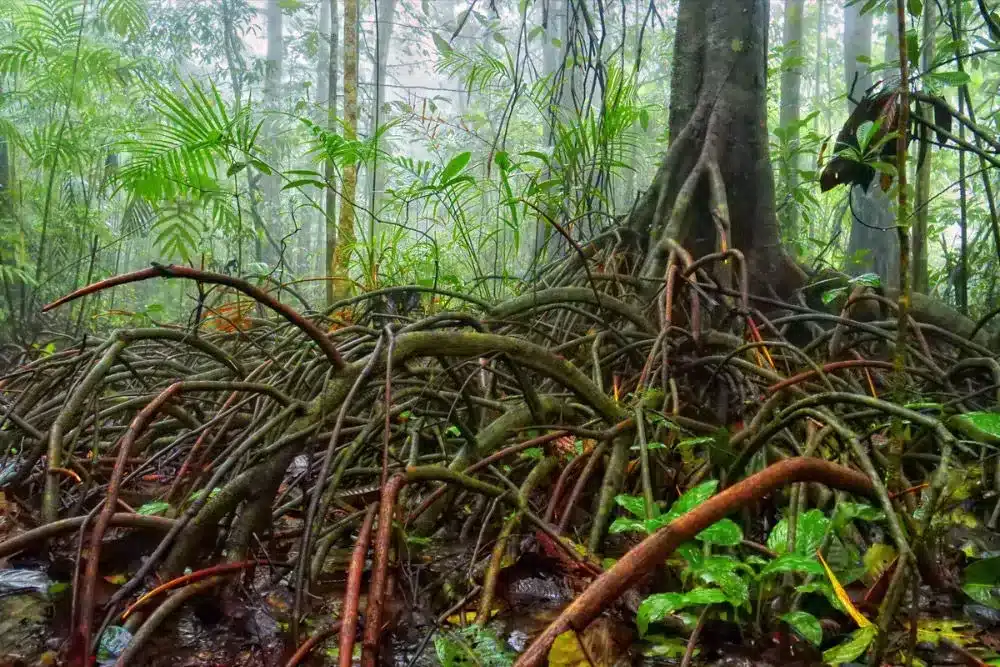
- These are freshwater swamps dominated by evergreen trees belonging to the Myristica ceae family.
- They are also denoted as living fossils due to the primitive nature of Myristica plants.
- With an evolutionary origin of about 140 million years, the swamps are valuable for evolutionary studies.
- These forests are characterized by trees with large protruding roots jutting out of waterlogged soil, which remains inundated throughout the year.
- Geographical distribution: In India, these unique habitats occur in the Western Ghats, and a smaller distribution exists in the Andaman and Nicobar Islands and Meghalaya.
- Historically, they formed a large hydrological network all along the Western Ghats.
- Climatic conditions: The formation of these swamps is dependent on abiotic conditions like the shape of the valley between the forested hills, the amount of rainfall a place receives (with an average of 3000 mm), and water availability throughout the year.
- Typically, Myristica swamps are seen next to rivers and help in retaining water and act as a sponge, ensuring perennial water availability.
- These forests have higher ability to sequester carbon than non-swampy forests.
- These swamps are home to many vertebrate and invertebrate faunal species. This is due to stable macroecological conditions like high humidity, moderate temperature, and macrohabitat availability.
- One example is the Myristica Swamp Treefrog (Mercurana myristicapalustris), only reported from a few pockets of the Shendurney and Peppara Wildlife Sanctuaries in Kerala.
Q1: What is a swamp?
A swamp is an area of land permanently saturated, or filled, with water. Many swamps are even covered by water. There are two main types of swamps: freshwater swamps and saltwater swamps. Swamps are dominated by trees. They are often named for the type of trees that grow in them, such as cypress swamps or hardwood swamps. Freshwater swamps are commonly found inland, while saltwater swamps are usually found along coastal areas. Swamps are transition areas.
Source: Myristica swamp forest discovered in Kumbral


 Last updated on August, 2026
→ UPSC Mains 2026 will be conducted on 21st, 22nd, 23rd, 29th and 30th August 2026.
→ Check out the latest UPSC Syllabus 2026 here.
→ UPSC Mains Admit Card 2026 is expected to be released soon at upsc.gov.in or upsconline.nic.in
→ Enroll in Vajiram & Ravi’s UPSC Mains Test Series 2027 for structured answer writing practice, expert evaluation, and exam-oriented feedback.
→ Join Vajiram & Ravi’s UPSC Mentorship Program 2027 for personalized guidance, strategy planning, and one-to-one support from experienced mentors.
→ Go through the UPSC Mains Previous Year Papers to enhance your preparation.
→ Download UPSC Mains Essay Paper 2025, UPSC Mains GS Paper-I 2025, UPSC Mains GS Paper-II 2025, UPSC Mains GS Paper-III 2025, UPSC Mains GS Paper-IV 2025, UPSC Mains English (Compulsory) Paper 2025, UPSC Mains Hindi (Qualifying) Paper 2025 here.
→ UPSC has released UPSC Toppers List 2025 with the Civil Services final result on its official website.
→ UPSC Calendar 2027 has been released.
→ Also check Best UPSC Coaching in India