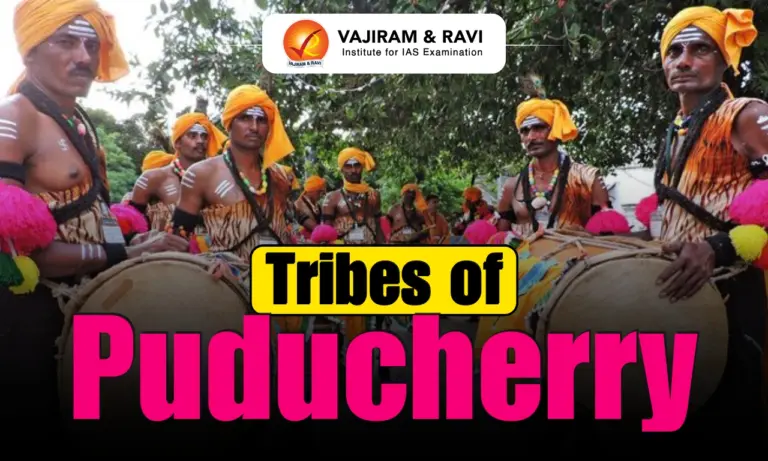
Puducherry does not currently have any officially notified Scheduled Tribes (ST) under the applicable Presidential Orders for the Union Territory as a whole. However, several indigenous, nomadic and semi-nomadic communities live across Puducherry, Karaikal, Yanam and other rural areas.
The Tribes of Puducherry include Irular, Kattunayakan, Malaikuravan, Kuruman and Yerukula. Many of these communities are locally identified as Backward Tribes, Most Backward Classes (MBCs) or other socially disadvantaged groups, while demands for their inclusion in the national ST list have been raised from time to time.
Major Tribes of Puducherry
The major Tribes of Puducherry include the Irular, Kattunayakan, Malaikuravan, Kuruman and Yerukula communities, which have distinct traditional occupations, cultural practices and settlement patterns.
1. Irular
- The Irular are an indigenous community traditionally associated with rural and forest-based livelihoods.
- Traditionally, sections of the community were known for snake catching and rat catching, activities that provided an important source of livelihood.
- Irular settlements are found in rural parts of Puducherry, particularly in village and commune areas.
- The community has traditionally possessed considerable knowledge of local wildlife, forests and natural resources.
- With changing economic conditions, many Irular families have moved towards agricultural labour, construction work and other wage-based occupations.
- The community has also been associated with demands for greater government recognition, welfare support and social development.
2. Kattunayakan
- The Kattunayakan are traditionally a forest-dependent indigenous community.
- Their traditional livelihood has included honey collection and gathering forest produce.
- Their knowledge of forests, plants and natural resources has historically played an important role in their livelihood.
- Members of the community are reported in parts of Puducherry and Karaikal.
- Changes in access to forest resources and the expansion of modern economic activities have affected their traditional occupations.
- Many community members have increasingly become dependent on wage labour and other livelihood opportunities.
- The Kattunayakan are among the communities whose recognition and inclusion in the ST category has been raised in public demands.
3. Malaikuravan
- The Malaikuravan, also known as Malaikuruvan, is an indigenous community found in different rural parts of Puducherry.
- The community has been reported particularly in areas such as Villianur and Bahour.
- Traditionally, members were associated with rural, forest-linked and traditional occupations.
- Their livelihood patterns have changed over time due to urbanisation, economic transformation and reduced dependence on traditional occupations.
- Many families today rely on agricultural labour, daily-wage employment and other informal occupations.
- The community forms part of the wider discussion on indigenous communities and demands for Scheduled Tribe recognition in Puducherry.
4. Kuruman
- The Kuruman community is found in selected rural pockets of Puducherry.
- Their presence has been reported particularly around Mannadipet commune and Oulgaret.
- Traditionally, the community has been associated with rural livelihood practices and traditional occupations.
- Like other indigenous communities, their occupational pattern has gradually changed with modernisation and changing employment opportunities.
- Community members may now depend on wage labour and other rural and informal-sector activities.
- The Kuruman community is part of the broader population of indigenous and socially disadvantaged groups in the Union Territory.
5. Yerukula
- The Yerukula, also spelled Yerkula, are traditionally a nomadic and semi-nomadic community.
- The community has historically been associated with occupations such as fortune-telling and basket-making.
- Members of the community are reported in parts of Puducherry and Yanam.
- Their traditional lifestyle is characterised by mobility and dependence on traditional occupations.
- Changing economic and social conditions have led many families to adopt more settled lifestyles and alternative occupations.
- The community has distinctive traditional knowledge, customs and occupational practices that contribute to Puducherry’s cultural diversity.
- The Yerukula are also among the communities for which demands for inclusion in the Scheduled Tribe list have been raised.
Traditional Occupations and Culture of Tribes of Puducherry
The Tribes of Puducherry have traditionally followed diverse occupations linked to forests, rural environments and nomadic lifestyles, while their traditional knowledge, customs and livelihood practices contribute to the cultural diversity of the region.
- Snake and Rat Catching: The Irular have traditionally been associated with snake catching and rat catching, along with other rural and forest-based activities.
- Honey Collection: The Kattunayakan have traditionally depended on honey collection and gathering forest produce.
- Forest-Based Livelihoods: Several indigenous communities have traditionally relied on forest resources, plants and natural products for their livelihoods.
- Basket Making: The Yerukula have traditionally practised basket-making, reflecting their traditional craft skills.
- Fortune-Telling: Fortune-telling has historically been one of the traditional occupations associated with the Yerukula community.
- Agricultural Labour: With changing economic conditions, many community members have shifted towards agricultural labour and other rural occupations.
- Daily-Wage Employment: Construction work and other informal-sector jobs have become increasingly important sources of income for families moving away from traditional occupations.
- Traditional Knowledge: Indigenous communities retain valuable knowledge related to local ecosystems, plants, animals and natural resources.
- Oral Traditions and Customs: Their community customs, oral traditions and social practices form an important part of Puducherry’s cultural diversity.


 Last updated on Oct, 2026
→ UPSC 2027 Notification will be released on 13 January 2027 at upsconline.nic.in.
→ Check Nobel Prize 2026 Winners List here.
→ Download PIB PRiSM Monthly Magazine 2026 here.
→ Check UPSC Monthly Current Affairs Magazine The Recitals here.
→ Check out the latest UPSC Syllabus here.
→ Download UPSC Model Answers for Mains 2026
→ UPSC Mains Question Paper 2026 is out now for Essay & GS Paper 1, 2, 3 & 4.
→ UPSC Calendar 2027 has been released.
→ Enroll in Vajiram & Ravi’s UPSC Mains Test Series 2027 for structured answer writing practice, expert evaluation, and exam-oriented feedback.
→ Join Vajiram & Ravi’s UPSC Mentorship Program 2027 for personalized guidance, strategy planning, and one-to-one support from experienced mentors.
→ Go through the UPSC Mains Previous Year Papers to enhance your preparation.
→ UPSC has released UPSC Toppers List 2025 with the Civil Services final result on its official website.
→ Also check Best UPSC Coaching in India
Tribes of Puducherry FAQs
Q1. Does Puducherry have any Scheduled Tribes?+
Q2. What are the major Tribes of Puducherry?+
Q3. Who are the Irular of Puducherry?+
Q4. What is the traditional occupation of Kattunayakan?+
Q5. Where are the Malaikuravan found in Puducherry?+
Q6. Where are Kurumans found in Puducherry?+
Tags: puducherry tribes tribes of puducherry