


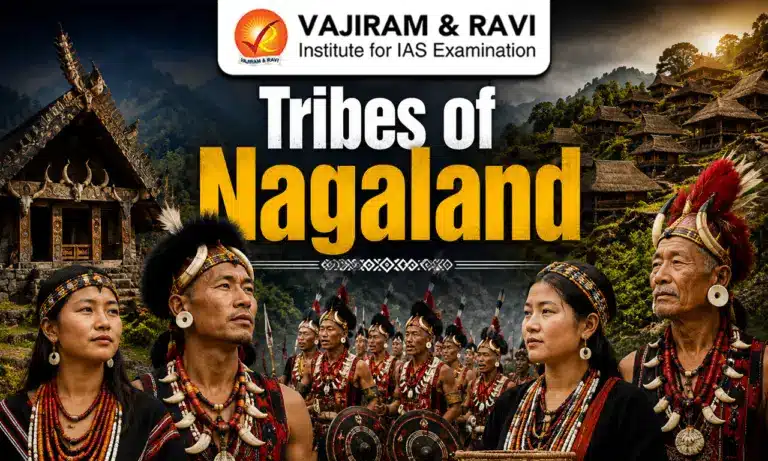
The Tribes of Nagaland are among India’s most diverse indigenous communities, known for their distinct languages, customs, traditional institutions, festivals, and rich cultural heritage. Nagaland, located in the northeastern region of India, is home to 17 officially recognised major tribes and several sub-tribes, each with its own identity and traditions. Protected under special constitutional provisions, the Naga tribes have preserved their unique way of life while adapting to modern development.
Tribes of Nagaland
Nagaland is often referred to as the “Land of Festivals” due to the cultural richness of its tribal communities. Most tribes traditionally lived in autonomous villages governed by customary laws and village councils. Although Christianity is the predominant religion today, many traditional customs, folklore, dances, and social institutions continue to shape Naga society.
Major Tribes of Nagaland
Nagaland officially recognises 17 major tribes, each possessing distinct cultural traditions, attire, dialects, and festivals.
| Major Tribes of Nagaland | ||
|
Tribe |
Primary District/Region |
Distinctive Features |
|
Angami |
Kohima |
Terrace farming, Sekrenyi Festival, traditional architecture |
|
Ao |
Mokokchung |
Moatsu Festival, literature and education |
|
Chakhesang |
Phek |
Colourful shawls, Sukhrunye Festival |
|
Chang |
Tuensang |
Naknyulum Festival and rich folklore |
|
Kachari |
Dimapur |
Agricultural traditions and river valley settlements |
|
Khiamniungan |
Noklak |
Border tribe known for unique customs and ornaments |
|
Konyak |
Mon |
Former headhunters, facial tattoos, wood carving, Aoleang Festival |
|
Kuki |
Various districts |
Traditional dance, agriculture, rich oral traditions |
|
Lotha |
Wokha |
Tokhu Emong Festival and vibrant weaving |
|
Phom |
Longleng |
Monyu Festival and skilled artisans |
|
Pochury |
Meluri |
Indigenous customs and traditional festivals |
|
Rengma |
Tseminyu |
Ngada Festival and community traditions |
|
Sangtam |
Kiphire |
Mongmong Festival and agricultural practices |
|
Sumi (Sema) |
Zunheboto |
Tuluni Festival and warrior traditions |
|
Tikhir |
Kiphire |
Distinct dialect and cultural identity |
|
Yimkhiung |
Shamator |
Metumnyo Festival and handicrafts |
|
Zeliang |
Peren |
Hega Festival, bamboo and cane craftsmanship |


Constitutional Safeguards for the Tribes of Nagaland
The Constitution of India provides special protection to the tribal communities of Nagaland to preserve their identity, customs, and traditional institutions.
- Article 371A grants Nagaland special constitutional status.
- Naga customary laws and social practices cannot be altered by Parliament unless approved by the Nagaland Legislative Assembly.
- Ownership and transfer of land and natural resources remain protected under customary practices.
- Religious and social customs of the Naga tribes receive constitutional protection.
- Village Councils function according to customary laws and continue to play an important role in local governance.
- The tribes are recognised as Scheduled Tribes under the Constitution, making them eligible for reservations in education, employment, and political representation.
- Various welfare schemes under the Fifth Schedule and tribal development programmes support socio-economic development, although Nagaland itself is not covered under the Fifth Schedule due to its special constitutional status.
Government Initiatives for Tribal Development
The Government of India and the Government of Nagaland have implemented several programmes to improve education, healthcare, livelihoods, infrastructure, and cultural preservation among the tribal communities.
- Article 371A safeguards Naga customary laws, land rights, religious practices, and traditional institutions.
- Ministry of Tribal Affairs implements welfare schemes for education, healthcare, infrastructure, and livelihood development.
- Eklavya Model Residential Schools (EMRS) provide quality residential education to tribal students.
- Pradhan Mantri Janjatiya Vikas Mission (PMJVM) promotes tribal entrepreneurship, value addition, and market access.
- Van Dhan Vikas Kendras (VDVKs) strengthen forest-based livelihoods through processing and marketing of minor forest produce.
- PM JANMAN (Pradhan Mantri Janjati Adivasi Nyaya Maha Abhiyan) improves housing, roads, drinking water, healthcare, digital connectivity, and education in vulnerable tribal areas.
- National Scheduled Tribes Finance and Development Corporation (NSTFDC) provides concessional finance and skill development support to tribal entrepreneurs.
- TRIFED promotes tribal handicrafts, handloom products, bamboo crafts, and traditional art at national and international markets.
- Nagaland State Rural Livelihoods Mission (NSRLM) supports women’s Self-Help Groups (SHGs), financial inclusion, and livelihood generation.
- Various cultural programmes encourage the preservation of Naga festivals, indigenous languages, traditional music, dances, weaving, and handicrafts.

 Last updated on Oct, 2026
→ UPSC 2027 Notification will be released on 13 January 2027 at upsconline.nic.in.
→ Check Nobel Prize 2026 Winners List here.
→ Download PIB PRiSM Monthly Magazine 2026 here.
→ Check UPSC Monthly Current Affairs Magazine The Recitals here.
→ Check out the latest UPSC Syllabus here.
→ Download UPSC Model Answers for Mains 2026
→ UPSC Mains Question Paper 2026 is out now for Essay & GS Paper 1, 2, 3 & 4.
→ UPSC Calendar 2027 has been released.
→ Enroll in Vajiram & Ravi’s UPSC Mains Test Series 2027 for structured answer writing practice, expert evaluation, and exam-oriented feedback.
→ Join Vajiram & Ravi’s UPSC Mentorship Program 2027 for personalized guidance, strategy planning, and one-to-one support from experienced mentors.
→ Go through the UPSC Mains Previous Year Papers to enhance your preparation.
→ UPSC has released UPSC Toppers List 2025 with the Civil Services final result on its official website.
→ Also check Best UPSC Coaching in India
Tribes of Nagaland FAQs
Q1. How many official tribes are there in Nagaland?+
Q2. Which is the largest tribe in Nagaland?+
Q3. Which constitutional provision protects the tribes of Nagaland?+
Q4. What is the famous festival of the Naga tribes?+
Q5. What are the traditional occupations of the Naga tribes?+
Q6. Which language is spoken by the tribes of Nagaland?+
Tags: nagaland tribes tribes of nagaland








