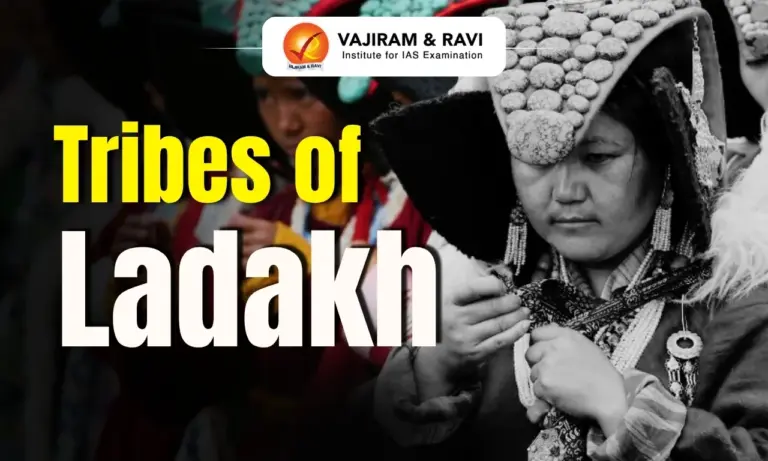
Ladakh is not only known for its high mountains, monasteries and beautiful landscapes. It is also home to several tribal communities with distinct languages, traditions, occupations and ways of life. Living in one of the world’s harshest high-altitude environments, these communities have developed unique ways to adapt to cold weather, limited vegetation and difficult terrain.
The major Scheduled Tribe communities of Ladakh include Balti, Beda, Bot/Boto, Brokpa/Drokpa/Dard/Shin, Changpa, Garra, Mon and Purigpa. The 2011 Census recorded 2,18,193 Scheduled Tribe people in Ladakh, while the Ministry of Tribal Affairs places Ladakh’s ST population at about 79.5% of its population based on Census 2011.
Major Tribes of Ladakh
Ladakh is home to several Scheduled Tribe communities, each with its own language, traditions, occupations and cultural practices. The major communities officially listed for Ladakh include Balti, Beda, Bot/Boto, Brokpa/Drokpa/Dard/Shin, Changpa, Garra, Mon and Purigpa.
1. Changpa
The Changpa are traditionally semi-nomadic pastoralists mainly found in the Changthang region of eastern Ladakh. Their lifestyle is closely connected with livestock, high-altitude pastures and the production of Pashmina wool.
- Major region: Changthang, eastern Ladakh
- Traditional occupation: Pastoralism and livestock rearing
- They rear Changthangi goats, sheep, yaks and horses.
- They are especially famous for producing high-quality Pashmina wool.
- Many families traditionally move seasonally in search of grazing pastures and water.
- Their traditional portable tents are known as Rebo.
- Their lifestyle is closely adapted to the cold and dry high-altitude environment.
- Pashmina production remains an important source of livelihood for Changpa pastoralists.
2. Brokpa
The Brokpa, also known as Drokpa, Dard or Shin, are an important tribal community associated with the Dha-Hanu region of Ladakh. They are known for their distinctive cultural traditions, traditional dress and strong Dardic heritage.
- Major region: Dha, Hanu, Garkone and Darchik areas
- Traditional occupations: Agriculture, livestock rearing and horticulture
- The community has a distinct Dardic linguistic and cultural heritage.
- Brokpa villages are often associated with the area popularly known as the Aryan Valley.
- They are known for their colourful traditional dress and jewellery.
- Women traditionally wear distinctive floral headgear, which is an important cultural symbol.
- Folk songs, dances and festivals help preserve their traditional identity.
- Their settled lifestyle differs from the more mobile pastoral lifestyle of the Changpa.
3. Bot or Boto
The Bot/Boto are one of the important tribal communities of Ladakh and are closely associated with the region’s traditional Ladakhi Buddhist and agrarian culture. Their way of life has historically centred around settled villages, farming and livestock.
- Major region: Leh and other parts of Ladakh
- Religion: Predominantly Tibetan Buddhism
- Traditional occupations: Agriculture and animal husbandry
- They traditionally cultivate crops such as barley, wheat and peas.
- Livestock provides important products such as milk, meat and wool.
- Their cultural life is closely connected with Buddhist monasteries and festivals.
- Traditional Ladakhi architecture, food, clothing and folk traditions are important parts of their cultural identity.
- The community represents an important part of the settled agrarian society of Ladakh.
4. Balti
The Balti are an important tribal community mainly associated with Kargil and the western parts of Ladakh. They have a distinctive language and cultural identity shaped by the historical connections of Ladakh with Tibet, Central Asia and the Himalayan region.
- Major region: Kargil and surrounding areas
- Religion: Predominantly Islam
- Language: Balti
- Traditional occupations: Agriculture, horticulture, livestock rearing and trade
- Fruit cultivation and horticulture are important in several Balti settlements.
- The community has a rich tradition of folk music, food, clothing and cultural practices.
- Balti cuisine reflects the region’s mountain environment and historical cultural connections.
- Their language and traditions form an important part of Kargil’s cultural diversity.
5. Purigpa
The Purigpa are traditionally associated with the Purig region of Kargil. They have a distinct cultural identity and speak Purgi, a language widely used in the region.
- Major region: Purig and Kargil areas
- Religion: Predominantly Islam
- Language: Purgi
- Traditional occupations: Agriculture, livestock rearing and local trade
- Farming is supported by the relatively fertile valleys of the Purig region.
- The community has historically maintained cultural links with Tibet and Central Asia.
- Folk songs, traditional food, clothing and local customs form an important part of Purigpa culture.
- The Purigpa community contributes significantly to the cultural heritage of Kargil.
6. Mon
The Mon are a traditional community of Ladakh associated historically with skilled crafts and occupational activities. Historical accounts of Ladakh mention Mon settlements in different parts of the region.
- Major region: Different parts of Ladakh
- Traditional occupations: Craftsmanship and skilled occupations
- They have historically been associated with carpentry, music and other traditional skills.
- Their skills were important in traditional village economies.
- Woodwork and craftsmanship were particularly useful in constructing houses and making household items.
- The community reflects the importance of traditional occupational groups in Ladakhi society.
- Modern education and changing employment patterns have gradually transformed many traditional occupations.
7. Beda
The Beda are traditionally associated with music, performing arts and entertainment in Ladakhi society. Their contribution is particularly important to the region’s folk and cultural traditions.
- Major occupation: Music and performing arts
- Traditionally performed at festivals, celebrations and community gatherings.
- They helped preserve folk songs, music and oral traditions.
- Traditional musical performances formed an important part of local social events.
- Their cultural role demonstrates the importance of occupational communities in Ladakhi society.
- Modernisation has changed many traditional occupations, but their historical contribution remains an important part of Ladakh’s cultural heritage.
8. Garra
The Garra are traditionally associated with blacksmithing and metalworking. Their skills were important in traditional Ladakhi villages, where locally produced and repaired tools were essential for agriculture and everyday life.
- Traditional occupation: Blacksmithing and metalworking
- They traditionally made and repaired agricultural tools and household implements.
- Their skills supported farming and other local occupations.
- Metal craftsmanship was an important traditional skill in rural Ladakh.
- The Garra represent the role of traditional artisans in Ladakh’s village economy.
- Modern tools and manufactured products have reduced the dependence on some traditional metalworking practices.
- Preserving such skills is important for maintaining Ladakh’s traditional craft heritage.
Government Schemes and Initiatives for Tribal Communities
The government has introduced various welfare, livelihood, education and development initiatives to improve the socio-economic conditions of tribal communities in Ladakh while also supporting their traditional livelihoods, culture and heritage.
- Tribal Sub-Plan (TSP): Focuses on directing development resources towards Scheduled Tribe communities and improving their access to education, healthcare, infrastructure and livelihood opportunities.
- Pashmina Development Initiatives: Special attention is given to Changpa pastoralists through support for Pashmina goat rearing, animal health, breeding, processing and market access.
- Ladakh Pashmina Development Board: The board aims to strengthen the Pashmina value chain and improve income opportunities for pastoral communities involved in Pashmina production.
- Production-Based Incentives for Pashmina Herders: Financial incentives have been introduced to encourage Pashmina production and provide better returns to local herders.
- Tribal Welfare and Education Support: Government programmes support scholarships, hostels, educational facilities and skill development for students belonging to Scheduled Tribes.
- Healthcare and Basic Infrastructure: Development efforts focus on improving healthcare, roads, drinking water, electricity and connectivity in remote tribal settlements.
- Livelihood and Skill Development: Tribal communities are encouraged to develop handicrafts, handlooms, tourism, agriculture, horticulture and other income-generating activities.
- Support for Traditional Crafts: Initiatives promote Ladakhi handicrafts, weaving, wool products and traditional skills, helping artisans preserve their cultural heritage while generating income.
- Self-Help Groups (SHGs): Tribal women and rural communities are encouraged to form Self-Help Groups to improve financial independence, entrepreneurship and access to livelihood opportunities.
- Cultural Preservation: Government programmes also focus on protecting tribal languages, traditional knowledge, folk arts, crafts and cultural practices while integrating communities into modern development.


 Last updated on Oct, 2026
→ UPSC 2027 Notification will be released on 13 January 2027 at upsconline.nic.in.
→ Asian Games 2026 are being held in Aichi-Nagoya, Japan, from 19 September to 4 October.
→ Check Nobel Prize 2026 Winners List here.
→ Download PIB PRiSM Monthly Magazine 2026 here.
→ Check UPSC Monthly Current Affairs Magazine The Recitals here.
→ Check out the latest UPSC Syllabus here.
→ Download UPSC Model Answers for Mains 2026
→ UPSC Mains Question Paper 2026 is out now for Essay & GS Paper 1, 2, 3 & 4.
→ UPSC Calendar 2027 has been released.
→ Enroll in Vajiram & Ravi’s UPSC Mains Test Series 2027 for structured answer writing practice, expert evaluation, and exam-oriented feedback.
→ Join Vajiram & Ravi’s UPSC Mentorship Program 2027 for personalized guidance, strategy planning, and one-to-one support from experienced mentors.
→ Go through the UPSC Mains Previous Year Papers to enhance your preparation.
→ UPSC has released UPSC Toppers List 2025 with the Civil Services final result on its official website.
→ Also check Best UPSC Coaching in India
Tribes of Ladakh FAQs
Q1. How many Scheduled Tribes are there in Ladakh?+
Q2. Which is the most famous tribal community of Ladakh?+
Q3. Where do the Changpa tribe live?+
Q4. Which tribe of Ladakh is famous for Pashmina?+
Q5. Which tribes of Ladakh mainly follow Islam?+
Q6. Where do the Brokpa people live?+
Tags: ladakh tribes tribes of ladakh