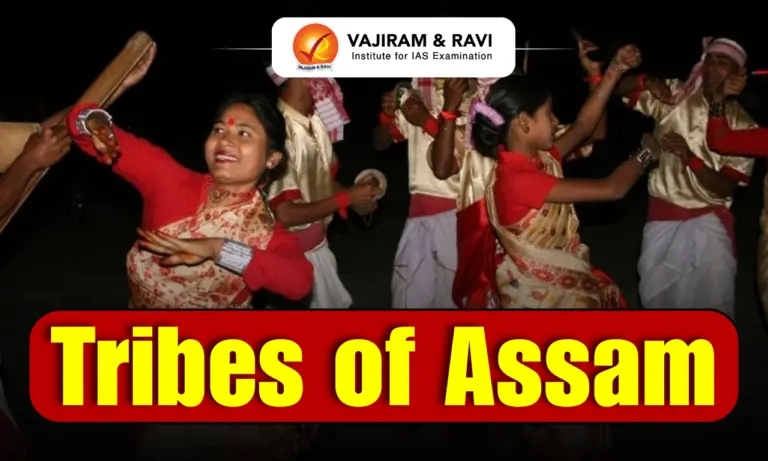
The Tribes of Assam form an important part of the state’s social, cultural and historical identity. Assam is home to a diverse population with Mongoloid, Indo-Burmese, Indo-Iranian and Aryan origins. The native people are known as Asomiya and Assamese serves as their principal language. The tribal communities preserve their own languages, customs, festivals, traditional occupations and cultural practices alongside the broader Assamese heritage.
Tribes of Assam
Assam has one of the richest tribal populations in India. According to the 2011 Census, the Scheduled Tribe population of Assam accounts for 12.44% of the state’s total population. The Constitution classifies these communities into Scheduled Tribes (Plains) and Scheduled Tribes (Hills).
Among Scheduled Tribes, majority of them speak Bodo and Assamese, while rest of the population speaks several other indigenous languages including- Mising, Karbi, Garo, Dimasa, Rabha, Deori, Hajong, Lalung, Zemi, Kuki, Hmar, Khasi and Bengali.
Major Tribes of Assam List
The List of Major Tribes of Assam has been provided below:
Bodo
- The Bodos are the largest Scheduled Tribe in Assam, constituting 35.06% of the ST population.
- Belonging to the Indo-Mongoloid Bodo group, they primarily practice agriculture, bamboo and cane craftsmanship, weaving and sericulture.
- Major festivals include Baisagu, Domashi, Katrigacha and the important religious festival Kherai.
Mising (Miri/ Mishing)
- The Mising are the second largest tribal community, accounting for 17.52% of Assam’s Scheduled Tribe population.
- Traditionally settled along the Brahmaputra riverbanks, they depend mainly on agriculture, fishing, bamboo crafts and weaving.
- Their important festivals are Ali-Aye-Ligang and Porag.
Karbi
- Representing 11.08% of Assam’s ST population, the Karbis belong to the Tibeto-Burman linguistic family.
- Agriculture remains their primary occupation.
- Rongker and Hacha Kekan are their major agricultural festivals celebrated before cultivation and after planting seasons.
Rabha
- The Rabhas account for 7.63% of the Scheduled Tribe population and are mainly concentrated in Goalpara, Kamrup and Darrang districts.
- Traditionally dependent on agriculture, forest resources and weaving, they combine indigenous religious practices with Hindu traditions, while music and dance remain integral to every ritual.
Kachari and Sonowal Kachari
- Constituting 6.52% of Assam’s Scheduled Tribe population, the Kachari communities have deep historical roots.
- Sonowal Kacharis, a branch of the Bodo-Kachari group, are concentrated in Dhemaji, Lakhimpur, Tinsukia and Dibrugarh.
- Most follow Vaishnavism and celebrate Bohag, Magh and Kati Bihu.
Deori
- The Deori community mainly inhabits riverbank settlements across Assam, Nagaland and Arunachal Pradesh.
- They have preserved their tribal identity through limited inter community marriages.
- Their major agricultural festivals include Bohagi Bisu, Magiyo Bisu and Joydam Festival, promoting cultural unity.
Dimasa
- One of the oldest tribal communities of Northeast India, the Dimasa mainly inhabit Dima Hasao while also residing in Nagaland and Manipur.
- Agriculture is their principal occupation.
- Bushu, celebrated after harvesting every year on 27 January, is their most significant community festival.
Also Read: Festivals of Assam
Tiwa (Lalung)
- The Tiwas are divided into Hill Tiwas and Plains Tiwas, reflecting different cultural traditions.
- Hill Tiwas largely speak Tibeto-Burman languages, while Plains Tiwas predominantly use Assamese.
- The Jonbeel Mela highlights their historical role in facilitating trade between hill and plain communities.
Tai-Phake
- The Tai-Phake community settled in Assam after migrating from the Shan Kingdom of Myanmar during the eighteenth century.
- Concentrated mainly in Dibrugarh and Tinsukia, they practice agriculture and fishing.
- Poi Sangken, Buddha Purnima and Poi Mai-ko-chum-fai are their principal festivals.
Singpho
- The Singpho community lives in Assam’s Tinsukia, Sivasagar, Jorhat and Golaghat districts besides Arunachal Pradesh.
- They practice Theravada Sect of Buddhism alongside animistic beliefs.
- The community introduced traditional tea cultivation methods that later influenced commercial tea production.
Tea Tribes (Adivasi)
- Tea Tribes comprise 106 sub groups and form about 18% of Assam’s population.
- Their ancestors were brought by the British from Odisha, Madhya Pradesh, Bihar, Andhra Pradesh and West Bengal during the mid nineteenth century.
- They contribute nearly 53% of India’s total tea production and are currently recognised as Other Backward Classes in Assam.
Koch-Rajbongshi
- Originating from the ancient Koch Kingdom, the Koch-Rajbongshi community inhabits Assam, West Bengal, Arunachal Pradesh, Meghalaya, Bangladesh and Nepal.
- They speak the Rajbongshi language and historically practiced animism before many adopted Shaiva and Vaishnava traditions of Hinduism.
Moran
- The Moran community is among the indigenous groups of Assam and earlier maintained an independent kingdom in the southeastern Brahmaputra valley before the Ahoms.
- During the early seventeenth century, Aniruddhadeva introduced Vaishnavism, significantly influencing their cultural development.
Other Recognised Tribes
- Assam’s Scheduled Tribe communities also include Hajong, Garo, Mech, Hmar, Chakma, Khasi, Jaintia, Synteng, Pnar, War, Bhoi, Lyngngam, Lakher, Pawi, Mizo tribes, Naga tribes, Kuki tribes, Barmans and several other notified tribal groups across hill and plain regions.


Tribes of Assam Government Initiatives
The Government of India and the Government of Assam have introduced several policy measures for tribal welfare, Scheduled Tribe development, infrastructure creation and examination of proposals related to Scheduled Tribe recognition. These initiatives include:
- Communities Under Consideration: The Assam Government has recommended Chutiya, Koch-Rajbongshi, Matak, Moran, Tai-Ahom and Tea Tribe communities for inclusion in the Scheduled Tribe list. These proposals continue to undergo examination under the approved constitutional process.
- State Committee on Reservation: Assam constituted a Group of Ministers to determine reservation for six communities, revise OBC reservation after any new Scheduled Tribe category and safeguard the rights of existing Scheduled Tribes. The committee was reconstituted on 4 July 2024 and 1 March 2025.
- Development Action Plan for Scheduled Tribes (DAPST): The Ministry of Tribal Affairs implements DAPST through 41 Ministries and Departments, supporting education, healthcare, agriculture, irrigation, roads, housing, electrification, employment generation and skill development to reduce development gaps between Scheduled Tribes and non Scheduled Tribe populations.
- Dharti Aaba Janjatiya Gram Utkarsh Abhiyan: Launched on 2 October 2024, the programme covers 25 interventions implemented by 17 Ministries. It aims to benefit over five crore tribal people across 63,843 villages, 549 districts and 2,911 blocks within five years.

 Last updated on Oct, 2026
→ UPSC 2027 Notification will be released on 13 January 2027 at upsconline.nic.in.
→ Check Nobel Prize 2026 Winners List here.
→ Download PIB PRiSM Monthly Magazine 2026 here.
→ Check UPSC Monthly Current Affairs Magazine The Recitals here.
→ Check out the latest UPSC Syllabus here.
→ Download UPSC Model Answers for Mains 2026
→ UPSC Mains Question Paper 2026 is out now for Essay & GS Paper 1, 2, 3 & 4.
→ UPSC Calendar 2027 has been released.
→ Enroll in Vajiram & Ravi’s UPSC Mains Test Series 2027 for structured answer writing practice, expert evaluation, and exam-oriented feedback.
→ Join Vajiram & Ravi’s UPSC Mentorship Program 2027 for personalized guidance, strategy planning, and one-to-one support from experienced mentors.
→ Go through the UPSC Mains Previous Year Papers to enhance your preparation.
→ UPSC has released UPSC Toppers List 2025 with the Civil Services final result on its official website.
→ Also check Best UPSC Coaching in India
Tribes of Assam FAQs
Q1. What are the Major Tribes of Assam?+
Q2. What is the difference between Scheduled Tribes (Plains) and Scheduled Tribes (Hills) in Assam?+
Q3. Which government scheme supports tribal development in Assam?+
Q4. Who are the Tea Tribes of Assam?+
Q5. Who are the Koch-Rajbongshi people of Assam?+
Q6. Who are the Mising Tribe of Assam?+
Tags: assam tribes tribes of assam