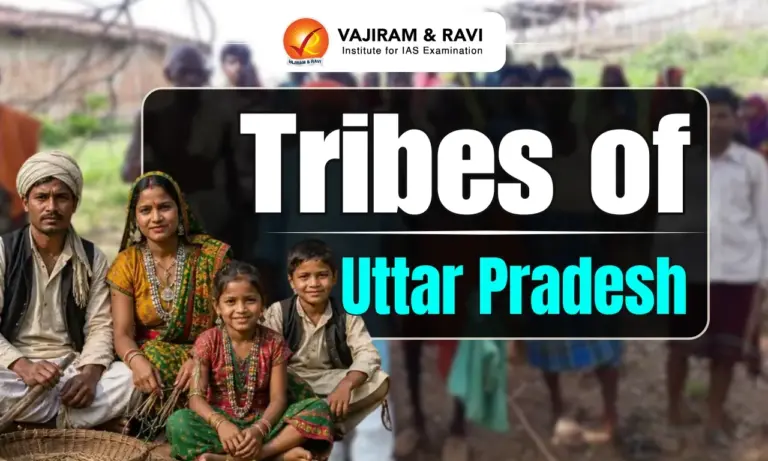
Uttar Pradesh has a relatively small tribal population of over 1.1 million people, accounting for around 0.5% of the state’s population, with more than 15 recognised Scheduled Tribe communities. The major groups include the Tharu in the Terai belt, Gond and Kharwar in the southern Sonbhadra and Mirzapur regions, along with smaller communities such as the Agariya and Baiga. These tribes have distinct traditions, cultural practices, and livelihoods closely linked to agriculture, forests, and natural resources.
Major Tribes of Uttar Pradesh
Uttar Pradesh has a relatively small tribal population, mainly concentrated in southern districts such as Sonbhadra, Mirzapur, Chandauli and Lalitpur, with communities known for their distinct culture, traditional knowledge and forest-based livelihoods.
1. Gond
- The Gond are one of the most prominent tribal communities of Uttar Pradesh.
- They are mainly found in Sonbhadra, Mirzapur and surrounding areas.
- Traditionally, their livelihood has depended on agriculture, forest resources and wage labour.
- They have a rich tradition of folk songs, dances, festivals and community customs.
- The community has a strong cultural connection with forests and natural resources.
2. Kol
- The Kol community is mainly found in Sonbhadra, Mirzapur and nearby regions.
- Agriculture and daily wage labour are important sources of livelihood.
- Traditionally, many Kol families have depended on forest products and local natural resources.
- Their social and cultural life is closely connected with community traditions and rural practices.
3. Kharwar
- The Kharwar are primarily concentrated in Sonbhadra and adjoining areas.
- Agriculture, forest-based activities and wage labour are important occupations.
- They have traditionally maintained a close relationship with the forest and surrounding natural environment.
- Their culture includes distinctive customs, festivals and traditional practices.
4. Chero
- The Chero community is mainly found in Sonbhadra and Mirzapur.
- Agriculture is an important source of livelihood, along with wage labour and forest-based activities.
- They have a distinct social and cultural identity.
- Their traditional practices are influenced by the rural and forest environment of southern Uttar Pradesh.
5. Baiga
- The Baiga are a tribal community associated particularly with the forest regions of Sonbhadra.
- Traditionally, they have had a strong dependence on forests and natural resources.
- They possess traditional knowledge related to medicinal plants and forest resources.
- Their culture includes distinctive rituals, beliefs, folk traditions and community practices.
- Forest conservation and livelihood security are important issues for the community.
6. Parahiya
- The Parahiya are mainly found in Sonbhadra and surrounding forest areas.
- Their traditional livelihood includes agriculture, forest resources and wage labour.
- They have distinctive customs, traditions and social practices.
- Improving access to education, healthcare, employment and basic infrastructure is important for their socio-economic development.
Culture and Traditions of Uttar Pradesh Tribes
The tribal communities of Uttar Pradesh have a rich cultural heritage shaped by their close relationship with nature, forests, agriculture, community life, and traditional beliefs.
- Folk Music and Dance: Traditional songs and dances are performed during festivals, marriages, harvests, and other community celebrations.
- Festivals: Many tribal festivals are linked to agriculture, seasons, nature, and religious beliefs.
- Traditional Knowledge: Communities possess valuable knowledge of medicinal plants, forest products, agriculture, and local biodiversity.
- Art and Handicrafts: Tribal communities practise traditional forms of painting, handicrafts, basket-making, pottery, and other local crafts.
- Nature Worship: Forests, rivers, trees, animals, and other elements of nature hold an important place in many tribal traditions.
- Community Life: Community institutions and collective participation play an important role in social decision-making and maintaining traditions.
- Language and Oral Traditions: Folk stories, songs, legends, and traditional knowledge are often passed from one generation to another through oral traditions.
- Traditional Customs: Marriage ceremonies, birth rituals, festivals, and other social practices reflect the distinct identity and heritage of different tribal groups.


Government Initiatives for Tribal Development in Uttar Pradesh
The government has introduced several initiatives to improve the education, healthcare, livelihoods, housing, and social security of tribal communities in Uttar Pradesh, with special focus on remote and economically weaker tribal populations.
- Tribal Sub-Plan (TSP): Focuses on the socio-economic development of Scheduled Tribes through targeted funding.
- Post-Matric Scholarship: Provides financial support to tribal students pursuing higher education.
- Pre-Matric Scholarship: Supports the education of tribal students at the school level.
- Eklavya Model Residential Schools (EMRS): Provide quality residential education to students from Scheduled Tribe communities.
- Pradhan Mantri Janjati Adivasi Nyaya Maha Abhiyan (PM-JANMAN): Focuses on improving basic facilities and livelihoods of Particularly Vulnerable Tribal Groups (PVTGs).
- Forest Rights Act, 2006: Recognises eligible traditional forest and land rights of forest-dwelling tribal communities.
- Livelihood and Skill Development: Promotes employment, entrepreneurship, skill training, and income generation among tribal communities.
- Healthcare and Infrastructure: Government programmes aim to improve access to healthcare, drinking water, housing, roads, and other basic services in tribal areas.

 Last updated on Oct, 2026
→ UPSC 2027 Notification will be released on 13 January 2027 at upsconline.nic.in.
→ Asian Games 2026 are being held in Aichi-Nagoya, Japan, from 19 September to 4 October.
→ Check Nobel Prize 2026 Winners List here.
→ Download PIB PRiSM Monthly Magazine 2026 here.
→ Check UPSC Monthly Current Affairs Magazine The Recitals here.
→ Check out the latest UPSC Syllabus here.
→ Download UPSC Model Answers for Mains 2026
→ UPSC Mains Question Paper 2026 is out now for Essay & GS Paper 1, 2, 3 & 4.
→ UPSC Calendar 2027 has been released.
→ Enroll in Vajiram & Ravi’s UPSC Mains Test Series 2027 for structured answer writing practice, expert evaluation, and exam-oriented feedback.
→ Join Vajiram & Ravi’s UPSC Mentorship Program 2027 for personalized guidance, strategy planning, and one-to-one support from experienced mentors.
→ Go through the UPSC Mains Previous Year Papers to enhance your preparation.
→ UPSC has released UPSC Toppers List 2025 with the Civil Services final result on its official website.
→ Also check Best UPSC Coaching in India
Tribes of Uttar Pradesh FAQs
Q1. How many Scheduled Tribes are there in Uttar Pradesh?+
Q2. Which is the major tribe of Uttar Pradesh?+
Q3. Where do tribal communities mainly live in Uttar Pradesh?+
Q4. Which tribe is found in the Terai region of Uttar Pradesh?+
Q5. Which tribes are found in Sonbhadra?+
Q6. What are the main occupations of tribes in Uttar Pradesh?+
Q7. What is the cultural importance of tribes in Uttar Pradesh?+
Tags: tribes tribes of india tribes of uttar pradesh uttar pradesh