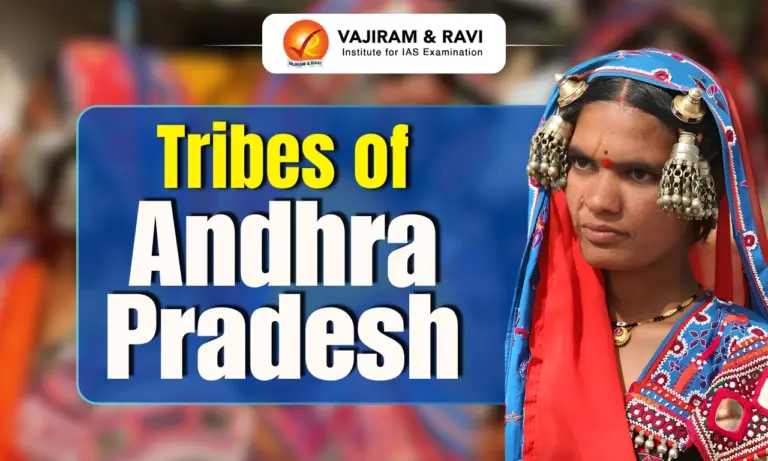
Tribes of Andhra Pradesh form an important part of the State’s social and cultural landscape. According to the 2011 Census, the tribal population of Andhra Pradesh was 27.39 lakh, accounting for 5.53% of the State population. Tribal communities are spread across forest, hill, river and plain areas. Major groups include Koya, Konda Reddi, Savara, Jatapu, Gadaba, Konda Dora, Chenchu, Yanadi, Yerukula and Lambada communities.
Tribes of Andhra Pradesh
The Tribes of Andhra Pradesh show considerable diversity in language, livelihood, settlement and cultural practices. Tribal regions can be grouped into Koya-Konda Reddi, Khond-Savara, Chenchu and plain area regions. The Godavari region is associated with Koyas and Konda Reddis. Northern districts have Savara, Jatapu, Gadaba and Konda Dora communities. Yanadi and Yerukula groups are widely found in plain areas.
Tribes of Andhra Pradesh Features
The major highlighting features of the Tribes of Andhra Pradesh has been listed below:
- Cultural traditions: Tribal communities preserve distinctive festivals, dances, religious practices and traditional institutions. Dimsa is particularly associated with tribal communities of northern Andhra, while festivals such as Kandi Pandaga and Pillipandaga remain culturally significant.
- Social institutions: Gadabas maintain a traditional village council headed by a Kulapedda. Desari or Pujaria performs religious duties, while marriage customs include negotiation and mutual choice.
- Literacy: Literacy among tribal communities remains a development concern. The recorded literacy rate for the Nellore tribal population is 40.49%, highlighting the continuing need for educational support.
- Settlement pattern: Tribal settlements occur across forests, hills, riverbanks and plain areas. Yanadis commonly inhabit river and canal banks, while several northern groups live in hill slopes and forest interiors.
- Economic transition: Traditional livelihoods are gradually changing. Yanadis combine fishing, agricultural labour and small farming, while Yerukulas and Nakkalas increasingly travel outside their local areas for commercial activities.
- Distribution:
- Visakhapatnam tribal groups: Major communities include Bagata, Gadaba, Kammara, Konda Dora, Kotia, Khond, Mali, Manne Dora, Mukha Dora, Reddi Dora, Porja, Valmiki, Goud and Kulia.
- Northern Andhra concentration: Srikakulam and Vizianagaram have important populations of Savara, Jatapu, Gadaba and Konda Dora communities. These groups are strongly associated with hill and forest environments.
- Godavari tribal region: East Godavari has Koya, Konda Reddi, Kammara and Konda Dora communities. West Godavari includes Koya, Konda Reddi, Yerukula and Yanadi populations.


List of Major Tribes of Andhra Pradesh
The major tribal communities of Andhra Pradesh have distinct geographical concentrations, traditional occupations, languages, festivals and social practices across the State.
Koya
- Koyas mainly inhabit areas along the Godavari River in East Godavari and West Godavari districts.
- Bhudevi Panduga is an important festival dedicated to the Earth Goddess.
Konda Reddi
- Konda Reddis mainly live in interior forest and hill areas of East Godavari and West Godavari.
- Shifting cultivation remains important, while Telugu is their mother tongue.
Savara
- Savaras are concentrated in Srikakulam and Vizianagaram and are also found in hill areas.
- They speak their own dialect, associated with the Mundari linguistic family.
- Savaras depend on agriculture, horticulture, Podu cultivation, terrace farming and minor forest produce.
- They cultivate Red Gram, Ragi, Jowar and pulses, while rice remains their staple food.
Jatapu
- Jatapus mainly reside in forest and hill areas of Vizianagaram, especially GLPuram, Kurupam and Komarada.
- They constitute 44% of the district’s total tribal population.
- Jatapus traditionally practise shifting cultivation or Podu cultivation. Red Gram, Ragi, Jowar, Bajra and other millets are cultivated, while Tamarind, Gum and hill brooms are collected.
Gadaba
- Gadabas are concentrated in Saluru, Pachipenta, JMvalasa and Parvathipuram.
- Their population is 19,164, representing 9.5% of the district’s ST population.
- Gadaba is their traditional dialect.
- Gadabas work mainly as cultivators and agricultural labourers.
- Those living in hilly areas practise Podu cultivation and grow Ragi, Red Gram and Niger.
Konda Dora
- Konda Doras are mainly found in Saluru, Pachipenta and Makkuva, besides Parvathipuram and other tribal areas.
- Agriculture and fishing are important livelihood activities.
Chenchu
- Chenchus traditionally inhabit the Nallamalai hills across Guntur, Prakasam and Kurnool areas.
- Hunting, gathering roots, tubers and honey historically formed important parts of their economy.
Yanadi
- Yanadis mainly settle along river, canal and tank areas because fishing is an important livelihood.
- Their traditional occupations also include agricultural labour, scavenging and small scale farming.
- Yanadis are traditionally divided into Reddi Yanadi, Adavi Yanadi, Paki Yanadi and Challa Yanadi groups based on occupation and dietary practices.
Yerukula
- Yerukula communities are distributed across different areas and traditionally depend on small businesses.
- Many members travel to other States to conduct small scale commercial activities.
Nakkala
- Nakkala communities traditionally manufacture small toys and sell them on city platforms.
- Some members travel to other States to market these toys and earn livelihoods.
Lambada
- Lambadas traditionally lived in separate hamlets called tandas near hills and pastures.
- They were formerly nomadic, but many have become settled cultivators, with cattle rearing as a secondary occupation.
Tribes of Andhra Pradesh Development Measures
Development measures for the Tribes of Andhra Pradesh focus on education, livelihoods, infrastructure, PVTG support, forest produce marketing and preservation of tribal culture.
- DAPST: Development Action Plan for Scheduled Tribes requires 41 Ministries and Departments to allocate a prescribed share of their budgets for tribal development covering education, health, roads, housing, irrigation and employment.
- Article 275(1): These 100% Central grants support Scheduled Areas and tribal welfare through infrastructure in education, health, drinking water, sanitation, skill development and livelihoods according to local requirements.
- Dharti Aaba Abhiyan: Launched on 2 October 2024, the initiative covers 63,843 villages through 25 interventions of 17 Ministries. It has an outlay of ₹79,156 crore.
- PM JANMAN: Launched on 15 November 2023, PM JANMAN has an approximate ₹24,000 crore outlay for PVTGs, covering housing, water, sanitation, education, healthcare, nutrition, roads, telecom and livelihoods.
- PMJVM: Pradhan Mantri Janjatiya Vikas Mission supports tribal livelihoods through Minimum Support Price for selected Minor Forest Produce, value addition, infrastructure, sustainable collection and better market access.
- EMRS: Eklavya Model Residential Schools provide quality residential education to tribal children. The scheme targets 728 schools nationally, with an intended benefit for around 3.5 lakh ST students.
- Scholarships: Pre Matric scholarships support eligible ST students in Classes IX and X, while Post Matric scholarships provide assistance for higher education, including reimbursement of eligible fees and monthly scholarship support.
- Higher education support: National Overseas Scholarships provide 20 annual awards, including 17 for ST candidates and 3 for PVTGs. National Fellowship provides 750 fellowships annually for higher studies.
- PVTG development: Savara and Gadaba communities are identified as Particularly Vulnerable Tribal Groups in the provided reference. Development measures therefore require focused education, livelihood, health and infrastructure interventions.
- Tribal education: Government programmes support tribal welfare residential schools and ashram schools. Savara language teachers have also been provided in selected primary schools to strengthen learning through the community’s own language.
- Cultural preservation: The Tribal Cultural Research and Training Mission is working on documenting tribal artistes, preserving traditional musical instruments and supporting training for emerging artistes and instructors.
- Tribal research: Support to Tribal Research Institutes promotes research, documentation, tribal museums, preservation of art and artefacts, cultural festivals and exchange programmes to protect tribal heritage.
- Livelihood protection: Better marketing of forest products, value addition and Minimum Support Price mechanisms can improve returns from products such as Tamarind, Gum and other minor forest produce.
- State priority: The State has emphasised quality education, employment opportunities and preservation of tribal traditions. Efforts also include improving residential school infrastructure and seeking wider recognition for tribal art and dance forms.

 Last updated on Oct, 2026
→ UPSC 2027 Notification will be released on 13 January 2027 at upsconline.nic.in.
→ Check Nobel Prize 2026 Winners List here.
→ Download PIB PRiSM Monthly Magazine 2026 here.
→ Check UPSC Monthly Current Affairs Magazine The Recitals here.
→ Check out the latest UPSC Syllabus here.
→ Download UPSC Model Answers for Mains 2026
→ UPSC Mains Question Paper 2026 is out now for Essay & GS Paper 1, 2, 3 & 4.
→ UPSC Calendar 2027 has been released.
→ Enroll in Vajiram & Ravi’s UPSC Mains Test Series 2027 for structured answer writing practice, expert evaluation, and exam-oriented feedback.
→ Join Vajiram & Ravi’s UPSC Mentorship Program 2027 for personalized guidance, strategy planning, and one-to-one support from experienced mentors.
→ Go through the UPSC Mains Previous Year Papers to enhance your preparation.
→ UPSC has released UPSC Toppers List 2025 with the Civil Services final result on its official website.
→ Also check Best UPSC Coaching in India
Tribes of Andhra Pradesh FAQs
Q1. Which are the major tribes of Andhra Pradesh?+
Q2. What is the tribal population of Andhra Pradesh?+
Q3. Which tribe is mainly found along the Godavari River?+
Q4. Where are the Chenchu Tribes of Andhra Pradesh mainly found?+
Q5. Which tribes are mainly found in northern Andhra Pradesh?+
Tags: andhra pradesh tribes tribes of andhra pradesh