


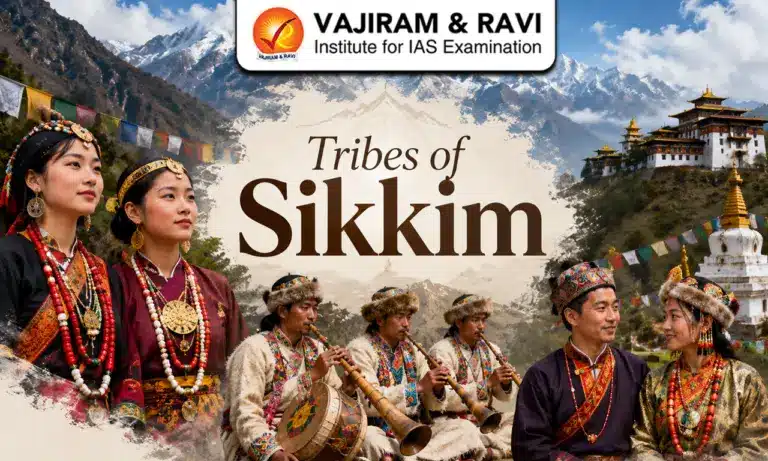
Tribes of Sikkim are an integral part of the state’s history, culture and social fabric. They have preserved distinct languages, scripts, religious traditions, festivals and customary institutions, contributing significantly to Sikkim’s unique Himalayan identity. The tribal communities of the state also enjoy special constitutional safeguards under Article 371F of the Constitution.
List of Major Tribes of Sikkim
The four major Scheduled Tribes of Sikkim are Lepcha, Bhutia, Limboo (Limbu) and Tamang. Lepcha and Bhutia were the original recognised Scheduled Tribes of Sikkim. Limboo (Limbu) and Tamang were added to the Scheduled Tribe list in 2003 through the Constitution (Scheduled Tribes) Order (Amendment) Act, 2002.
Lepcha Tribe
- The Lepchas are the indigenous and earliest known tribal community of Sikkim, mainly residing in the Dzongu Reserve of North Sikkim.
- They speak the Lepcha (Rong) language, which is written in the Lepcha (Rong) script.
- They primarily follow Vajrayana Buddhism along with their traditional animistic (nature-worship) beliefs. Religious rituals are performed by Bongthing (male shaman) and Mun (female shaman).
- Their traditional occupations include agriculture, shifting cultivation, forest-based livelihoods and large-cardamom cultivation. They worship Mount Khangchendzonga as their guardian deity.
- Major festivals include Pang Lhabsol, Tendong Lho Rum Faat and Namsoong.
- The Lepchas call themselves Rongkup, which means “children of the Róng (Lepcha people).” Their traditional ceremonial name is Mútuncí Róngkup Rumkup, meaning “beloved children of the Róng and of God.”
Bhutia Tribe
- The Bhutias are of Tibetan origin and are mainly concentrated in North and East Sikkim, especially in Lachen and Lachung.
- They speak Sikkimese (Dranjongke/Lhokey), which is written in the Tibetan script.
- The community predominantly follows Vajrayana Buddhism, and monasteries, lamas and Guru Padmasambhava (Guru Rinpoche) occupy an important place in their religious life.
- Their traditional occupations include trans-Himalayan trade, yak pastoralism, agriculture, livestock rearing and large-cardamom cultivation.
- The Dzumsa system, a traditional village self-governance institution, continues to function in Lachen and Lachung, managing local administration, natural resources and dispute resolution.
- Major festivals include Losar, Pang Lhabsol, Bumchu, Lossong, Saga Dawa and Lhabab Duchen.
Limboo (Limbu) Tribe
- The Limboos, also known as Tsong, are mainly concentrated in West and South Sikkim and trace their origin to the historic Limbuwan region of eastern Nepal.
- They speak the Limbu language, which is written in the indigenous Sirijonga script.
- The community follows the indigenous Yuma Samyo (Kirati) faith along with Hindu and Buddhist traditions, and religious rituals are conducted by Phedangba and Samba priests.
- Agriculture, horticulture and livestock rearing constitute their traditional occupations, while their rich heritage of folk music, dance and oral literature remains an important part of Sikkim’s cultural landscape.
- Chasok Tangnam is the principal harvest festival celebrated by the Limboo community.
- The Limboo community was granted Scheduled Tribe status in 2003.
Tamang Tribe
- The Tamangs are a Tibeto-Burman tribal community distributed mainly across West, South and Central Sikkim.
- They speak the Tamang language, which is generally written using the Tibetan-based script.
- The community predominantly follows Tibetan Buddhism, while preserving several customary practices influenced by the ancient Bon tradition.
- Their traditional occupations include agriculture, livestock rearing, handicrafts and other rural occupations.
- Sonam Lhochhar is the most important festival of the Tamang community and marks the Tamang New Year.
- The Tamang community was included in the Scheduled Tribe list in 2003.


 Last updated on Oct, 2026
→ UPSC 2027 Notification will be released on 13 January 2027 at upsconline.nic.in.
→ Check Nobel Prize 2026 Winners List here.
→ Download PIB PRiSM Monthly Magazine 2026 here.
→ Check UPSC Monthly Current Affairs Magazine The Recitals here.
→ Check out the latest UPSC Syllabus here.
→ Download UPSC Model Answers for Mains 2026
→ UPSC Mains Question Paper 2026 is out now for Essay & GS Paper 1, 2, 3 & 4.
→ UPSC Calendar 2027 has been released.
→ Enroll in Vajiram & Ravi’s UPSC Mains Test Series 2027 for structured answer writing practice, expert evaluation, and exam-oriented feedback.
→ Join Vajiram & Ravi’s UPSC Mentorship Program 2027 for personalized guidance, strategy planning, and one-to-one support from experienced mentors.
→ Go through the UPSC Mains Previous Year Papers to enhance your preparation.
→ UPSC has released UPSC Toppers List 2025 with the Civil Services final result on its official website.
→ Also check Best UPSC Coaching in India
Tribes of Sikkim FAQs
Q1. Which are the major Tribes of Sikkim?+
Q2. Which protected tribal reserve is associated with the Lepcha community?+
Q3. Which tribe follows the traditional Dzumsa system of self-governance?+
Q4. Which language and script are used by the Lepcha tribe?+
Q5. Which tribe uses the Sirijonga script?+
Q6. Which tribe of Sikkim follows the indigenous Yuma Samyo (Kirati) faith?+
Q7. Which is the principal festival of the Tamang community?+
Tags: tribes of sikkim








