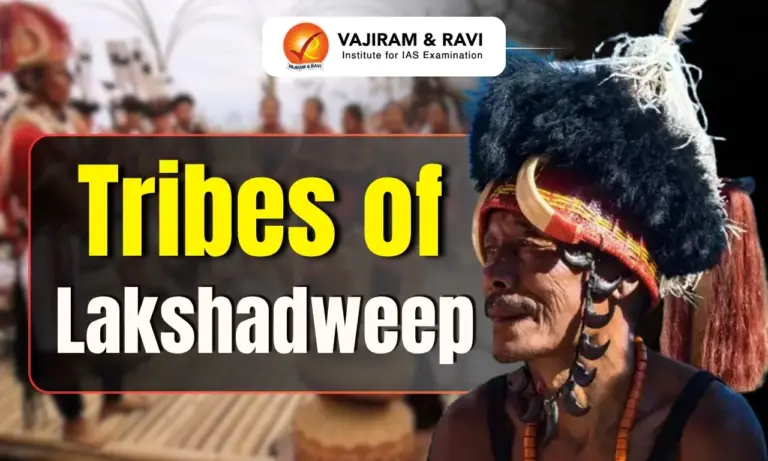
Tribes of Lakshadweep have a distinctive social and cultural identity shaped by the islands’ geography, Islamic traditions, matrilineal family system, and dependence on the sea. Unlike many other parts of India, the native population of Lakshadweep is broadly recognized as a Scheduled Tribe, and the traditional society is divided into social groups such as the Koyas, Malmis and Melacheris rather than into completely separate tribes.
Major Tribes of Lakshadweep
The indigenous population of Lakshadweep is recognized as a Scheduled Tribe, with its traditional society historically divided into groups such as the Koyas, Malmis and Melacheris. These communities share common cultural features, including Islamic traditions, matrilineal social practices, Malayalam-based dialects, and livelihoods linked to fishing and coconut cultivation.
1. Koyas
- Koyas have traditionally been regarded as the landowning and socially influential group in Lakshadweep.
- They were historically associated with land ownership, local administration and community leadership.
- Coconut cultivation has been an important traditional occupation among them.
- Koyas also participated in sailing and maritime activities because of the islands’ dependence on the sea.
- Their traditional social position was linked to ownership of land and other economic resources.
- They form an important part of the historical social structure of Lakshadweep.
2. Malmis
- Malmis have traditionally been associated with sailing, navigation and maritime activities.
- They developed specialized knowledge of the Arabian Sea and local waterways, which was important for travel between islands.
- Traditional occupations included fishing, sailing and handling boats.
- Malmis also contributed to boat-related activities and maritime trade.
- Their skills were particularly important in communities where transportation and economic activity depended heavily on the sea.
- The group reflects the strong maritime heritage of Lakshadweep.
3. Melacheris
- Melacheris traditionally worked mainly in coconut-related occupations.
- They were particularly associated with coconut climbing, harvesting and processing.
- Coir production and twisting were also important traditional activities.
- Coconut products provided both household resources and economic opportunities for island communities.
- Their traditional occupations supported the wider coconut-based economy of Lakshadweep.
- The community’s traditional skills remain an important part of the islands’ cultural and occupational history.
4. Aminidivi
- Aminidivi refers to the traditional population associated with the Aminidivi group of islands, including Amini, Kadmat, Kiltan, Chetlat and Bitra.
- Their traditional lifestyle has been strongly influenced by fishing and other maritime activities.
- Coconut cultivation has also been an important part of their local economy.
- Traditional handicrafts and island-based skills form part of their cultural heritage.
- The community shares many broader cultural characteristics with other indigenous groups of Lakshadweep.
- The Aminidivi islands also have their own local linguistic and cultural traditions.
Important Cultural Features of Tribes of Lakshadweep
The cultural identity of the Tribes of Lakshadweep is shaped by their island environment, Islamic traditions, matrilineal social system, maritime lifestyle, and dependence on fishing and coconut-based livelihoods.
- Islamic Traditions: Islam is the dominant religion and strongly influences social customs, festivals, food habits, and daily life.
- Matrilineal Society: Traditional family lineage and inheritance are generally traced through the female line.
- Malayalam-Based Languages: Malayalam and local dialects such as Jeseri are widely used among the indigenous communities.
- Mahl Language: The Mahl language is predominantly spoken by the people of Minicoy.
- Fishing Tradition: Tuna fishing is one of the most important traditional occupations and forms a major part of the island’s maritime culture.
- Coconut Culture: Coconut cultivation, harvesting and processing are closely connected with traditional livelihoods.
- Coir Making: Coir extraction and twisting have traditionally been important household and economic activities.
- Maritime Heritage: Sailing, navigation, boat building and knowledge of the sea are important elements of the traditional culture.
- Traditional Handicrafts: Local communities have maintained traditional skills related to coir products, coconut-based items and boat making.
- Community Life: Strong family and community networks play an important role in maintaining social traditions and cultural practices.


 Last updated on Oct, 2026
→ UPSC 2027 Notification will be released on 13 January 2027 at upsconline.nic.in.
→ Asian Games 2026 are being held in Aichi-Nagoya, Japan, from 19 September to 4 October.
→ Check Nobel Prize 2026 Winners List here.
→ Download PIB PRiSM Monthly Magazine 2026 here.
→ Check UPSC Monthly Current Affairs Magazine The Recitals here.
→ Check out the latest UPSC Syllabus here.
→ Download UPSC Model Answers for Mains 2026
→ UPSC Mains Question Paper 2026 is out now for Essay & GS Paper 1, 2, 3 & 4.
→ UPSC Calendar 2027 has been released.
→ Enroll in Vajiram & Ravi’s UPSC Mains Test Series 2027 for structured answer writing practice, expert evaluation, and exam-oriented feedback.
→ Join Vajiram & Ravi’s UPSC Mentorship Program 2027 for personalized guidance, strategy planning, and one-to-one support from experienced mentors.
→ Go through the UPSC Mains Previous Year Papers to enhance your preparation.
→ UPSC has released UPSC Toppers List 2025 with the Civil Services final result on its official website.
→ Also check Best UPSC Coaching in India
Tribes of Lakshadweep FAQs
Q1. What are the major tribes of Lakshadweep?+
Q2. What is the main religion of the tribes of Lakshadweep?+
Q3. What is the traditional social system of Lakshadweep tribes?+
Q4. What are the main occupations of Lakshadweep tribes?+
Q5. Who are the Koyas of Lakshadweep?+
Q6. Who are the Malmis of Lakshadweep?+
Tags: lakshadweep tribes tribes of lakshadweep