


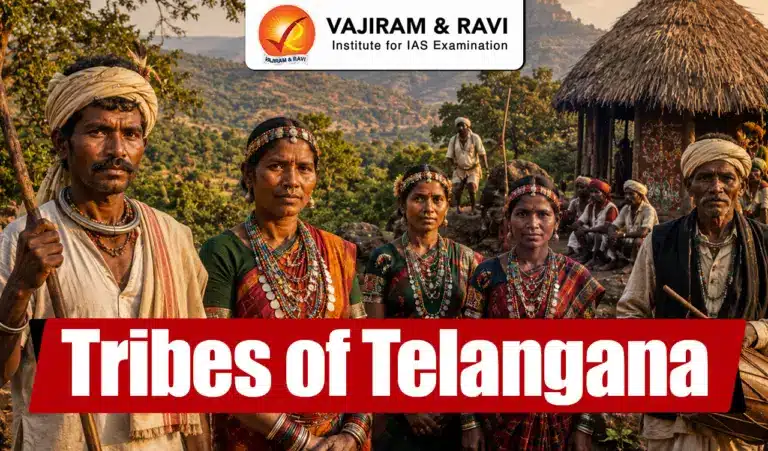
Tribes of Telangana form an important part of the state’s social and cultural heritage. Telangana is home to several Scheduled Tribes (STs), each with its own language, traditions, customs, festivals, and traditional occupations. These tribal communities have preserved their unique identity while contributing significantly to the state’s biodiversity, folk culture, and indigenous knowledge systems.
Most tribal populations are concentrated in the forested districts of Adilabad, Komaram Bheem Asifabad, Bhadradri Kothagudem, Mulugu, Mahabubabad, Warangal, and Nagarkurnool.
List of Major Tribes of Telangana
Telangana has more than 30 recognized Scheduled Tribes, with some communities having a larger population and wider geographical distribution than others. The major tribes are:
| List of Major Tribes of Telangana | ||
|
Tribe |
Key Features |
Major Areas |
|
Gond |
Largest tribal community, known for Gondi language and rich cultural traditions |
Adilabad, Komaram Bheem, Warangal |
|
Koya |
Traditional agriculturists and forest dwellers |
Bhadradri Kothagudem, Mulugu |
|
Lambada (Banjara) |
Famous for colourful attire, embroidery and folk dances |
Across Telangana |
|
Kolam |
Primitive forest-dependent tribe |
Adilabad |
|
Chenchu |
Traditional hunter-gatherers living near forest regions |
Nagarkurnool, Nallamala forests |
|
Yerukula |
Traditionally engaged in basket making and animal rearing |
Warangal, Khammam |
|
Thoti |
Small tribal community with rich folk traditions |
Adilabad |
|
Savara (Sabara) |
Forest-based community |
Khammam region |
|
Sugali |
Traditionally associated with trade and livestock |
Southern Telangana |
|
Konda Reddi |
Hill-dwelling tribal community |
Godavari forest belt |
Important Tribal Communities
The tribes of Telangana are known for their unique cultural traditions, languages, and traditional livelihoods. While each tribe has its own distinct identity, some communities are larger and play a significant role in the state’s tribal heritage.
1. Gond Tribe
- Largest tribal community in Telangana.
- Primarily found in Adilabad and Komaram Bheem Asifabad districts.
- Speaks the Gondi language along with Telugu.
- Traditionally engaged in agriculture and forest-based livelihoods.
- Known for folk dances, music, and rich oral traditions.
2. Lambada (Banjara) Tribe
- One of the most widely distributed tribes across Telangana.
- Famous for colourful traditional attire, mirror-work embroidery, and silver jewellery.
- Historically known as nomadic traders.
- Celebrates vibrant folk dances and cultural festivals.
- Mainly depends on agriculture, livestock rearing, and handicrafts.
3. Koya Tribe
- Predominantly inhabits Bhadradri Kothagudem, Mulugu, and surrounding forest regions.
- Traditionally depends on agriculture, fishing, and forest produce.
- Speaks the Koya language along with Telugu.
- Known for their close relationship with forests and nature.
- Celebrates traditional harvest and community festivals.


Particularly Vulnerable Tribal Groups (PVTGs) in Telangana
Particularly Vulnerable Tribal Groups (PVTGs) are the most vulnerable among the Scheduled Tribes, identified by the Government of India based on factors such as low literacy, pre-agricultural technology, stagnant or declining population, and economic backwardness. Telangana is home to three PVTGs: Chenchu, Kolam, and Thoti, which receive special assistance through targeted welfare and development programmes.
1. Chenchu
- One of the oldest forest-dwelling tribal communities in India.
- Primarily inhabits the Nallamala forest in Nagarkurnool district.
- Traditionally depends on hunting, gathering, honey collection, fishing, and forest produce.
- Possesses extensive knowledge of medicinal plants and forest biodiversity.
- Benefits from special programmes for education, healthcare, nutrition, and sustainable livelihoods.
2. Kolam
- Mainly found in Adilabad and Komaram Bheem Asifabad districts.
- Traditionally practised shifting cultivation and collection of minor forest produce.
- Relies on agriculture, bamboo crafts, and forest resources for livelihood.
- Preserves the Kolami language and unique cultural traditions.
- Receives focused support for housing, education, skill development, and income generation.
3. Thoti
- A small tribal community concentrated in northern Telangana.
- Traditionally worked as village messengers, agricultural labourers, and folk artists.
- Known for their oral traditions, storytelling, folk songs, and indigenous cultural practices.
- Faces challenges related to education, healthcare, and economic opportunities.
- Covered under special tribal welfare programmes aimed at improving socio-economic conditions.
Government Schemes for Tribes of Telangana
The Government of Telangana and the Government of India implement various welfare initiatives to improve the education, healthcare, livelihoods, infrastructure, and overall socio-economic development of Scheduled Tribes. These schemes aim to promote inclusive growth while protecting the rights and cultural identity of tribal communities.
- Tribal Welfare Residential Educational Institutions provide quality education through Ashram Schools, Gurukul Schools, and Residential Schools for tribal students.
- Pre-Matric and Post-Matric Scholarships offer financial assistance to eligible students pursuing school and higher education.
- Support for Minor Forest Produce (MFP) helps tribal families generate sustainable income through the collection and marketing of forest products.
- Agriculture and Livelihood Assistance includes support for farming, horticulture, irrigation, livestock rearing, and other income-generating activities.
- Infrastructure Development Programmes improve roads, drinking water, sanitation, housing, schools, hostels, and community centres in tribal areas.
- Special Development Programmes for PVTGs focus on the Chenchu, Kolam, and Thoti communities through targeted interventions in education, healthcare, housing, nutrition, and livelihoods.
- Pradhan Mantri Janjati Adivasi Nyaya Maha Abhiyan (PM-JANMAN) supports the holistic development of Particularly Vulnerable Tribal Groups (PVTGs) by improving access to basic services and infrastructure.
- Tribal Sub-Plan (TSP) ensures dedicated funding for the socio-economic development of Scheduled Tribes across sectors.
- Grants under Article 275(1) provide financial assistance for the development of tribal areas and welfare projects.
- Dharti Aaba Janjatiya Gram Utkarsh Abhiyan (DA-JGUA) promotes integrated development of tribal villages through improved infrastructure, education, healthcare, and livelihood opportunities.
Constitutional Safeguards for Tribes of Telangana
The Constitution of India provides several safeguards to protect the rights, welfare, and socio-economic development of Scheduled Tribes. These provisions ensure equal opportunities in education, employment, political representation, and the administration of tribal areas while preserving the identity and interests of tribal communities.
- Article 342 empowers the President of India to notify communities as Scheduled Tribes (STs) for each State and Union Territory.
- Article 366(25) defines the term Scheduled Tribes under the Constitution.
- Article 46 directs the State to promote the educational and economic interests of Scheduled Tribes and protect them from social injustice and exploitation.
- Article 15(4) enables the State to make special provisions for the educational advancement of Scheduled Tribes and other socially and educationally backward classes.
- Article 16(4) permits reservation in public employment for backward classes, including Scheduled Tribes, to ensure adequate representation.
- Article 244 read with the Fifth Schedule provides for the administration and protection of Scheduled Areas in Telangana and other Fifth Schedule States.
- Fifth Schedule empowers the Governor to make regulations for the peace and good governance of Scheduled Areas and establishes a Tribes Advisory Council (TAC) to advise on tribal welfare.
- Article 275(1) provides grants-in-aid from the Union Government to States for the welfare and development of Scheduled Tribes and Scheduled Areas.
- Article 330 provides reservation of seats for Scheduled Tribes in the Lok Sabha.
- Article 332 provides reservation of seats for Scheduled Tribes in State Legislative Assemblies.
- Article 338A establishes the National Commission for Scheduled Tribes (NCST) to safeguard the constitutional and legal rights of Scheduled Tribes and monitor their welfare.

 Last updated on Oct, 2026
→ UPSC 2027 Notification will be released on 13 January 2027 at upsconline.nic.in.
→ Check Nobel Prize 2026 Winners List here.
→ Download PIB PRiSM Monthly Magazine 2026 here.
→ Check UPSC Monthly Current Affairs Magazine The Recitals here.
→ Check out the latest UPSC Syllabus here.
→ Download UPSC Model Answers for Mains 2026
→ UPSC Mains Question Paper 2026 is out now for Essay & GS Paper 1, 2, 3 & 4.
→ UPSC Calendar 2027 has been released.
→ Enroll in Vajiram & Ravi’s UPSC Mains Test Series 2027 for structured answer writing practice, expert evaluation, and exam-oriented feedback.
→ Join Vajiram & Ravi’s UPSC Mentorship Program 2027 for personalized guidance, strategy planning, and one-to-one support from experienced mentors.
→ Go through the UPSC Mains Previous Year Papers to enhance your preparation.
→ UPSC has released UPSC Toppers List 2025 with the Civil Services final result on its official website.
→ Also check Best UPSC Coaching in India
Tribes of Telangana FAQs
Q1. How many Scheduled Tribes are there in Telangana?+
Q2. Which is the largest tribe in Telangana?+
Q3. Which are the Particularly Vulnerable Tribal Groups (PVTGs) in Telangana?+
Q4. Which districts have the highest tribal population in Telangana?+
Q5. What are the main occupations of the tribes of Telangana?+
Tags: telangana tribes tribes of telangana








