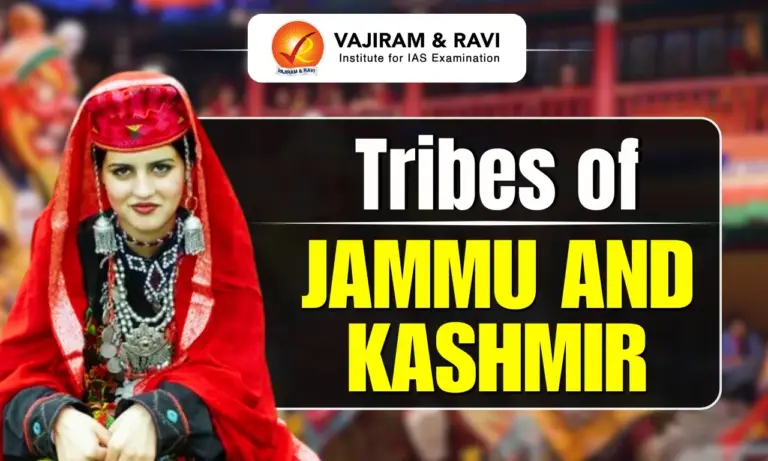
Tribes of Jammu and Kashmir form an important part of the region’s identity, as it is home to a variety of tribal communities living across mountains, valleys, and high-altitude regions, contributing to its rich cultural diversity, traditions, and heritage. Many of these tribes follow a nomadic or semi-nomadic lifestyle, mainly engaged in animal rearing and pastoral activities. Major tribes such as Gujjar, Bakarwal, Gaddi, Sippi, Balti, Changpa, and Brokpa have their own distinct language, customs, and way of life, and are recognized as Scheduled Tribes (STs), playing an important role in the social and economic structure of the region.
Tribes of Jammu and Kashmir
- Jammu and Kashmir are a land inhabited by various Tribal groups, spread across the Hill State, making its culture and tradition richer and colourful.
- Eight communities – Balti, Beda, Bot, Brookpa, Changpa, Garra, Mon, Purigpa and Bakarwals, Gujjars, Gaddis, Sippis were notified as Scheduled Tribes under the Constitution (Scheduled Tribes) Order (Amendment) Act, 1991.
- All the twelve (12) Scheduled Tribes (STs) were first enumerated in the 2001 Census with population 1,105,979, forming 10.9% of the State population and 1.3% of the country’s tribal population.
- Major tribes: Balti, Beda, Bot/Boto, Brokpa/Drokpa/Dard/Shin, Changpa, Garra, Mon, Purigpa, Gujjar, Bakarwal, Gaddi, Sippi.
Bakarwal Tribe
- The Bakarwal Tribe is a nomadic pastoral community mainly found in the Pir Panjal Range of Jammu & Kashmir and nearby Himalayan regions.
- They are widely distributed across Jammu, Kashmir Valley, Himachal Pradesh, Uttarakhand, and Punjab, showing a strong pattern of seasonal movement.
- The term “Bakarwal” comes from “Bakri/Bakar” (goat) and “Wal” (caretaker), meaning “goat herder”, which reflects their traditional identity.
- Their main occupation is animal husbandry, especially rearing sheep and goats for milk, wool, and meat.
- They practice transhumance (seasonal migration), moving to high-altitude pastures in summer and returning to lowlands in winter.
- Their lifestyle is simple, mobile, and isolated, as they live in temporary shelters or tents during migration.
- They usually travel in small family groups along with their livestock, ensuring survival in harsh conditions.
- Their culture, language, and dress show strong similarities with the Gujjar community, indicating close ethnic connections.
- Bakarwal men are often identified by their long beards and traditional attire, reflecting their cultural identity.
Balti Tribe
- The Balti Tribe is a Scheduled Tribe mainly settled in the Suru Valley of Ladakh and Kargil region.
- They are believed to have a mixed origin of Dardic and Tibetan (Mongoloid) ancestry, making their identity culturally unique.
- The majority of Baltis follow Shia Islam, along with the Noorbakshi Sufi order, which plays an important role in their spiritual life.
- They speak the Balti language, which has strong roots in the Tibetan linguistic family.
- Their primary occupation is animal husbandry, along with horticulture, trade, and labor work.
- Their culture reflects a rich blend of Tibetan, Islamic, and Indian influences, visible in daily life and traditions.
- Their traditional houses are flat-roofed, white-painted, and inward sloping, showing strong Tibetan architectural influence.
- They also follow Muta (temporary marriage) and participate in Sufi spiritual practices in Khankahs.
- The Baltis are known for being hospitable, culturally rich, and deeply rooted in tradition, while still preserving elements of pre-Islamic beliefs.
Dogra Tribe
- The Dogra Tribe mainly inhabits the Jammu region and forms a significant cultural group of the area.
- They are believed to be descendants of Aryan settlers who migrated and settled in the southern hills of Kashmir.
- The community includes both Hindu and Muslim Dogras, reflecting religious diversity within the same cultural group.
- Their primary language is Dogri, which has a rich tradition of folk literature, songs, and oral storytelling.
- Dogri folk songs express themes of love, bravery, sacrifice, and family relationships, forming an important part of their culture.
- Marriage customs include practices like Dohry (exchange marriage) and Chadar Pana (widow remarriage), along with clan exogamy.
- Their traditional dress includes kurta-pajama and turban for men and pheran and headgear for women, suited to the climate.
- The Dogras are known for their strong social structure, martial traditions, and rich cultural heritage.
Changpa Tribe
- The Changpa Tribe is a nomadic tribal community living in the Changthang Plateau of Ladakh, one of the harshest regions.
- They survive in extreme climatic conditions, where temperatures can drop to -50°C and altitude ranges between 3600-4500 meters.
- Their main occupation is animal husbandry, especially rearing Pashmina goats, which produce valuable Pashmina wool.
- They also practice barley cultivation, salt collection, and small trade to support their livelihood.
- They live in portable tents made of yak hair, which help them adapt to their mobile lifestyle.
- Their society is divided into regional groups, each with its own grazing land and leadership system.
- Most Changpas follow Tibetan Buddhism (Drukpa sect), while some have adopted Islam.
- They strongly believe in a three-tier cosmic system (heaven, earth, and underworld) connected with colors and spiritual meaning.
- Animals are treated as sacred beings, and special animals are blessed and never harmed, reflecting deep spiritual beliefs.
- Their wealth and social status are measured in terms of livestock ownership, especially sheep, goats, and yaks.
Brokpa Tribe
- The Brokpa Tribe is mainly found in the Dras Valley and Dah-Hanu region of Ladakh.
- They are believed to be descendants of the Dardic (Indo-Aryan) people, giving them a distinct historical identity.
- The Brokpa are known for their unique physical features, preserved traditions, and cultural isolation.
- Their language is Shina, which belongs to the Indo-European language family, and some also speak Balti.
- Their main occupations include agriculture, animal husbandry, and allied activities.
- They are famous for their colorful traditional dress, especially the floral headgear worn by women.
- Their culture includes festivals, ornaments, music, and strong community traditions.
- They follow both Buddhism and Islam, along with local customs and spiritual beliefs.
- The Brokpa tribe is considered one of the most culturally distinct and well-preserved tribal communities in India.
Constitutional Safeguards for the Tribes of Jammu and Kashmir
- Recognition under Scheduled Tribe framework: Tribal communities in Jammu and Kashmir are recognized through the Constitution (Jammu and Kashmir) Scheduled Tribes Order, 1989, which formally identifies them as Scheduled Tribes and enables access to constitutional protections and welfare measures.
- Equality and protective discrimination: Articles 14, 15, and 16 of the Indian Constitution guarantee equality before law while allowing the State to make special provisions for the advancement of Scheduled Tribes, ensuring balanced social justice.
- Directive for welfare and development: Article 46 directs the State to promote the educational and economic interests of Scheduled Tribes and protect them from social injustice and exploitation.
- Political representation: Provisions under Articles 330 and 332 ensure reservation of seats for Scheduled Tribes in legislative bodies, including representation in the Jammu and Kashmir Legislative Assembly after delimitation.
- Reservation in employment and education: Constitutional provisions support affirmative action policies, providing reservation for Scheduled Tribes in government jobs and educational institutions, improving access to opportunities.
- Forest Rights Act, 2006: The extension of the Forest Rights Act (FRA) to Jammu and Kashmir recognizes the rights of forest-dwelling tribal communities over land, forest resources, and traditional habitats, ensuring legal protection of their livelihood base.
- Protection from exploitation: Constitutional safeguards, along with supporting laws, aim to prevent social discrimination, economic exploitation, and land alienation of tribal communities.
- Administrative and welfare provisions: Various government schemes and institutional mechanisms operate under constitutional provisions to support healthcare, education, housing, and livelihood development for Scheduled Tribes in the region.


Key Government Schemes for Tribal Empowerment
- Dharti Aaba Janjatiya Gram Utkarsh Abhiyan – This scheme focuses on holistic development of tribal villages by improving infrastructure, healthcare, education, and livelihood opportunities, covering around 63,000 villages and benefiting over 5 crore tribal people.
- Eklavya Model Residential Schools (EMRS) – Provides quality residential education to tribal students from Class VI to XII, with modern facilities aimed at improving academic performance, skill development, and access to higher education.
- Pradhan Mantri Janjati Adivasi Nyaya Maha Abhiyan (PM-JANMAN) – Targets Particularly Vulnerable Tribal Groups (PVTGs) by improving road connectivity, housing, electrification, healthcare, and basic services in remote tribal regions.
- National Overseas Scholarship for ST Students – Enables meritorious tribal students to pursue higher education abroad, promoting global exposure and academic excellence.
- Support to Tribal Research Institutes (TRIs) – Promotes research, documentation, and preservation of tribal culture, traditions, and languages while supporting policy development.
- Development Action Plan for Scheduled Tribes (DAPST) – Ensures coordinated efforts across ministries for tribal welfare, focusing on filling gaps in education, healthcare, and infrastructure.
- National Fellowship for ST Students – Provides financial assistance for higher education and research through a transparent digital system, encouraging advanced studies among tribal students.
- National Scheduled Tribes Finance and Development Corporation (NSTFDC) – Offers concessional financial support to tribal individuals for self-employment and income-generating activities.
- Tribal Cooperative Marketing Development Federation of India (TRIFED) – Promotes tribal products through marketing platforms, supporting artisans and creating sustainable livelihood opportunities.
- Aadi Mahotsav and Cultural Initiatives – Organizes cultural festivals to showcase tribal heritage, promote handicrafts, and generate economic opportunities through cultural promotion.
- Pradhan Mantri Adi Adarsh Gram Yojana (PMAAGY) – Aims to develop tribal-majority villages by providing basic infrastructure such as roads, drinking water, and housing.
- National Health Mission (NHM) – Tribal Focus – Strengthens healthcare services in tribal areas, addressing major health issues and improving access to medical facilities.

 Last updated on Oct, 2026
→ UPSC 2027 Notification will be released on 13 January 2027 at upsconline.nic.in.
→ Asian Games 2026 are being held in Aichi-Nagoya, Japan, from 19 September to 4 October.
→ Check Nobel Prize 2026 Winners List here.
→ Download PIB PRiSM Monthly Magazine 2026 here.
→ Check UPSC Monthly Current Affairs Magazine The Recitals here.
→ Check out the latest UPSC Syllabus here.
→ Download UPSC Model Answers for Mains 2026
→ UPSC Mains Question Paper 2026 is out now for Essay & GS Paper 1, 2, 3 & 4.
→ UPSC Calendar 2027 has been released.
→ Enroll in Vajiram & Ravi’s UPSC Mains Test Series 2027 for structured answer writing practice, expert evaluation, and exam-oriented feedback.
→ Join Vajiram & Ravi’s UPSC Mentorship Program 2027 for personalized guidance, strategy planning, and one-to-one support from experienced mentors.
→ Go through the UPSC Mains Previous Year Papers to enhance your preparation.
→ UPSC has released UPSC Toppers List 2025 with the Civil Services final result on its official website.
→ Also check Best UPSC Coaching in India
Tribes of Jammu and Kashmir FAQs
Q1. Who are the major Tribes of Jammu and Kashmir?+
Q2. What is the lifestyle of tribes in Jammu and Kashmir?+
Q3. Which tribe is known for pastoral nomadism in Jammu and Kashmir?+
Q4. What is the significance of the Changpa tribe?+
Q5. Where is the Balti tribe mainly located?+
Q6. Which tribe is known for its unique floral headgear?+
Q7. What language is spoken by the Gujjar and Bakarwal tribes?+
Q8. What is transhumance in the context of J&K tribes?+
Q9. What are Scheduled Tribes (STs) in Jammu and Kashmir?+
Q10. Which constitutional provision recognizes tribes in J&K?+
Tags: indian polity indian polity notes jammu and kashmir tribes of jammu and kashmir