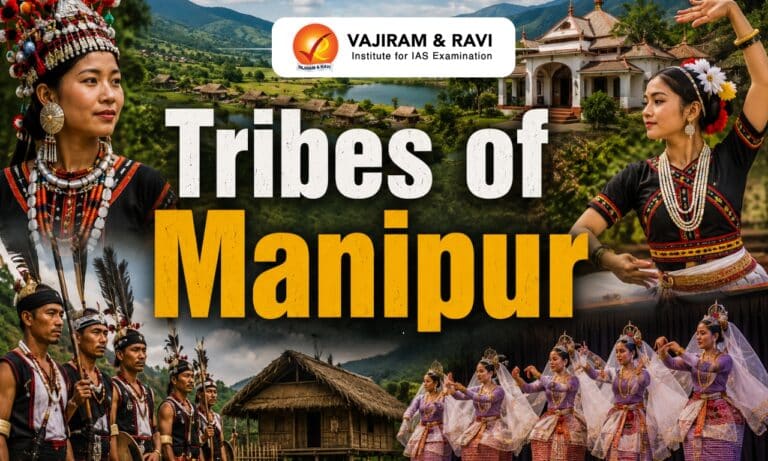
Manipur is a multi-ethnic state in northeastern India with a geographical area of 22,327 square kilometres and a population of 28,55,794 according to the 2011 Census. The state has a distinct valley-hill settlement pattern. Most settlements of Tribes of Manipur are located in the hill districts, where agriculture remains the primary occupation.
Tribes of Manipur
Manipur has 33 recognised Scheduled Tribes, most of which belong to the broader Naga and Kuki tribal groups. These communities have distinct dialects, customs, traditional attire and cultural practices, yet they share common Mongoloid ethnic roots.
Rice is the staple food, while meat, fish and seasonal vegetables form an important part of the traditional diet. Communication within communities is generally through native dialects, whereas Meitei (Manipuri) serves as the common language between different tribes.
Scheduled Tribes of Manipur
Manipur officially recognises 33 Scheduled Tribes, providing constitutional safeguards related to education, employment and political representation while protecting the cultural identity of tribal communities.
| Scheduled Tribes of Manipur | |||
| S. No | Scheduled Tribes | S. No. | Scheduled Tribes |
|
1 |
Aimol |
2 |
Anal |
|
3 |
Angami |
4 |
Chiru |
|
5 |
Chothe |
6 |
Gangte |
|
7 |
Hmar |
8 |
Kabui |
|
9 |
Kacha Naga |
10 |
Koirao |
|
11 |
Koireng |
12 |
Kom |
|
13 |
Lamgang |
14 |
Mizo |
|
15 |
Lushai |
16 |
Maram |
|
17 |
Maring |
18 |
Mao |
|
19 |
Monsang |
20 |
Moyon |
|
21 |
Paite |
22 |
Ralte |
|
23 |
Sema |
24 |
Simte |
|
25 |
Suhte |
26 |
Tangkhul |
|
27 |
Thadou |
28 |
Vaiphei |
|
29 |
Zou |
30 |
Poumei Naga |
|
31 |
Tarao |
32 |
Kharam |
|
33 |
|||
The state also recognises 7 Scheduled Castes namely Loi, Yaithabi, Dhobi, Muchi or Rabidas, Namsudra, Patni and Sutradhar.


Major Tribes of Manipur List
The recognised Scheduled Tribes of Manipur are distributed across different hill districts and preserve distinct cultural identities. The major Tribes of Manipur include:
Mao Tribe
- The Mao community is concentrated mainly in Senapati district and forms one of the major Naga tribes.
- Agriculture is their traditional occupation.
- Chiithuni and Saleni are among their important cultural festivals.
Tangkhul Tribe
- The Tangkhuls primarily inhabit Ukhrul and Kamjong districts.
- They were the first community in Manipur to adopt Christianity.
- They celebrate festivals such as Luira Phanit, Dhareo and Shirui Festival.
Kabui (Rongmei) Tribe
- The Kabui or Rongmei tribe is centred in Tamenglong district, with settlements in several other districts.
- Cultivation, weaving and post harvest celebrations like Chakan Gaan-Ngai remain important cultural features.
Anal Tribe
- The Anal tribe mainly resides in the southern hills of Tengnoupal district.
- Recognised as a Scheduled Tribe in 1951, the community is now generally identified within the Naga tribal group.
Maring Tribe
- The Maring community is concentrated in Chandel district, although smaller settlements exist elsewhere.
- Agriculture remains their principal livelihood.
- Hnungkaap is their major traditional festival celebrated every five years.
Thadou Tribe
- The Thadou tribe is widely distributed across Manipur, with major settlements in Churachandpur and Senapati districts.
- Farming, traditional weaving and the Chavang-kut post harvest festival are central to community life.
Aimol Tribe
- Aimols mainly inhabit parts of Chandel, Senapati and areas around Loktak Lake in Bishnupur district.
- They speak the Aimol language of the Kuki-Chin-Mizo language family and traditionally practise shifting cultivation.
Hmar Tribe
- The Hmar community belongs to the Kuki-Chin-Mizo group and is concentrated in Churachandpur district.
- Agriculture and weaving are major occupations, while village administration traditionally functions under a chief and council.
Gangte Tribe
- The Gangte tribe is found mainly in Churachandpur, Tamenglong and Senapati districts.
- With an estimated global population of around 40,000 (2018) and nearly 99% literacy, it is regarded as one of the more educated tribal communities.
Paite Tribe
- The Paite community is dominant in Churachandpur district.
- Jhum cultivation, oral traditions, folk songs and the Paite language continue to play an important role in preserving their cultural identity.
Poumai Naga Tribe
- The Poumai community is concentrated in Senapati district.
- They speak the Poula language and celebrate Thounii, the traditional New Year festival, while preserving distinctive traditional costumes and ornaments.
Koirao (Thangal) Tribe
- The Koirao, also known as Thangals, mainly live in Senapati district along National Highway 2 (NH 2).
- Their colourful attire, close knit settlements and unique traditions distinguish the community.
Chiru and Chothe Tribes
- Chirus are distributed across Tamenglong, Kangpokpi, Churachandpur and Thoubal.
- Chothes mainly inhabit Chandel and Bishnupur districts
- They are known for traditionally practising cultivation, weaving, livestock rearing and blacksmithing.
Other Recognised Tribes
- Communities such as Kharam, Khoibu, Lamkang, Liangmai, Mate, Monsang, Moyon, Ralte, Simte, Suhte, Tarao, Vaiphei, Zeme and Zou contribute to Manipur’s linguistic and cultural diversity through their distinct dialects, festivals and customary practices.
Tribes of Manipur Ethnic Violence
The recent ethnic conflict reflects long standing geographical, political and socio-economic differences between major communities living in Manipur.
- Immediate Trigger: The immediate catalyst was the April 2023 Manipur High Court direction asking the state government to consider recommending Scheduled Tribe status for the Meitei community, which was strongly opposed by Kuki-Zo tribal organisations.
- Land and Resource Concerns: Tribal communities feared that granting ST status to Meiteis could enable land ownership in constitutionally protected hill areas and increase competition for reservation benefits, government jobs and educational opportunities.
- Forest Evictions and Anti Drug Campaign: Eviction drives in protected forests and action against illegal poppy cultivation led to allegations from Kuki groups that their settlements were being selectively targeted during the government’s anti drug campaign.
- Myanmar Border Factor: Following the 2021 military coup in Myanmar, thousands of Chin refugees entered Manipur through the porous border, adding demographic and security concerns because of their close ethnic links with Kuki-Zo communities.
- Geographical Divide: The Imphal Valley occupies only about 10% of Manipur’s land area but contains most of the population, while the surrounding 90% hill region is inhabited mainly by Scheduled Tribe communities.
- Political Representation: The valley elects 40 of the 60 Members of the Legislative Assembly, whereas the much larger hill districts elect only 20 MLAs, contributing to long standing concerns over political representation and regional development.
- Land Law Difference: Existing laws protect tribal land in the hills by restricting purchase by non tribals, while tribal communities are allowed to acquire land in the valley, creating continuing debates over land ownership and resource access.
- Implementation of Section 43A of UAPA: The Home Department implemented Section 43A of the Unlawful Activities (Prevention) Act 1967, allowing police officers not below the rank of Head Constable or Havildar to conduct arrests, searches and seizures under specified conditions.
- Security and Human Rights Debate: Expanded enforcement powers under the UAPA, continued weapon proliferation, community segregation and public mistrust have highlighted the need for balanced legal safeguards, dialogue, rehabilitation and equitable development for lasting peace.
Also Read: Kuki-Zo Groups Renew Demand for Union Territory Status

 Last updated on Oct, 2026
→ UPSC 2027 Notification will be released on 13 January 2027 at upsconline.nic.in.
→ Check Nobel Prize 2026 Winners List here.
→ Download PIB PRiSM Monthly Magazine 2026 here.
→ Check UPSC Monthly Current Affairs Magazine The Recitals here.
→ Check out the latest UPSC Syllabus here.
→ Download UPSC Model Answers for Mains 2026
→ UPSC Mains Question Paper 2026 is out now for Essay & GS Paper 1, 2, 3 & 4.
→ UPSC Calendar 2027 has been released.
→ Enroll in Vajiram & Ravi’s UPSC Mains Test Series 2027 for structured answer writing practice, expert evaluation, and exam-oriented feedback.
→ Join Vajiram & Ravi’s UPSC Mentorship Program 2027 for personalized guidance, strategy planning, and one-to-one support from experienced mentors.
→ Go through the UPSC Mains Previous Year Papers to enhance your preparation.
→ UPSC has released UPSC Toppers List 2025 with the Civil Services final result on its official website.
→ Also check Best UPSC Coaching in India
Tribes of Manipur FAQs
Q1. How many Scheduled Tribes are there in Manipur?+
Q2. Which are the Major Tribes of Manipur?+
Q3. Which districts have the largest tribal population in Manipur?+
Q4. What are the main occupations of the Tribes of Manipur?+
Q5. What are the main reasons behind the Manipur Ethnic Conflict?+
Tags: tribes tribes of manipur