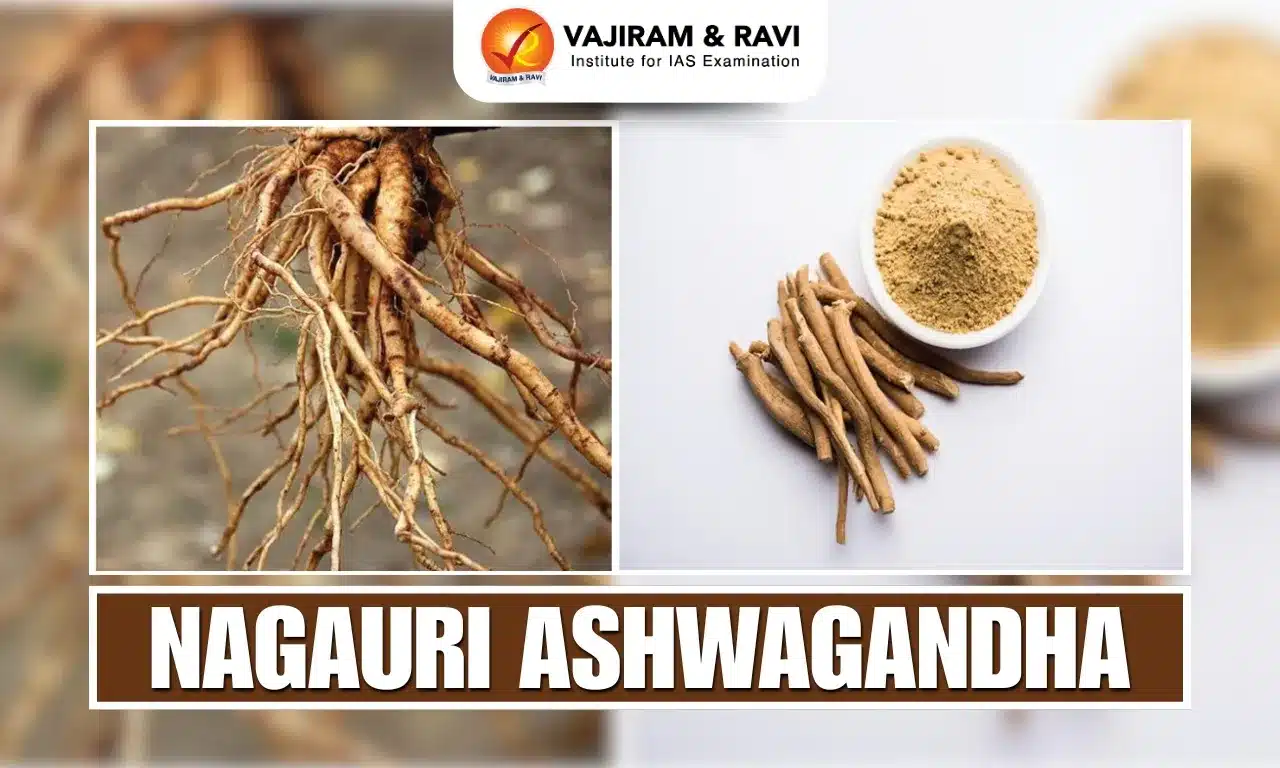
Nagori Ashwagandha Latest News
The Prime Minister recently presented GI-tagged Nagori Ashwagandha as a traditional Indian gift during the G7 Summit in France, symbolizing India’s rich Ayurvedic heritage and traditional knowledge systems.
About Nagori Ashwagandha
- It is a premium variety of Ashwagandha, sourced from the Nagaur region in Rajasthan.
- Nagaur’s dry climate and sandy soil are ideally suited for Ashwagandha cultivation.
- It has longer, thicker roots rich in medicinal compounds, particularly alkaloids.
- Its berries are known for their dark, bright red colour, which is considered a clear indicator of superior quality.
- It has brittle and starchy roots.
- It received the Geographical Indication (GI) tag in January, 2026.


Key Facts about Ashwagandha
- Ashwagandha (Withania somnifera) is an important medicinal plant cultivated in regions of South Asia, Africa, and Central Asia.
- Other names: Indian ginseng or Indian winter cherry
- It is a small perennial shrub growing up to 35–75 cm in height.
- It has been in use as a medicinal plant for thousands of years, especially in traditional Ayurvedic medicine.
- It was first mentioned by the learned Punarvasu Atreya over 4000 years ago.
- Subsequently, the medicinal properties of this plant were mentioned in Ayurvedic treatises such as Charaka Samhita, Sushruta Samhita, Astanga Hridaya, Bhava Prakasha Nighantu, etc.
Ashwagandha Benefits
- It is often called an adaptogen, meaning it helps the body adapt to stressors and restore balance.
- Its other benefits are reducing inflammation, increasing energy, alleviating anxiety, ease pain, and improving sleep.
- Different parts of the ashwagandha plant, such as the root, leaves, and berries, may have different concentrations of bioactive compounds.
Required Climatic Conditions for Ashwagandha
- It grows in dry and subtropical regions.
- Soil: It grows well in sandy loam or light red soil having pH 7.5 to 8.0 with good drainage.
- Climate: It is grown as a late rainy season (kharif) crop.
- Rain: The semi-tropical areas receiving 500 to 750 mm rainfall are suitable for its cultivation as a rainfed crop.
- Temperature: It can tolerate a temperature range of 20 to 38 degree Celsius.
- Major Ashwagandha-Producing States in India: Madhya Pradesh, Rajasthan, Punjab, Haryana, Uttar Pradesh, Gujarat, Maharashtra.
News: ICAR

 Last updated on Oct, 2026
→ UPSC 2027 Notification will be released on 13 January 2027 at upsconline.nic.in.
→ Check Nobel Prize 2026 Winners List here.
→ Download PIB PRiSM Monthly Magazine 2026 here.
→ Check UPSC Monthly Current Affairs Magazine The Recitals here.
→ Check out the latest UPSC Syllabus here.
→ Download UPSC Model Answers for Mains 2026
→ UPSC Mains Question Paper 2026 is out now for Essay & GS Paper 1, 2, 3 & 4.
→ UPSC Calendar 2027 has been released.
→ Enroll in Vajiram & Ravi’s UPSC Mains Test Series 2027 for structured answer writing practice, expert evaluation, and exam-oriented feedback.
→ Join Vajiram & Ravi’s UPSC Mentorship Program 2027 for personalized guidance, strategy planning, and one-to-one support from experienced mentors.
→ Go through the UPSC Mains Previous Year Papers to enhance your preparation.
→ UPSC has released UPSC Toppers List 2025 with the Civil Services final result on its official website.
→ Also check Best UPSC Coaching in India
Nagori Ashwagandha FAQs
Q1. What is Nagori Ashwagandha?+
Q2. What is the special characteristic of the roots of Nagori Ashwagandha?+
Q3. When did Nagori Ashwagandha receive the Geographical Indication (GI) tag?+
Q4. What is the scientific name of Ashwagandha?+
Q5. What are some health benefits of Ashwagandha?+
Tags: Nagori Ashwagandha prelims pointers upsc current affairs upsc prelims current affairs