Nalabana Wildlife Sanctuary
Altogether 24 fishermen were arrested by wildlife officials on Friday for illegally fishing inside Nalabana wildlife sanctuary.
About Nalabana Wildlife Sanctuary
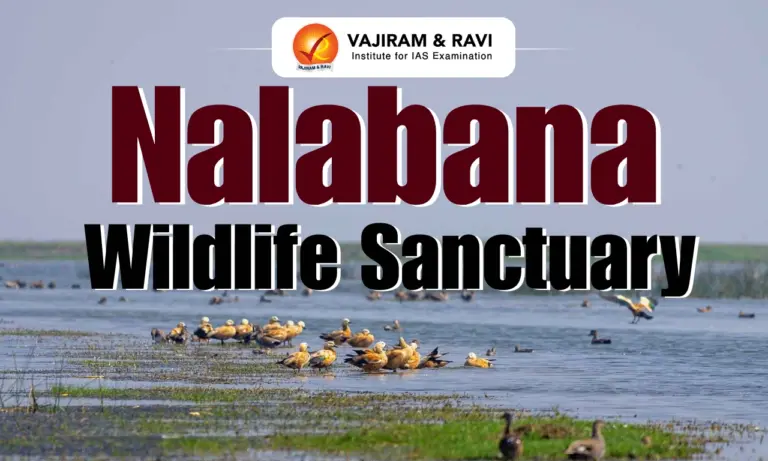
- Nalabana Wildlife Sanctuary, or the Nalbana Bird Sanctuary, is the core area of the Ramsar-designated wetlands of Chilika Lake, located in the state of Odisha.
- In the center of the lake, it is a major island with an area of 15.53 sq.km.
- The Island of Nalabana was declared a bird sanctuary in the year 1987 after observing the sheer number of diverse bird species found there.
- It supports a congregation of about 60% of the total migratory birds visiting Chilika Lagoon each year.
- Rare or threatened species such as the Asian dowitcher (Limnodromus semipalmatus), the critically endangered spoon-billed sandpiper (Calidris pygmaea), and Pallas’ fish eagle (Haliaeetus leucoryphus) are often recorded as part of this crowd.
- During monsoons, the entire sanctuary is submerged under water with only a few treetops and watchtower above water level.


Key Facts about Chilika Lake
- It is a brackish water lake and a shallow lagoon with estuarine character located in the state of Odisha.
- It is Asia’s largest brackish water lake.
- It is the second-largest brackish water lagoon in the world, after the New Caledonian barrier reef in New Caledonia.
- It is connected to the Bay of Bengal by a 32 km long and 1.5 km wide channel that mostly runs parallel to the Bay, separated by a narrow spit.
- The Daya and Bhargavi rivers feed the lake except during the dry months from December to June, when saline ocean water enters through a small passage.
- In 1981, Chilika Lake was designated the first Indian wetland of international importance under the Ramsar Convention.
- Chilika supports some of the largest congregation of migratory birds in the country, particularly during the winter.
- Flocks of migratory waterfowl arrive from as far as the Caspian Sea, Lake Baikal, the Aral Sea, remote parts of Russia, Kirghiz steppes of Mongolia, Central and Southeast Asia, Ladakh, and the Himalayas.
News: TOI

 Last updated on Oct, 2026
→ UPSC 2027 Notification will be released on 13 January 2027 at upsconline.nic.in.
→ Check Nobel Prize 2026 Winners List here.
→ Download PIB PRiSM Monthly Magazine 2026 here.
→ Check UPSC Monthly Current Affairs Magazine The Recitals here.
→ Check out the latest UPSC Syllabus here.
→ Download UPSC Model Answers for Mains 2026
→ UPSC Mains Question Paper 2026 is out now for Essay & GS Paper 1, 2, 3 & 4.
→ UPSC Calendar 2027 has been released.
→ Enroll in Vajiram & Ravi’s UPSC Mains Test Series 2027 for structured answer writing practice, expert evaluation, and exam-oriented feedback.
→ Join Vajiram & Ravi’s UPSC Mentorship Program 2027 for personalized guidance, strategy planning, and one-to-one support from experienced mentors.
→ Go through the UPSC Mains Previous Year Papers to enhance your preparation.
→ UPSC has released UPSC Toppers List 2025 with the Civil Services final result on its official website.
→ Also check Best UPSC Coaching in India
Nalabana Wildlife Sanctuary FAQs
Q1. What is Nalabana Wildlife Sanctuary?+
Q2. Which wetland is Nalabana Wildlife Sanctuary a part of?+
Q3. What happens to Nalabana Wildlife Sanctuary during the monsoon season?+
Q4. Why is Nalabana Wildlife Sanctuary important for bird conservation?+
Tags: Nalabana Wildlife Sanctuary