About Nalanda University:
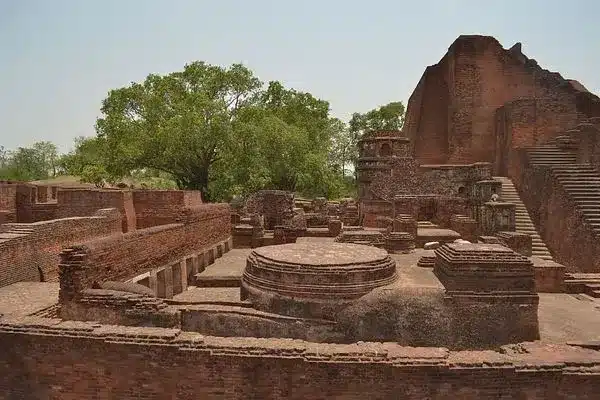
- Nalanda stands out as the most ancient university on the Indian Subcontinent.
- It was founded by Kumar gupta of the Gupta dynasty in Bihar in the early 5th century, and it flourished for 600 years until the 12th century.
- During the era of Harshavardhan and the Pala monarchs, it rose to popularity.
- It was a center of learning, culture, and intellectual exchange that had a profound impact on the development of Indian civilization and beyond.
- Nalanda was a monastic establishment in the sense that it was primarily a place where monks and nuns lived and studied. It used to teach all the major philosophies of Buddhism.
- It had students from far-flung regions such as China, Korea, Japan, Tibet, Mongolia, Sri Lanka, and Southeast Asia.
- The students at Nalanda were expected to follow a strict code of conduct and were required to participate in daily meditation and study sessions.
- Subjects such as medicine, the ancient Indian medical system Ayurveda, religion, Buddhism, mathematics, grammar, astronomy, and Indian philosophy were taught there.
- It continued to be a centre of intellectual activity up until it was destroyed in the 12th century AD, in 1193, by Turkish ruler Qutbuddin Aibak’s general Bakhtiyar Khilji.
- After six centuries, the university was rediscovered in 1812by Scottish surveyor Francis Buchanan-Hamilton and later identified as the ancient university by Sir Alexander Cunningham in 1861.
- The Chinese monk Xuan Zang has offered invaluable insights into the academic and architectural grandeur of ancient Nalanda.
- It is also a UNESCO World Heritage Site.
Q1: What is the Gupta Dynasty?
Gupta dynasty, rulers of the Magadha (now Bihar) state in northeastern India. They maintained an empire over northern and parts of central and western India from the early 4th to the late 6th century CE. Among the products traditionally thought to be from the Gupta era were the decimal system of notation, the great Sanskrit epics, and Hindu art, along with contributions to the sciences of astronomy, mathematics, and metallurgy.
Source: PM Narendra Modi to inaugurate Nalanda University in Bihar today | Things to know about the campus


 Last updated on Oct, 2026
→ UPSC 2027 Notification will be released on 13 January 2027 at upsconline.nic.in.
→ Check Nobel Prize 2026 Winners List here.
→ Download PIB PRiSM Monthly Magazine 2026 here.
→ Check UPSC Monthly Current Affairs Magazine The Recitals here.
→ Check out the latest UPSC Syllabus here.
→ Download UPSC Model Answers for Mains 2026
→ UPSC Mains Question Paper 2026 is out now for Essay & GS Paper 1, 2, 3 & 4.
→ UPSC Calendar 2027 has been released.
→ Enroll in Vajiram & Ravi’s UPSC Mains Test Series 2027 for structured answer writing practice, expert evaluation, and exam-oriented feedback.
→ Join Vajiram & Ravi’s UPSC Mentorship Program 2027 for personalized guidance, strategy planning, and one-to-one support from experienced mentors.
→ Go through the UPSC Mains Previous Year Papers to enhance your preparation.
→ UPSC has released UPSC Toppers List 2025 with the Civil Services final result on its official website.
→ Also check Best UPSC Coaching in India