


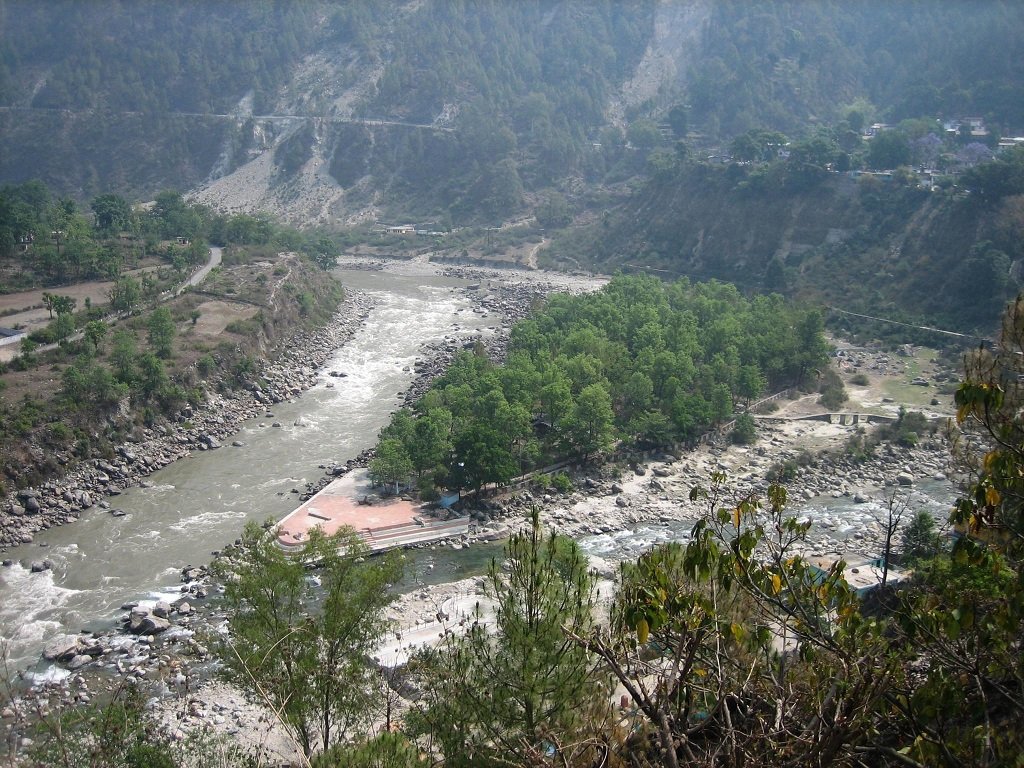
About Nandakini River
- Nandakini is one of the five main tributaries of the Ganges River.
- Origin: Originating in the glaciers below Nanda Ghunti on the Nanda Devi Sanctuary, the river joins the Alaknanda at Nandprayag (870m), which is one of the panch prayags or holy confluences on the Alaknanda.
- Course of Nandakini River
- It flows through the Chamoli district of Uttarakhand primarily in the Garhwal region, covering a distance of approximately 105 kilometers before merging with the Alaknanda River at Nandprayag.
- At this point, the combined waters of the Nandakini and Alaknanda form the Ganges River.
- It is surrounded by the majestic Himalayan peaks, including Nanda Devi, Trisul, and Kamet.
- Cultural Significance of Nandakini River
- The river holds great significance in Hindu mythology and is considered sacred. It is believed to be the abode of Lord Vishnu.
- The region surrounding the river is dotted with ancient temples and shrines.
- The most famous temple along the Nandakini River is the Nandprayag Temple, dedicated to Lord Vishnu.
- The temple is believed to have been built by Adi Shankaracharya, a renowned philosopher and saint.
- Tributaries: Several smaller streams and rivers join the Nandakini as it makes its way through the mountainous terrain. One of the notable tributaries is the Pindar River.
- The banks of the Nandakini River are rich with wildlife and biodiversity. The region is home to several protected areas, including the Nanda Devi National Park and the Valley of Flowers National Park.
- The Nanda Devi National Park, a UNESCO World Heritage Site, is home to a wide range of flora and fauna. The park is known for its diverse ecosystem, which includes alpine meadows, high-altitude forests, and snow-capped peaks.
- The Valley of Flowers National Park, on the other hand, is famous for its vibrant alpine flowers that bloom during the monsoon season. It is also home to several rare and endangered plant species.
Q1) Which are the major tributaries of Ganges river?
Tributaries of Ganga include Ramganga, Gomti, Ghaghara, Gandak, Kosi and Mahananda from the left bank and Yamuna, Tamsa, Son and Punpun from the right bank.
Source: Uttarakhand’s Nandakini River Swells After Heavy Rain, Water Enters Houses In Chamoli


 Last updated on Oct, 2026
→ UPSC 2027 Notification will be released on 13 January 2027 at upsconline.nic.in.
→ Check Nobel Prize 2026 Winners List here.
→ Download PIB PRiSM Monthly Magazine 2026 here.
→ Check UPSC Monthly Current Affairs Magazine The Recitals here.
→ Check out the latest UPSC Syllabus here.
→ Download UPSC Model Answers for Mains 2026
→ UPSC Mains Question Paper 2026 is out now for Essay & GS Paper 1, 2, 3 & 4.
→ UPSC Calendar 2027 has been released.
→ Enroll in Vajiram & Ravi’s UPSC Mains Test Series 2027 for structured answer writing practice, expert evaluation, and exam-oriented feedback.
→ Join Vajiram & Ravi’s UPSC Mentorship Program 2027 for personalized guidance, strategy planning, and one-to-one support from experienced mentors.
→ Go through the UPSC Mains Previous Year Papers to enhance your preparation.
→ UPSC has released UPSC Toppers List 2025 with the Civil Services final result on its official website.
→ Also check Best UPSC Coaching in India








