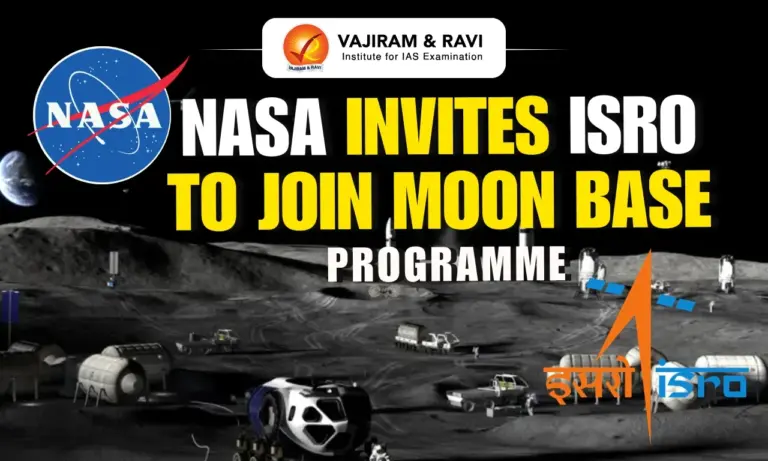
Why in the News? : NASA has invited ISRO to join its Moon Base programme, strengthening India-U.S. cooperation in lunar exploration and paving the way for deeper collaboration in human spaceflight.
The invitation was extended during the 9th India-U.S. Civil Space Joint Working Group (CSJWG) meeting held at ISRO headquarters in Bengaluru on August 5-6, 2026.
About 9th India-U.S. Civil Space Joint Working Group Meeting
The India-U.S. Civil Space Joint Working Group (CSJWG) is a bilateral forum for discussing and advancing cooperation in civil space activities.
- The 9th meeting was held at ISRO headquarters in Bengaluru on August 5-6, 2026.
- Senior officials from both countries reviewed ongoing space cooperation and discussed new areas for collaboration.
- The meeting expanded the focus beyond existing joint missions to lunar exploration, human-spaceflight technologies, scientific data sharing and commercial space activities.
Key Outcomes
- NASA invited ISRO to join its planned Moon Base programme.
- Both sides agreed to advance discussions on open scientific data sharing under the Artemis Accords.
- India and the U.S. discussed cooperation in human-spaceflight technologies and future space science missions.
- Both sides agreed to build on their cooperation after the successful NISAR mission.
- India and the U.S. reaffirmed their commitment to the long-term sustainability of outer space activities.
- The two sides reviewed multilateral efforts under the UN Committee on the Peaceful Uses of Outer Space (COPUOS).
- The meeting also advanced civil and commercial space cooperation under the U.S.-India TRUST Initiative.
About NASA’s Moon Base Programme
NASA’s Moon Base programme aims to establish a long-term human presence on the Moon, with the planned outpost located near the lunar South Pole.
- The programme will use a series of crewed and uncrewed missions to gradually build the infrastructure needed for astronauts to live, work and conduct research on the Moon.
- The lunar South Pole is preferred because permanently shadowed craters there are believed to contain water ice, which can potentially provide drinking water, oxygen and ingredients for rocket fuel.
- Using these local lunar resources could reduce the need to transport supplies from Earth and make longer stays on the Moon more practical.
- The experience gained from living and working on the Moon is also expected to help NASA prepare for future human missions to Mars.


Why NASA Invited ISRO to Join Moon Base Programme
NASA has invited ISRO because India has already demonstrated its ability to land and operate a spacecraft in the lunar South Pole region, where the Moon Base is planned.
- Chandrayaan-1: India’s first lunar mission in 2008 provided important evidence of water molecules on the lunar surface, increasing scientific interest in lunar water resources.
- Chandrayaan-3: Building on this experience, India successfully soft-landed on the Moon in 2023 and demonstrated its ability to operate in the challenging southern polar region.
- Vikram and Pragyan: The lander and rover carried out surface operations and scientific experiments, giving ISRO valuable experience in lunar landing, mobility and surface exploration.
ISRO’s experience in lunar landing, surface exploration and low-cost space missions can contribute to NASA’s plans for sustained lunar operations.
Significance for India
For India, the invitation provides an opportunity to move from successful lunar missions towards participation in sustained lunar exploration.
- First, it can help deepen India’s technological capabilities in areas such as lunar robotics, surface operations, communications and navigation.
- Second, cooperation in human-spaceflight technologies can complement India’s Gaganyaan programme, particularly as India develops experience in sending humans beyond Earth orbit.
- Third, participation can give Indian scientists and space companies opportunities to contribute to future lunar infrastructure and scientific missions.
- Most importantly, it places India closer to the centre of the emerging international effort to establish a long-term human presence on the Moon.
About India-U.S. Space Cooperation
The NASA invitation builds on a growing India-U.S. space partnership that has gradually expanded from scientific cooperation and Earth observation to lunar exploration, human spaceflight and commercial space activities.
- Artemis Accords
- India signed the Artemis Accords on June 21, 2023, becoming the 27th signatory.
- The Accords provide principles for peaceful, transparent, sustainable and cooperative exploration of the Moon, Mars and other celestial bodies.
- India’s participation provides a framework for deeper cooperation with the U.S. on future lunar exploration.
- NISAR Mission
- NISAR (NASA-ISRO Synthetic Aperture Radar) is a joint Earth-observation mission developed by NASA and ISRO.
- It uses advanced radar technology to monitor changes in land, ice, forests and other Earth systems.
- Its successful cooperation has strengthened the technological relationship between the two space agencies.
- Human Spaceflight
- India and the U.S. are exploring cooperation in human-spaceflight technologies.
- This is relevant to India’s Gaganyaan programme and its longer-term ambitions in human space exploration.
- Scientific Data Sharing
- At the 9th CSJWG meeting, both sides agreed to advance discussions on open scientific data sharing under the Artemis Accords. This can improve scientific collaboration and access to data from future lunar and space missions.
- TRUST Initiative
- The U.S.-India Transforming the Relationship Utilizing Strategic Technology (TRUST) Initiative provides a broader framework for cooperation in critical and emerging technologies.
- Under this initiative, India and the U.S. are expanding cooperation in civil and commercial space activities.
The partnership is now moving from individual joint missions towards lunar exploration, human-spaceflight technologies and commercial space cooperation.

 Last updated on Oct, 2026
→ UPSC 2027 Notification will be released on 13 January 2027 at upsconline.nic.in.
→ Check Nobel Prize 2026 Winners List here.
→ Download PIB PRiSM Monthly Magazine 2026 here.
→ Check UPSC Monthly Current Affairs Magazine The Recitals here.
→ Check out the latest UPSC Syllabus here.
→ Download UPSC Model Answers for Mains 2026
→ UPSC Mains Question Paper 2026 is out now for Essay & GS Paper 1, 2, 3 & 4.
→ UPSC Calendar 2027 has been released.
→ Enroll in Vajiram & Ravi’s UPSC Mains Test Series 2027 for structured answer writing practice, expert evaluation, and exam-oriented feedback.
→ Join Vajiram & Ravi’s UPSC Mentorship Program 2027 for personalized guidance, strategy planning, and one-to-one support from experienced mentors.
→ Go through the UPSC Mains Previous Year Papers to enhance your preparation.
→ UPSC has released UPSC Toppers List 2025 with the Civil Services final result on its official website.
→ Also check Best UPSC Coaching in India
NASA Invites ISRO to Join Moon Base Programme FAQs
Q1. What is NASA’s Moon Base programme?+
Q2. Why has NASA invited ISRO to join the Moon Base programme?+
Q3. Why is the lunar South Pole important for the Moon Base programme?+
Q4. What are the Artemis Accords?+
Q5. When did India join the Artemis Accords?+
Q6. What is NISAR?+
Q7. What is the TRUST Initiative in the context of space cooperation?+
Q8. What is the significance of NASA inviting ISRO to join the Moon Base programme?+
Tags: nasa invites isro to join moon base programme