What’s in today’s article:
- Coronal holes – About, significance
Why in news?
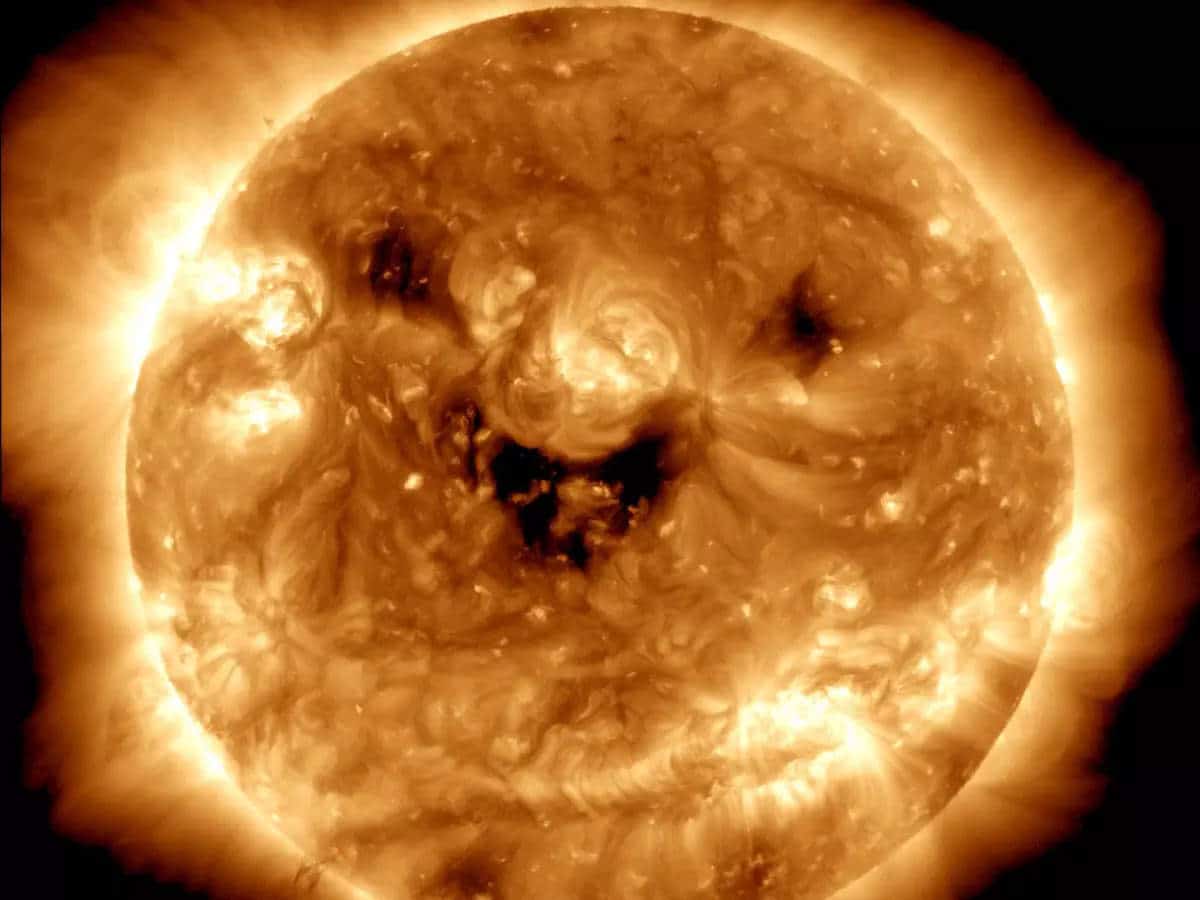
- Recently, the Twitter handle of NASA shared an image of the sun seemingly ‘smiling’.
- Captured by the NASA Solar Dynamics Observatory, the image has dark patches on the sun’s surface resembling eyes and a smile.
- NASA explained that the patches are called coronal holes, which can be seen in ultraviolet light but are typically invisible to our eyes.

Coronal holes
- These are regions on the sun’s surface from where fast solar wind gushes out into space.
- Because they contain little solar material, they have lower temperatures and thus appear much darker than their surroundings.
- Here, the magnetic field is open to interplanetary space, sending solar material out in a high-speed stream of solar wind. Coronal holes can last between a few weeks to months.
- The holes are not a unique phenomenon, appearing throughout the sun’s approximately 11-year solar cycle.
- They can last much longer during solar minimum – a period of time when activity on the Sun is substantially diminished, according to NASA.
Significance
- As per NASA, these coronal holes are important to understanding the space environment around the earth through which our technology and astronauts travel.
- NASA had said this in 2016 when coronal holes covering six-eight per cent of the total solar surface were spotted.
- While it is unclear what causes coronal holes, they correlate to areas on the sun where magnetic fields soar up and away, without looping back down to the surface as they do elsewhere.
- Scientists study these fast solar wind streams because they sometimes interact with earth’s magnetic field, creating what’s called a geomagnetic storm.
- These coronal holes can also cause a solar storm on Earth as they release a complex stream of solar winds.


What happens during a geomagnetic storm?
- According to the National Oceanic and Atmospheric Administration, geomagnetic storms relate to earth’s magnetosphere – the space around a planet that is influenced by its magnetic field.
- When a high-speed solar stream arrives at the earth, in certain circumstances it can allow energetic solar wind particles to hit the atmosphere over the poles.
- Such geomagnetic storms cause a major disturbance of the magnetosphere as there is a very efficient exchange of energy from the solar wind into the space environment surrounding earth.
- In cases of a strong solar wind reaching the earth, the resulting geomagnetic storm can cause changes in the ionosphere, part of the earth’s upper atmosphere.
- Radio and GPS signals travel through this layer of the atmosphere, and so communications can get disrupted.

 Last updated on Oct, 2026
→ UPSC 2027 Notification will be released on 13 January 2027 at upsconline.nic.in.
→ Asian Games 2026 are being held in Aichi-Nagoya, Japan, from 19 September to 4 October.
→ Check Nobel Prize 2026 Winners List here.
→ Download PIB PRiSM Monthly Magazine 2026 here.
→ Check UPSC Monthly Current Affairs Magazine The Recitals here.
→ Check out the latest UPSC Syllabus here.
→ Download UPSC Model Answers for Mains 2026
→ UPSC Mains Question Paper 2026 is out now for Essay & GS Paper 1, 2, 3 & 4.
→ UPSC Calendar 2027 has been released.
→ Enroll in Vajiram & Ravi’s UPSC Mains Test Series 2027 for structured answer writing practice, expert evaluation, and exam-oriented feedback.
→ Join Vajiram & Ravi’s UPSC Mentorship Program 2027 for personalized guidance, strategy planning, and one-to-one support from experienced mentors.
→ Go through the UPSC Mains Previous Year Papers to enhance your preparation.
→ UPSC has released UPSC Toppers List 2025 with the Civil Services final result on its official website.
→ Also check Best UPSC Coaching in India