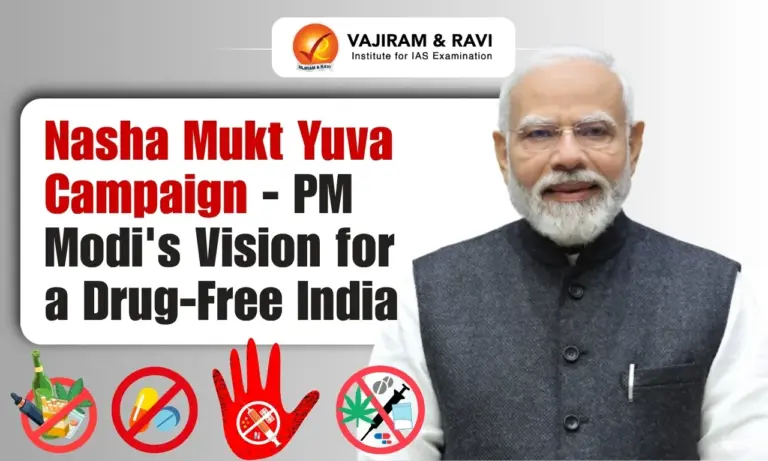
Nasha Mukt Yuva Campaign Latest News
- Prime Minister Narendra Modi has launched the nationwide “Nasha Mukt Yuva for Viksit Bharat Sankalp Abhiyan” campaign, calling for a drug-free youth population essential for building a developed India by 2047.
The Drug Menace in India
- Drug abuse has emerged as one of India’s most serious social and public health challenges, affecting individuals, families, and national security.
- The problem is particularly acute among the youth, who are the most vulnerable to substance abuse and also the demographic most critical to India’s future.
- Scale of the Problem
- India has a large youth population, making it a major target for drug traffickers.
- Commonly abused substances include cannabis, opioids, heroin, and increasingly, synthetic drugs.
- Border states are particularly vulnerable due to proximity to drug production regions.
- The “Golden Crescent” (Afghanistan, Pakistan, Iran) and “Golden Triangle” (Myanmar, Laos, Thailand) are major sources of drugs entering India.
- Impact of Drug Abuse
- Individual level: Physical and mental health deterioration, loss of productivity, and diminished career prospects.
- Family level: Emotional distress, financial burden, and often family breakdown.
- Society level: Rising crime, loss of human capital, and weakening of social fabric.
- National security: Drug trafficking is often linked to terror financing and cross-border conspiracies to weaken the country.


Steps Taken by the Government
- Legal and Institutional Framework
- Narcotic Drugs and Psychotropic Substances (NDPS) Act, 1985: The principal law governing drug control, prohibiting production, sale, and consumption of narcotics.
- Narcotics Control Bureau (NCB): The apex agency for coordinating anti-drug efforts and enforcement.
- Prevention of Illicit Trafficking in NDPS Act, 1988: Provides for preventive detention of drug traffickers.
- Exclusive Courts for Narcotic-related Cases: With about 3.96 lakh cases under the NDPS Act pending across the country, the Ministry of Home Affairs has asked all states and Union Territories to set up exclusive courts for narcotics-related cases.
- Key Programmes and Campaigns
- Nasha Mukt Bharat Abhiyaan (NMBA): Launched in 2020, focusing on awareness generation, community outreach, and rehabilitation in vulnerable districts.
- National Action Plan for Drug Demand Reduction (NAPDDR): Aimed at reducing both demand and supply through education, treatment, and rehabilitation.
- De-addiction and rehabilitation centres: Set up across the country to help those struggling with addiction recover.
- Awareness campaigns: In schools, colleges, and communities to educate youth about the dangers of drugs.
- Enforcement Measures
- Increased seizures of drugs worth thousands of crores of rupees.
- Significant rise in arrests of traffickers and dealers.
- Strengthened border surveillance and coordination among agencies.
- Use of technology and intelligence to track drug networks.
News Summary
- Prime Minister Narendra Modi launched the “Nasha Mukt Yuva for Viksit Bharat Sankalp Abhiyan” (Drug-Free Youth for Developed India Pledge Campaign), laying out a national vision for building a drug-free youth population as the foundation of “Viksit Bharat” (developed India).
- Scale of the Launch
- The programme was conducted at over 28,000 locations across the country.
- It saw participation from over one crore youth, along with several Chief Ministers and Governors.
- It was supported by more than 125 spiritual and public organisations, educational institutions, and industrial associations.
- Participating youth took a pledge to make India drug-free before the PM’s address.
Key Highlights of the PM’s Speech
- Youth as Foundation of Viksit Bharat
- PM Modi emphasised that as India aims to become a developed country by 2047, it is essential for the youth to remain physically and mentally fit and stay away from drug abuse.
- He noted that today’s youth would eventually lead India to developed nation status and enjoy the fruits of that achievement.
- Cost of Addiction
- The PM stated that when a young person falls into drug addiction:
- It is not only the individual who loses.
- A dream dies before it can be fulfilled.
- An entire family suffers and often falls apart.
- The strength of the country is weakened.
- He said, “Drugs give a temporary high, but they cause a long-term low in your career and family life.”
- The PM stated that when a young person falls into drug addiction:
- National Security Dimension
- PM Modi warned that hostile countries conspire to lure Indian youth into drug addiction as part of their malicious agenda, profiting from drug trafficking while weakening the country.
- He described this as part of a terror conspiracy, since enemy countries know that “youth are the future of our country.”
- Second Chances for Those Recovering
- The PM urged people not to hide cases of addiction and to seek professional help. He appealed to parents to:
- Maintain open communication with their children to detect early signs of addiction.
- Not hide addiction under the guise of social prestige.
- Enlist the help of experts and medical assistance.
- He described those who overcome addiction as “real warriors” whose courage is their true identity, urging society to respect them, embrace them, and give them a second chance.
- The PM urged people not to hide cases of addiction and to seek professional help. He appealed to parents to:
- 100-Week Roadmap
- PM Modi outlined that the pledge would continue over the next 100 weeks. Every Sunday, activities related to art, culture, sports, meditation, spirituality, and service would be organised to spread the message of a drug-free life.
- He said, “The coming 100 Sundays will absolutely become 100 strong steps in the direction of a completely drug-free India.”
- Government’s Commitment
- The PM noted that the government has been taking stringent action against drug traffickers and dealers:
- Arrests have increased significantly compared to previous years.
- Drugs worth thousands of crores of rupees have been seized.
- This reflects how seriously the government is tackling the issue.
Significance of the Campaign
- Youth-centric approach: Recognises the youth as both the most vulnerable group and the key to India’s future.
- Community participation: Involves spiritual organisations, educational institutions, and industry for a whole-of-society effort.
- Sustained engagement: The 100-week roadmap ensures continuous action rather than a one-time event.
- Rehabilitation focus: Emphasises treatment and second chances alongside prevention and enforcement.
- National security link: Connects the fight against drugs to protecting the country from hostile external conspiracies.

 Last updated on Oct, 2026
→ UPSC 2027 Notification will be released on 13 January 2027 at upsconline.nic.in.
→ Asian Games 2026 are being held in Aichi-Nagoya, Japan, from 19 September to 4 October.
→ Check Nobel Prize 2026 Winners List here.
→ Download PIB PRiSM Monthly Magazine 2026 here.
→ Check UPSC Monthly Current Affairs Magazine The Recitals here.
→ Check out the latest UPSC Syllabus here.
→ Download UPSC Model Answers for Mains 2026
→ UPSC Mains Question Paper 2026 is out now for Essay & GS Paper 1, 2, 3 & 4.
→ UPSC Calendar 2027 has been released.
→ Enroll in Vajiram & Ravi’s UPSC Mains Test Series 2027 for structured answer writing practice, expert evaluation, and exam-oriented feedback.
→ Join Vajiram & Ravi’s UPSC Mentorship Program 2027 for personalized guidance, strategy planning, and one-to-one support from experienced mentors.
→ Go through the UPSC Mains Previous Year Papers to enhance your preparation.
→ UPSC has released UPSC Toppers List 2025 with the Civil Services final result on its official website.
→ Also check Best UPSC Coaching in India
Nasha Mukt Yuva Campaign FAQs
Q1. What is the Nasha Mukt Yuva for Viksit Bharat Sankalp Abhiyan?+
Q2. How many people participated in the campaign launch?+
Q3. What is the duration of the campaign roadmap?+
Q4. Which law is the principal legislation against drugs in India?+
Q5. How did PM Modi describe those who overcome addiction?+
Tags: mains articles Nasha Mukt Yuva Campaign upsc current affairs upsc mains current affairs