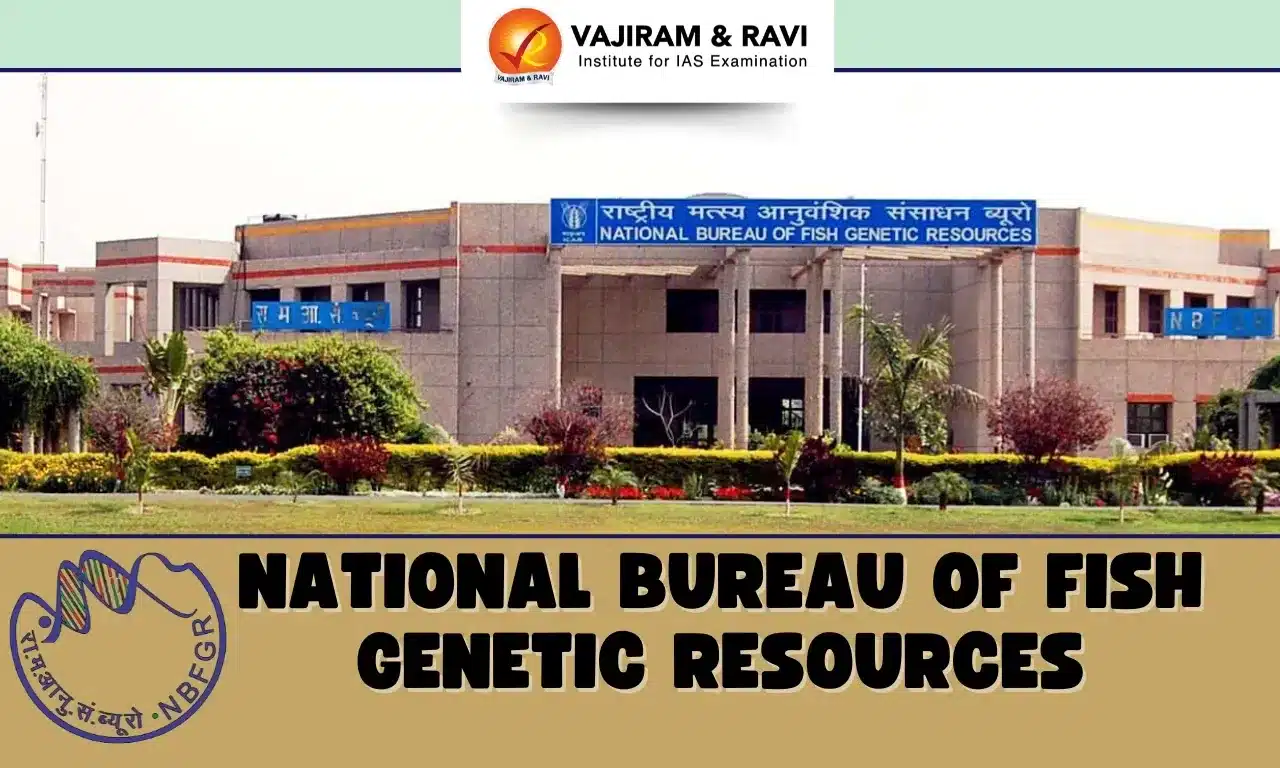
About National Bureau of Fish Genetic Resources (NBFGR):
- It was established in December 1983 in Allahabad under the aegis of Indian Council of Agricultural Research (ICAR) to undertake research related to the conservation of fish germplasm resources of the country.
- The Bureau’s permanent infrastructure was developed at Lucknow, Uttar Pradesh in 1999.
- The Institute’s vision is assessment and conservation of fish genetic resources for intellectual property protection, sustainable utilization and posterity.
- They work to identify, document, and conserve the genetic diversity of fish species, which is important for maintaining healthy and sustainable fish populations.
- The Bureau has developed modern facilities, multidimensional strategies and technological capabilities to achieve its mandate related to database development, genotyping, registration of aquatic germplasm, gene banking and evaluation of endangered and exotic fish species.
What is Aquaculture?
- It is the propagation and husbandry of aquatic plants, animals, and other organisms for commercial, recreational, and scientific purposes.
- Aquaculture has been in existence since at least 500 BC. However, only since the mid-20th century has it assumed commercial importance.
- There are two main types of aquacultures—marine and freshwater.
- Aquaculture can happen all over the world: in coastal ocean waters, fresh water ponds and rivers, and even on land in tanks.
- It is oneof the fastest-growing forms of food production in the world.
- Globally, aquaculture already supplies more than half of all seafood consumed by humans.
- Major Producers:
- China is firmly at the top of the global aquaculture production, producing nearly 60% of farmed seafood.
- Other leaders include Indonesia, India, and Vietnam.
Q1: What is gene bank for fish?
Gene banks serve as the conservation of genetic resources for long term usage. The principal mandate of fish gene banks is almost the same for other gene banks focusing on preserving genetic materials especially for organisms under threat or close to extinction and the use of the preserved material.
Source: TH


 Last updated on Oct, 2026
→ UPSC 2027 Notification will be released on 13 January 2027 at upsconline.nic.in.
→ Check Nobel Prize 2026 Winners List here.
→ Download PIB PRiSM Monthly Magazine 2026 here.
→ Check UPSC Monthly Current Affairs Magazine The Recitals here.
→ Check out the latest UPSC Syllabus here.
→ Download UPSC Model Answers for Mains 2026
→ UPSC Mains Question Paper 2026 is out now for Essay & GS Paper 1, 2, 3 & 4.
→ UPSC Calendar 2027 has been released.
→ Enroll in Vajiram & Ravi’s UPSC Mains Test Series 2027 for structured answer writing practice, expert evaluation, and exam-oriented feedback.
→ Join Vajiram & Ravi’s UPSC Mentorship Program 2027 for personalized guidance, strategy planning, and one-to-one support from experienced mentors.
→ Go through the UPSC Mains Previous Year Papers to enhance your preparation.
→ UPSC has released UPSC Toppers List 2025 with the Civil Services final result on its official website.
→ Also check Best UPSC Coaching in India