


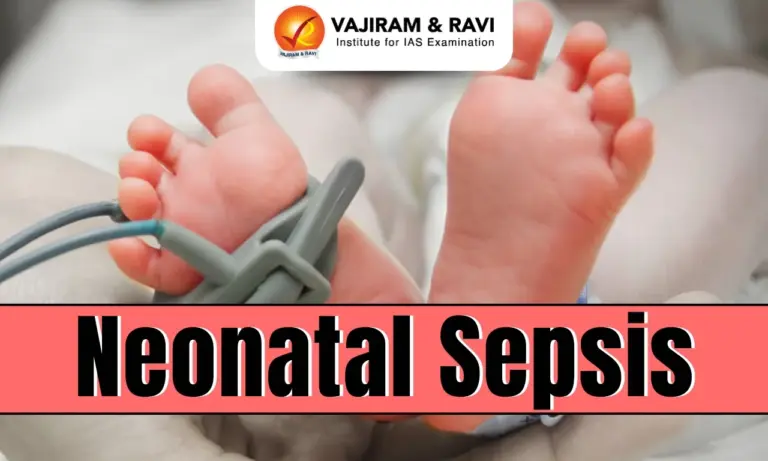
Neonatal Sepsis Latest News
Striking at the heart of antimicrobial resistance, the international NeoSep 1 trial to evaluate life-saving antibiotic combinations for newborns with sepsis has expanded to India, with the first baby being recruited at the JIPMER in Puducherry.
About Neonatal Sepsis
- It is a life-threatening bloodstream infection that occurs in babies under 90 days old, often affecting premature or low-birth-weight infants.
- It is one of the leading causes of neonatal mortality in the world, taking 30% to 50% of babies’ lives.


Neonatal Sepsis Cause
- Bacterial infections are the most common cause of neonatal sepsis.
- It can be caused by bacteria such as Escherichia coli (E coli), Listeria, and some strains of streptococcus.
- The herpes simplex virus (HSV) can also cause a severe infection in a newborn baby. This happens most often when the mother is newly infected with HSV.
Neonatal Sepsis Classification
- Early-onset sepsis (EOS):
- It presents at or before 72 hours of life.
- The source of infection has been traditionally believed to be the maternal genital tract.
- Late-onset sepsis (LOS):
- It presents after 72 hours of life.
- LOS can be either healthcare-associated (HAI) or community-acquired infection.
Neonatal Sepsis Symptoms
- Infants with neonatal sepsis may have the following symptoms:
- Body temperature changes
- Breathing problems
- Diarrhea or decreased bowel movements
- Low blood sugar
- Reduced movements
- Reduced sucking
- Seizures
- Slow or fast heart rate
- Swollen belly area
- Vomiting
- Yellow skin and whites of the eyes (jaundice)
Neonatal Sepsis Treatment
- Sepsis in newborns is curable.
- It must be treated in a hospital, usually through antibiotics transmitted intravenously.
News: TH

 Last updated on Oct, 2026
→ UPSC 2027 Notification will be released on 13 January 2027 at upsconline.nic.in.
→ Check Nobel Prize 2026 Winners List here.
→ Download PIB PRiSM Monthly Magazine 2026 here.
→ Check UPSC Monthly Current Affairs Magazine The Recitals here.
→ Check out the latest UPSC Syllabus here.
→ Download UPSC Model Answers for Mains 2026
→ UPSC Mains Question Paper 2026 is out now for Essay & GS Paper 1, 2, 3 & 4.
→ UPSC Calendar 2027 has been released.
→ Enroll in Vajiram & Ravi’s UPSC Mains Test Series 2027 for structured answer writing practice, expert evaluation, and exam-oriented feedback.
→ Join Vajiram & Ravi’s UPSC Mentorship Program 2027 for personalized guidance, strategy planning, and one-to-one support from experienced mentors.
→ Go through the UPSC Mains Previous Year Papers to enhance your preparation.
→ UPSC has released UPSC Toppers List 2025 with the Civil Services final result on its official website.
→ Also check Best UPSC Coaching in India
Neonatal Sepsis FAQs
Q1. What is Neonatal Sepsis?+
Q2. What is the most common cause of Neonatal Sepsis?+
Q3. Is Neonatal Sepsis curable?+
Q4. What is the standard treatment for Neonatal Sepsis?+
Tags: neonatal sepsis








