Climate Compensation Latest News
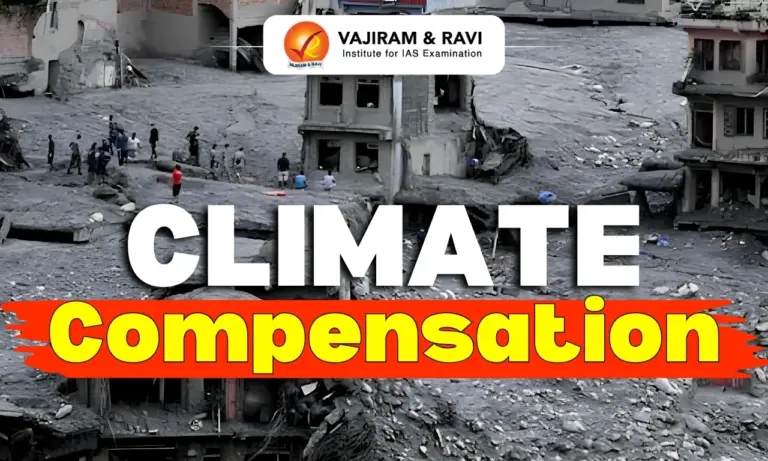
- Following a catastrophic glacial collapse and flash flood on August 26 that killed over 1,200 people, Nepal has launched a diplomatic demand for climate compensation from the world’s three biggest emitters, the United States, China and India.
The Disaster and Nepal’s Response
- Nepal’s Foreign Minister declared on September 1 that the country was “paying the ultimate price for a global crisis we did not create.“
- What makes Nepal’s response significant is not the scale of the tragedy alone but the shift in approach. Instead of issuing the customary appeals for humanitarian aid, Kathmandu launched a diplomatic offensive demanding direct climate compensation.
- By moving foreign policy from seeking charity to enforcing legal liability, Nepal has turned a national disaster into a global test of climate justice, forcing the international community to confront the limits of adaptation.


The Third Pole Paradox
- The injustice Nepal represents is stark in numerical terms.
- Nepal contributes a negligible 0.1% of global greenhouse gas emissions and generates almost all its electricity from renewable hydropower. Yet its geography places it at the epicentre of global warming.
- The Hindu Kush Himalayas, often called the “Third Pole”, are warming at nearly twice the global average, melting glaciers at ten times their historical norms.
How Distant Warming Reaches the Himalayas
- This accelerated melt does not occur in isolation. It is driven by global teleconnections: warming in the North Eurasian Arctic disrupts planetary waves and the stratospheric polar vortex, which in turn destabilises the South Asian monsoon.
- The August 26 disaster, triggered by a massive glacial collapse on the Nepal-China border, demonstrated how extreme events in the cryosphere can cascade down into densely populated valleys.
- The major powers treated Nepal’s crisis as a localised weather event manageable through temporary relief. But the Himalayan ecosystem depends on a delicate climatic balance now failing under the weight of Northern Hemisphere pollution.
Economic Devastation
- Nepal’s development strategy rested heavily on hydropower. The country had planned to harness its 43,000 MW of commercially viable capacity to become a regional energy exporter, and had only recently achieved net-exporter status.
- The August floods reversed this in a matter of days:
- Approximately 10% of installed capacity was crippled
- Older surface-level plants such as Devighat were wiped out
- Under-construction projects were completely buried in mud
- Nepal was forced to halt exports and import power to survive the winter
- Rebuilding will require climate-resilient, underground engineering, driving up future project costs by 10% to 12%.
- Total damages are estimated between $4 billion and $7 billion, roughly a tenth of Nepal’s entire GDP.
The Climate Finance Trap
- Nepal’s demand also exposes the inadequacy of existing global climate finance architecture.
- At COP27 in 2022, vulnerable nations successfully fought to establish the Fund for Responding to Loss and Damage (FRLD), which was operationalised at COP28 a year later.
- In practice, however, the mechanism is handicapped by slow-moving bureaucracy. For a country in ruins, waiting months for a standard UN review is a luxury it cannot afford.
- By bypassing normal channels and launching an out-of-cycle demand on September 1, just six days after the disaster, Nepal has forced the fund’s board to decide whether it can respond to a real-time emergency or remains merely a paper-pushing exercise.
- The Scale Mismatch
- The entire global fund holds a mere $700 million in pledges.
- Under pilot phase rules, individual grants are capped between $5 million and $20 million.
- A $20 million payout against a $7 billion catastrophe exposes the system’s inability to provide meaningful compensation.
- There is a further concern. With the fund temporarily hosted by the World Bank, debt-saddled developing nations fear that “compensation” may eventually morph into crippling loans.
Why This Matters Beyond Nepal
- Nepal’s diplomatic gambit has already altered the landscape, regardless of its immediate outcome.
- Even if Kathmandu does not extract a multi-billion-dollar cheque, its stance has exposed the profound inadequacies of global climate diplomacy.
- The gap between the scale of climate damage and the scale of available compensation is now impossible to ignore.
- More significantly, Nepal has shifted the framework from charity to liability, setting a disruptive precedent for the entire Global South that heavy emitters will find increasingly difficult to dismiss.
Implications for India
- This incident carries particular consequences for Indian climate diplomacy.
- India has long argued for differentiated responsibility based on historical emissions and per-capita metrics.
- Nepal’s application of that principle within South Asia creates an uncomfortable position, one where India finds itself on the receiving end of an argument it has advanced globally.
- At the same time, India faces genuine Himalayan climate risk itself. Glacier retreat threatens river systems supporting hundreds of millions across northern India, making the region’s ecological stability a shared rather than purely bilateral concern.
Source: TH

 Last updated on Oct, 2026
→ UPSC 2027 Notification will be released on 13 January 2027 at upsconline.nic.in.
→ Check Nobel Prize 2026 Winners List here.
→ Download PIB PRiSM Monthly Magazine 2026 here.
→ Check UPSC Monthly Current Affairs Magazine The Recitals here.
→ Check out the latest UPSC Syllabus here.
→ Download UPSC Model Answers for Mains 2026
→ UPSC Mains Question Paper 2026 is out now for Essay & GS Paper 1, 2, 3 & 4.
→ UPSC Calendar 2027 has been released.
→ Enroll in Vajiram & Ravi’s UPSC Mains Test Series 2027 for structured answer writing practice, expert evaluation, and exam-oriented feedback.
→ Join Vajiram & Ravi’s UPSC Mentorship Program 2027 for personalized guidance, strategy planning, and one-to-one support from experienced mentors.
→ Go through the UPSC Mains Previous Year Papers to enhance your preparation.
→ UPSC has released UPSC Toppers List 2025 with the Civil Services final result on its official website.
→ Also check Best UPSC Coaching in India
Climate Compensation FAQs
Q1. What share of global emissions does Nepal contribute?+
Q2. Why are the Hindu Kush Himalayas called the Third Pole?+
Q3. What are the estimated damages from the August 26 disaster?+
Q4. What is the Fund for Responding to Loss and Damage?+
Q5. What is the equity paradox concerning India?+
Tags: climate compensation mains articles upsc current affairs upsc mains current affairs