New Method to Estimate Helium Abundance in the Sun Latest News
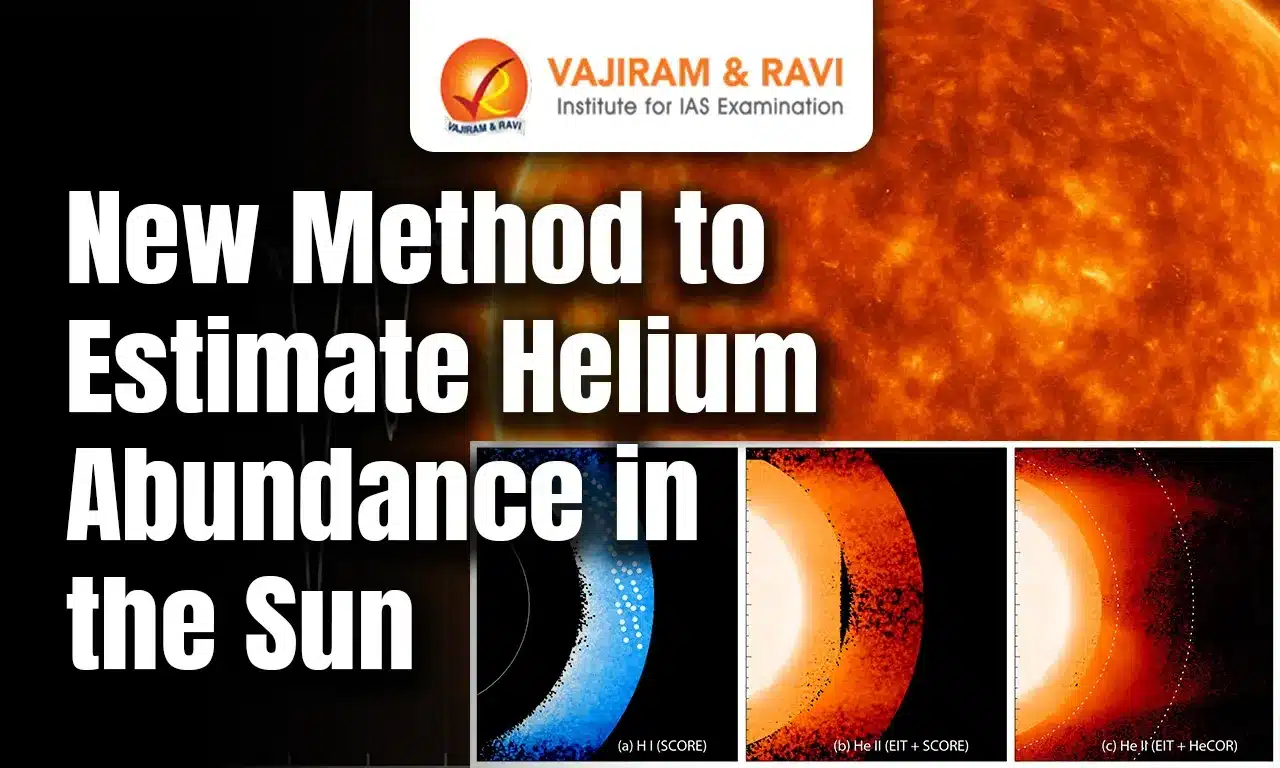
Indian scientists from the Indian Institute of Astrophysics (IIA) have successfully developed a novel method to accurately estimate the abundance of Helium in the Sun’s photosphere using indirect spectral analysis.
Background
- Helium is the second most abundant element in the Sun, but direct detection in the Sun’s photosphere is extremely difficult due to the absence of Helium spectral lines in the visible range.
- Traditionally, Helium abundance was estimated indirectly using:
- Solar wind or corona data,
- Extrapolation from hotter stars,
- Helioseismology (solar interior vibrations).
- These methods were not based on direct photospheric observations and hence lacked precision.


What is the New Method?
- Scientists used spectral lines of neutral Magnesium (Mg I) and neutral Carbon (C I), along with molecular lines of MgH, CH, and C₂, observed in the Sun’s photosphere.
- This method is based on the principle that the relative abundance of Helium affects the availability of Hydrogen, which in turn influences the formation and strength of molecular lines (e.g., CH and MgH).
- The researchers matched the atomic and molecular abundances of Magnesium and Carbon for different Helium-to-Hydrogen (He/H) ratios.
- The technique confirmed that only at a He/H ratio of ~0.1 do the atomic and molecular line abundances agree, validating the assumed solar value.
About Helium
- Helium (He) is a noble gas with a closed-shell electronic configuration, making it stable and chemically inert.
- Discovered in 1868 by Jules Janssen and Norman Lockyer via a yellow spectral line during a solar eclipse.
- Named after the Greek word ‘Helios’, meaning Sun.
- Largest global reserves: United States, Algeria, and Russia.
- India’s Rajmahal Volcanic Basin (Jharkhand) is a significant helium reservoir trapped for billions of years.
Source: PIB

 Last updated on Oct, 2026
→ UPSC 2027 Notification will be released on 13 January 2027 at upsconline.nic.in.
→ Check Nobel Prize 2026 Winners List here.
→ Download PIB PRiSM Monthly Magazine 2026 here.
→ Check UPSC Monthly Current Affairs Magazine The Recitals here.
→ Check out the latest UPSC Syllabus here.
→ Download UPSC Model Answers for Mains 2026
→ UPSC Mains Question Paper 2026 is out now for Essay & GS Paper 1, 2, 3 & 4.
→ UPSC Calendar 2027 has been released.
→ Enroll in Vajiram & Ravi’s UPSC Mains Test Series 2027 for structured answer writing practice, expert evaluation, and exam-oriented feedback.
→ Join Vajiram & Ravi’s UPSC Mentorship Program 2027 for personalized guidance, strategy planning, and one-to-one support from experienced mentors.
→ Go through the UPSC Mains Previous Year Papers to enhance your preparation.
→ UPSC has released UPSC Toppers List 2025 with the Civil Services final result on its official website.
→ Also check Best UPSC Coaching in India
New Method to Estimate Helium Abundance in the Sun FAQs
Q1. What is the primary source of helium in the Sun?+
Q2. What is the approximate composition of the Sun by mass?+
Tags: new method to estimate helium abundance in the Sun prelims pointers upsc current affairs upsc prelims current affairs