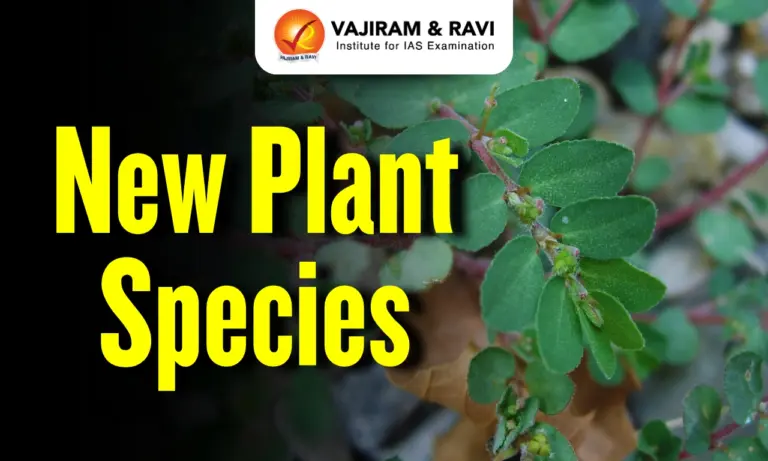
New Plant Species Latest News
Scientists have identified three new plant species named Euphorbia ananthapuramensis, Euphorbia chalamensis, and Ceropegia andhrica, in the Eastern Ghats of Andhra Pradesh.
About Euphorbia Ananthapuramensis
- It is a new shrubby plant species.
- It was discovered in Nigidi Forest in the Sri Sathya Sai district, Andhra Pradesh.
- It grows among granite rocks in scrub forests at elevations of 450 to 550 metres.
- About 80 individual plants were recorded within an area of around 2.5 sq km.
- It has medicinal properties and is used by local tribal communities to treat wounds, skin diseases, and digestive disorders.
- The species faces threats from granite mining and forest fires.
- IUCN Red List Classification: Critically Endangered


About Euphorbia Chalamensis
- It is a small annual herb.
- It was discovered in Chalama Forest in Gundla Brahmeswaram Wildlife Sanctuary in Nandyal district, Andhra Pradesh.
- It was found in dry deciduous forests at elevations of 300 to 500 metres.
- Its population is limited to just over 100 individuals across about 2 sq km.
- It has medicinal properties and is used by local tribal communities to treat wounds, skin diseases, and digestive disorders.
- Forest fires and human activity have been listed among the major threats.
- IUCN Red List Classification: Critically Endangered
About Ceropegia Andhrica
- It is a dwarf tuberous herb.
- It was discovered in Paderu forest division in Alluri Sitharamaraju district, Andhra Pradesh.
- It was found in open forest edges at elevations above 1,000 metres.
- About 200 individuals were recorded in less than one sq km.
- The plant is leafless during flowering, which occurs after the first rains between May and June, and produces leaves later.
- It produces edible tubers roughly the size of small potatoes.
- Grazing, forest fires, and habitat loss threaten the species.
- IUCN Red List Classification: Critically Endangered
Source: TOI

 Last updated on Oct, 2026
→ UPSC 2027 Notification will be released on 13 January 2027 at upsconline.nic.in.
→ Check Nobel Prize 2026 Winners List here.
→ Download PIB PRiSM Monthly Magazine 2026 here.
→ Check UPSC Monthly Current Affairs Magazine The Recitals here.
→ Check out the latest UPSC Syllabus here.
→ Download UPSC Model Answers for Mains 2026
→ UPSC Mains Question Paper 2026 is out now for Essay & GS Paper 1, 2, 3 & 4.
→ UPSC Calendar 2027 has been released.
→ Enroll in Vajiram & Ravi’s UPSC Mains Test Series 2027 for structured answer writing practice, expert evaluation, and exam-oriented feedback.
→ Join Vajiram & Ravi’s UPSC Mentorship Program 2027 for personalized guidance, strategy planning, and one-to-one support from experienced mentors.
→ Go through the UPSC Mains Previous Year Papers to enhance your preparation.
→ UPSC has released UPSC Toppers List 2025 with the Civil Services final result on its official website.
→ Also check Best UPSC Coaching in India
New Plant Species FAQs
Q1. What is Euphorbia ananthapuramensis?+
Q2. Where was Euphorbia ananthapuramensis discovered?+
Q3. What type of plant is Euphorbia chalamensis?+
Q4. Where was Euphorbia chalamensis discovered?+
Q5. What type of plant is Ceropegia andhrica?+
Tags: new plant species upsc prelims current affairs