Medium Enterprises Latest News
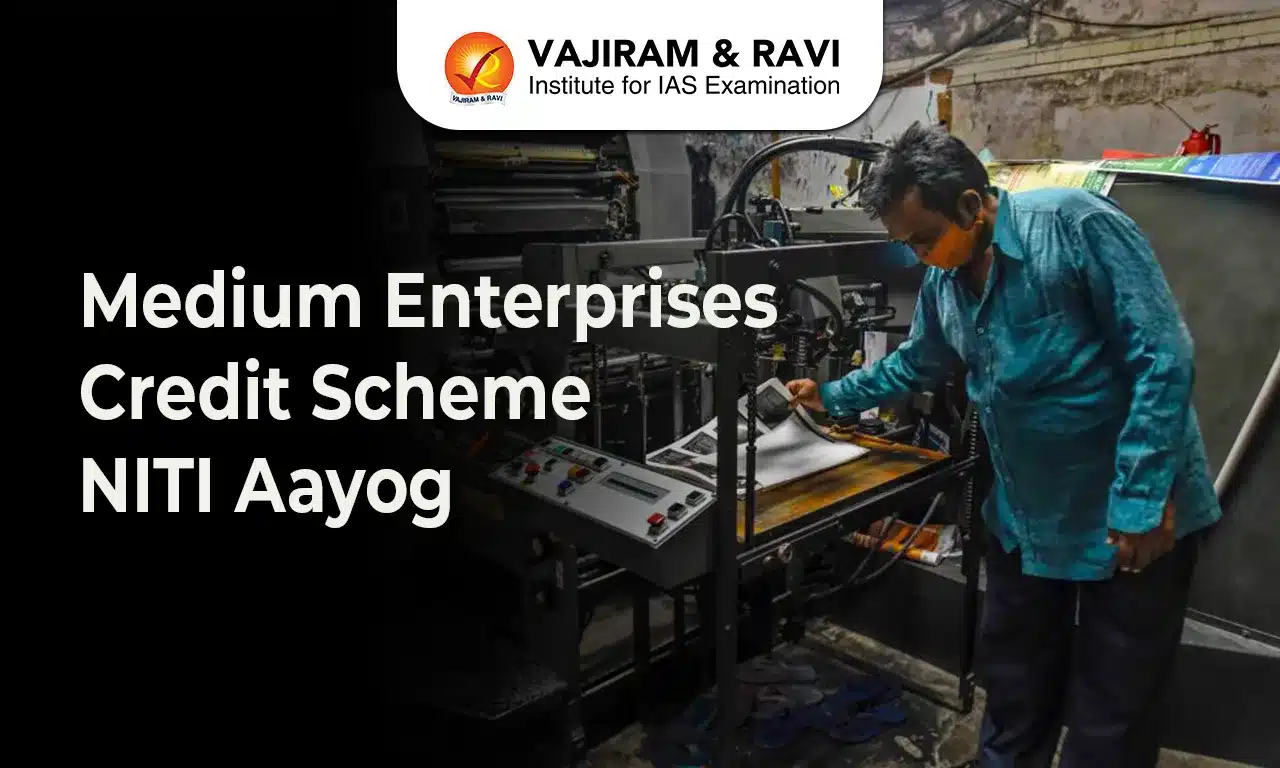
- The NITI Aayog, government’s policy think tank, has recommended the introduction of a dedicated financing scheme to allow medium enterprises to avail loans at concessional rates.
Introduction
- Medium enterprises (MEs) represent a crucial but often overlooked segment of India’s economic fabric.
- Despite contributing significantly to exports and employment, they face persistent challenges in accessing affordable credit.
- In response, NITI Aayog has released a comprehensive report recommending policy interventions to ease financial constraints and strengthen the sector’s growth trajectory.


Significance of Medium Enterprises in the MSME Ecosystem
- India’s MSME sector, comprising Micro, Small, and Medium Enterprises, contributes about 29% to the country’s GDP and employs over 60% of its workforce.
- While micro enterprises make up 97% and small enterprises 2.7% of registered MSMEs, medium enterprises form only 0.3%.
- However, this small segment is responsible for nearly 40% of MSME exports, underlining its strategic importance in driving India’s industrial competitiveness and export performance.
Credit Challenges Faced by Medium Enterprises
- According to the NITI Aayog report titled “Designing Policy for Medium Enterprises”, the sector faces a credit gap of $10 billion (as of 2024), primarily due to structural and institutional barriers.
- Medium enterprises typically receive fewer priority sector loans than micro units and face borrowing costs that are approximately 4% higher than large corporations.
- Moreover, only 8 of the 18 MSME government schemes cater to medium enterprises, and just 17.81% of total funds are allocated to them.
- This has exacerbated funding constraints, leaving MEs without sufficient working capital support.
NITI Aayog’s Recommendations
- Dedicated Working Capital Financing Scheme
- NITI Aayog has suggested a sector-wise financing scheme based on enterprise turnover, with loans capped at ₹25 crore, and a maximum of ₹5 crore per individual request.
- The scheme would be managed by the Ministry of MSME and aim to provide timely and flexible funding for manufacturing and services units.
- Medium Enterprise Credit Card
- To address urgent liquidity needs such as payroll, inventory purchases, and equipment repair, a medium enterprise credit card facility with a ₹5 crore limit has been proposed.
- The interest rates would align with market norms but include a grace period for repayment.
- Faster Fund Disbursal Through Retail Banks
- The report advocates the involvement of retail banks for quicker fund distribution, under the supervision of the MSME ministry.
- This would cut bureaucratic delays and ensure timely credit access.
Broader Structural Issues Identified
- Apart from financial constraints, medium enterprises struggle with several non-financial challenges:
- Low adoption of advanced technologies
- Inadequate R&D support
- Lack of sector-specific testing infrastructure
- Mismatch between training programmes and actual enterprise needs
- These factors hinder scalability and innovation potential within the segment.
Suggested Digital and Skilling Reforms
- To improve access to government resources, NITI Aayog recommends developing a dedicated sub-portal under the existing Udyam platform. This portal would include:
- Scheme discovery tools
- Compliance support
- AI-driven navigation assistance for enterprises
- Additionally, it calls for the integration of medium enterprise-specific modules into skilling and entrepreneurship training, aligned with regional and sectoral demands.
Policy Outlook: Building a Supportive Ecosystem
- The report underscores that unlocking the potential of medium enterprises demands an inclusive and coordinated policy framework.
- Strategic interventions in financing, skilling, digital access, and infrastructure are essential to harness the segment’s full capabilities.
- By enabling greater ease of doing business and removing systemic credit bottlenecks, India can position its medium enterprises as powerful drivers of export growth, employment, and self-reliance in the global economy.
Medium Enterprises Credit Scheme FAQs
Q1. What percentage of registered MSMEs are medium enterprises?
Ans. Medium enterprises account for just 0.3% of all registered MSMEs.
Q2. How much of MSME exports are contributed by medium enterprises?
Ans. Medium enterprises contribute nearly 40% of all MSME exports.
Q3. What is the proposed credit card limit for medium enterprises?
Ans. NITI Aayog has recommended a ₹5 crore credit card facility for medium enterprises.
Q4. What is the estimated credit demand gap for medium enterprises?
Ans. The credit gap for medium enterprises in 2024 is estimated at $10 billion.
Q5. What additional digital support has NITI Aayog proposed for medium enterprises?
Ans. A dedicated Udyam portal subsection with scheme discovery tools, compliance help, and AI-based guidance has been proposed.

 Last updated on Oct, 2026
→ UPSC 2027 Notification will be released on 13 January 2027 at upsconline.nic.in.
→ Asian Games 2026 are being held in Aichi-Nagoya, Japan, from 19 September to 4 October.
→ Check Nobel Prize 2026 Winners List here.
→ Download PIB PRiSM Monthly Magazine 2026 here.
→ Check UPSC Monthly Current Affairs Magazine The Recitals here.
→ Check out the latest UPSC Syllabus here.
→ Download UPSC Model Answers for Mains 2026
→ UPSC Mains Question Paper 2026 is out now for Essay & GS Paper 1, 2, 3 & 4.
→ UPSC Calendar 2027 has been released.
→ Enroll in Vajiram & Ravi’s UPSC Mains Test Series 2027 for structured answer writing practice, expert evaluation, and exam-oriented feedback.
→ Join Vajiram & Ravi’s UPSC Mentorship Program 2027 for personalized guidance, strategy planning, and one-to-one support from experienced mentors.
→ Go through the UPSC Mains Previous Year Papers to enhance your preparation.
→ UPSC has released UPSC Toppers List 2025 with the Civil Services final result on its official website.
→ Also check Best UPSC Coaching in India
Tags: mains articles medium enterprises upsc current affairs upsc mains current affairs