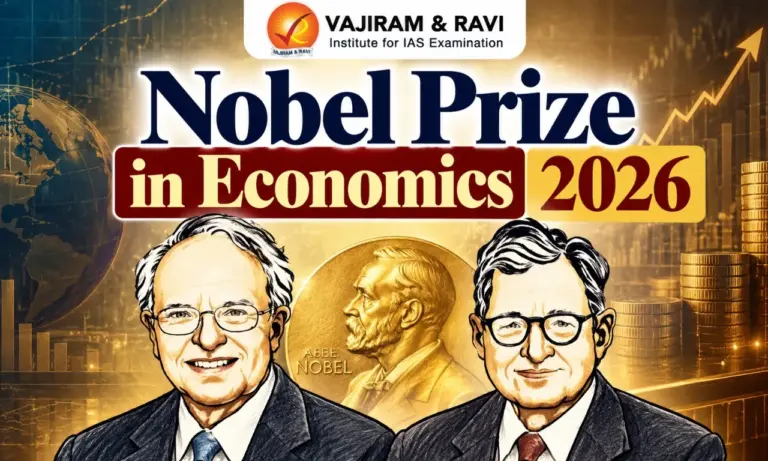
Nobel Prize in Economics 2026 has been awarded jointly to Robert E. Hall and Michael Woodford, two American economists, for their contributions to understanding how governments and central banks can stabilise the economy.
The award officially recognises their work “for microeconomic foundations of macroeconomic stabilisation.” Their research has helped develop economic models that explain how the decisions of households and businesses affect the wider economy.
Nobel Prize in Economics 2026 Winners
The 2026 Nobel Prize in Economic Sciences was awarded to Robert E. Hall and Michael Woodford for developing the microeconomic foundations of macroeconomic stabilisation.
Robert E. Hall
Robert E. Hall is an American economist associated with Stanford University in California, USA. His research has contributed to the understanding of household consumption, employment, economic fluctuations and public policy.
- Research Focus: Hall studied how households make decisions about consumption and saving based on their expectations of future income and economic conditions.
- Household Behaviour: His work highlighted that people’s spending decisions depend not only on their current income but also on what they expect to earn in the future.
- Economic Modelling: His research helped economists understand how individual consumption decisions influence total demand and economic activity.
- Policy Relevance: Understanding household behaviour helps policymakers assess how changes in taxes, income, interest rates and economic expectations may affect consumption.
Michael Woodford
Michael Woodford is an American economist associated with Columbia University in New York, USA. He is widely known for his contributions to monetary economics, macroeconomic theory and central bank policy.
- Research Focus: Woodford developed economic frameworks explaining how monetary policy affects inflation, output and economic activity.
- Role of Interest Rates: His work highlighted the importance of current and expected future interest rates in influencing economic decisions.
- Forward Guidance: He demonstrated why central banks’ communication about future policy can influence household and business expectations.
- Policy Relevance: His research has helped establish a theoretical foundation for modern monetary policy frameworks used by central banks.
Why Did Robert E. Hall and Michael Woodford Win the Nobel Prize in Economics 2026?
Robert E. Hall and Michael Woodford were recognised for developing economic models that connect individual decisions with overall economic performance. Their research has improved the theoretical basis for policies intended to reduce fluctuations in growth, inflation and employment.
The main reasons for the award are:
- Strengthening Economic Stabilisation: Their work improved the models used to determine when governments and central banks should stimulate or slow economic activity.
- Connecting Microeconomics and Macroeconomics: They showed how decisions made by individual households and businesses influence the economy as a whole.
- Understanding Future Expectations: Their research explains how expectations about future income, prices and interest rates affect current spending and business decisions.
- Improving Monetary Policy: Their work clarified how interest rates and central bank communication can influence inflation and economic activity.
- Supporting Effective Fiscal Policy: Their research contributes to understanding how government spending, taxation and budget deficits affect economic demand.
- Responding to Economic Shocks: Their models provide policymakers with tools to analyse unexpected developments, including energy crises and sudden changes in consumer behaviour.


What Is Microeconomic Foundation of Macroeconomic Stabilisation?
The microeconomic foundations of macroeconomic stabilisation refer to the use of individual economic decisions to understand how the overall economy behaves and how policy can reduce economic fluctuations.
Microeconomics studies the behaviour of individual households, consumers and businesses. Macroeconomics examines the economy as a whole, including inflation, unemployment, economic growth and national output.
Hall and Woodford helped strengthen the connection between these two fields by developing models that explain how individual decisions influence broader economic outcomes.
For example, households may reduce spending if they expect lower future income. Businesses may delay investment or change prices based on their expectations of future demand and interest rates. When these decisions occur across the economy, they can affect production, employment, inflation and growth.
What Is Macroeconomic Stabilisation?
Macroeconomic stabilisation refers to the use of fiscal and monetary policies to reduce excessive fluctuations in economic activity, control inflation and support stable growth and employment.
An economy generally experiences periods of expansion and contraction. During an expansion, production and employment rise, while a downturn may lead to lower output, falling demand and job losses. Inflation can also increase when demand exceeds the economy’s productive capacity or when supply shocks raise costs.
Role of Monetary Policy
Monetary policy is implemented by a country’s central bank. In India, the Reserve Bank of India (RBI) is responsible for monetary policy.
- During an Economic Slowdown: A central bank may reduce interest rates to make borrowing cheaper and encourage consumption and investment, subject to inflation and other economic conditions.
- During High Inflation: It may increase interest rates to moderate borrowing and demand and reduce inflationary pressures.
- Managing Expectations: Central bank announcements can influence expectations about future interest rates, prices and economic activity.
- Maintaining Price Stability: Monetary policy aims to keep inflation under control while supporting sustainable economic activity.
Role of Fiscal Policy
Fiscal policy refers to the government’s use of taxation, public expenditure and borrowing to influence economic activity.
- During a Recession: The government may increase public investment, raise spending or reduce taxes to support demand, depending on fiscal space and economic conditions.
- During Excessive Demand: It may moderate spending or increase taxes to reduce inflationary pressures.
- Public Investment: Spending on infrastructure, healthcare and education can support demand while also improving productive capacity over time.
- Managing the Budget Deficit: Fiscal measures must consider public debt, borrowing costs and long-term fiscal sustainability.
Significance of the Nobel Prize in Economics 2026
The Nobel Prize in Economics 2026 highlights the importance of understanding how individual decisions shape the wider economy. Its significance extends to economic research, central banking and government policymaking.
- Improved Economic Policy: The laureates’ research strengthens the analytical foundations used to evaluate fiscal and monetary measures.
- Better Management of Recessions: Their models help policymakers assess when economic stimulus may be appropriate.
- Inflation Control: Their work helps explain how interest rates and expectations influence price-setting and economic demand.
- Understanding Consumer Behaviour: It highlights the role of expected future income in decisions about consumption and saving.
- Stronger Central Bank Communication: It demonstrates why clear and credible communication can influence economic expectations.
- Response to Global Shocks: The research provides tools for analysing the economic effects of energy crises, supply disruptions and sudden changes in consumption.
- Relevance for Developing Economies: Countries such as India can draw on modern macroeconomic frameworks when analysing inflation, employment, growth and policy trade-offs, while adapting them to domestic conditions.

 Last updated on Oct, 2026
→ UPSC 2027 Notification will be released on 13 January 2027 at upsconline.nic.in.
→ Check Nobel Prize 2026 Winners List here.
→ Download PIB PRiSM Monthly Magazine 2026 here.
→ Check UPSC Monthly Current Affairs Magazine The Recitals here.
→ Check out the latest UPSC Syllabus here.
→ Download UPSC Model Answers for Mains 2026
→ UPSC Mains Question Paper 2026 is out now for Essay & GS Paper 1, 2, 3 & 4.
→ UPSC Calendar 2027 has been released.
→ Enroll in Vajiram & Ravi’s UPSC Mains Test Series 2027 for structured answer writing practice, expert evaluation, and exam-oriented feedback.
→ Join Vajiram & Ravi’s UPSC Mentorship Program 2027 for personalized guidance, strategy planning, and one-to-one support from experienced mentors.
→ Go through the UPSC Mains Previous Year Papers to enhance your preparation.
→ UPSC has released UPSC Toppers List 2025 with the Civil Services final result on its official website.
→ Also check Best UPSC Coaching in India
Nobel Prize in Economics 2026 FAQs
Q1. Who won the Nobel Prize in Economics 2026?+
Q2. Why did Robert E. Hall and Michael Woodford win the Nobel Prize in Economics 2026?+
Q3. What is the official name of the Nobel Prize in Economics?+
Q4. Who awards the Nobel Prize in Economics?+
Q5. What is macroeconomic stabilisation?+
Tags: nobel prize in economics nobel prize in economics 2026