About Nolamba Dynasty
- They were one of the significant political powers in South India.
- The Nolambas ruled from the 8th to the 12th centuries C.E. over an area traditionally called Nolambavadi, which extended over south-east Karnataka and parts of Tamil Nadu and Andhra Pradesh.
- Their ruled first as feudatories to Pallavas, Chalukyas of Badami, Gangas, and Rasjtrakutas, and later to Chalukyas of Kalyani.
- Nolambas commonly referred themselves as Nolamba Pallava in several inscriptions.
- Their earlier capital was Chitradurga, which they later shifted to Hemavati in modern Andhra Pradesh. Hemavathi was the capital between the 8th and 10th centuries AD.
- Origin:
- Mangala Nomabathi Raja (735–785 A.D) was considered the founder of Nolamba dynasty.
- Inscriptional evidence suggests that they came into existence as governors when the Pallavas and Chalukyas were supreme powers.
- With the seizure of Badami by the Pallava ruler Mamalla Narasimhavarman I, the Chalukyas ceded the territories that were ruled by the Banas and Vaidumbas to the Pallavas.
- The Banas and Vaidumbas thus became feudatories of the Pallavas.
- The Nolambas, who were perhaps related to the Pallava family, governed the region adjacent to these land of Pallava feudatories, namely the Banas and Vaidumbas.
- Sometime later, during the rule of Vikramaditya I, the Chalukyas regained the lost territories. The Banas and Vaidumbas thus had to change their political relationship back to the Chalukyas.
- The Pallava chiefs, who were adjacent to the Banas and Vaidumbas, were defeated by the Chalukyas, who soon came under their protection. These Pallava chiefs soon came into existence under the name of “Nolambas”.
- Decline: Nolambas were overrun by the Ganga king Marasimha, who boasts of having destroyed the Nolamba family and had the title Nolambakulantaka.
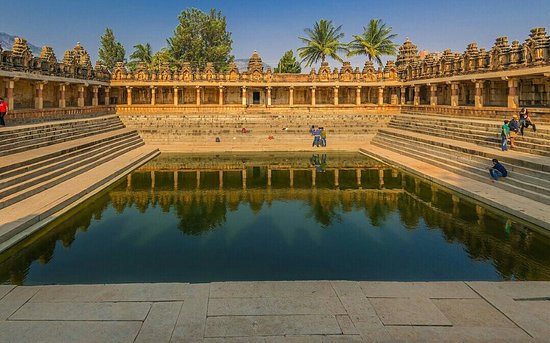
- Three grand temple complexes that are attributed to this dynasty’s glory are the Kalleshwara Temple in Aralaguppe, the Bhoganandishwara Temple in Nandi, and the Ramalingeshwara Temple in Avani.
- The Nolambas were Shaivites, and the temples they built were dedicated to Lord Shiva.
Q1) Who were Pallavas?
Today’s southern India was once ruled by the Pallava dynasty between the 2nd and 9th centuries CE, who are known for their great architecture. The Pallava dynasty was one of the most significant dynasties of ancient India, and a major force in southern India. Kanchi or modern-day Kanchipuram was the capital city of the Pallavas. Telgu, Tamil and Sanskrit were their main languages. Different architectural patterns, especially the stone-cut religious sites in Mahabalipuram, are associated with them. Most of their places worships were devoted to Lord Shiva.
Source: Hero stones, inscriptions found in Sathya Sai district


 Last updated on Oct, 2026
→ UPSC 2027 Notification will be released on 13 January 2027 at upsconline.nic.in.
→ Asian Games 2026 are being held in Aichi-Nagoya, Japan, from 19 September to 4 October.
→ Check Nobel Prize 2026 Winners List here.
→ Download PIB PRiSM Monthly Magazine 2026 here.
→ Check UPSC Monthly Current Affairs Magazine The Recitals here.
→ Check out the latest UPSC Syllabus here.
→ Download UPSC Model Answers for Mains 2026
→ UPSC Mains Question Paper 2026 is out now for Essay & GS Paper 1, 2, 3 & 4.
→ UPSC Calendar 2027 has been released.
→ Enroll in Vajiram & Ravi’s UPSC Mains Test Series 2027 for structured answer writing practice, expert evaluation, and exam-oriented feedback.
→ Join Vajiram & Ravi’s UPSC Mentorship Program 2027 for personalized guidance, strategy planning, and one-to-one support from experienced mentors.
→ Go through the UPSC Mains Previous Year Papers to enhance your preparation.
→ UPSC has released UPSC Toppers List 2025 with the Civil Services final result on its official website.
→ Also check Best UPSC Coaching in India