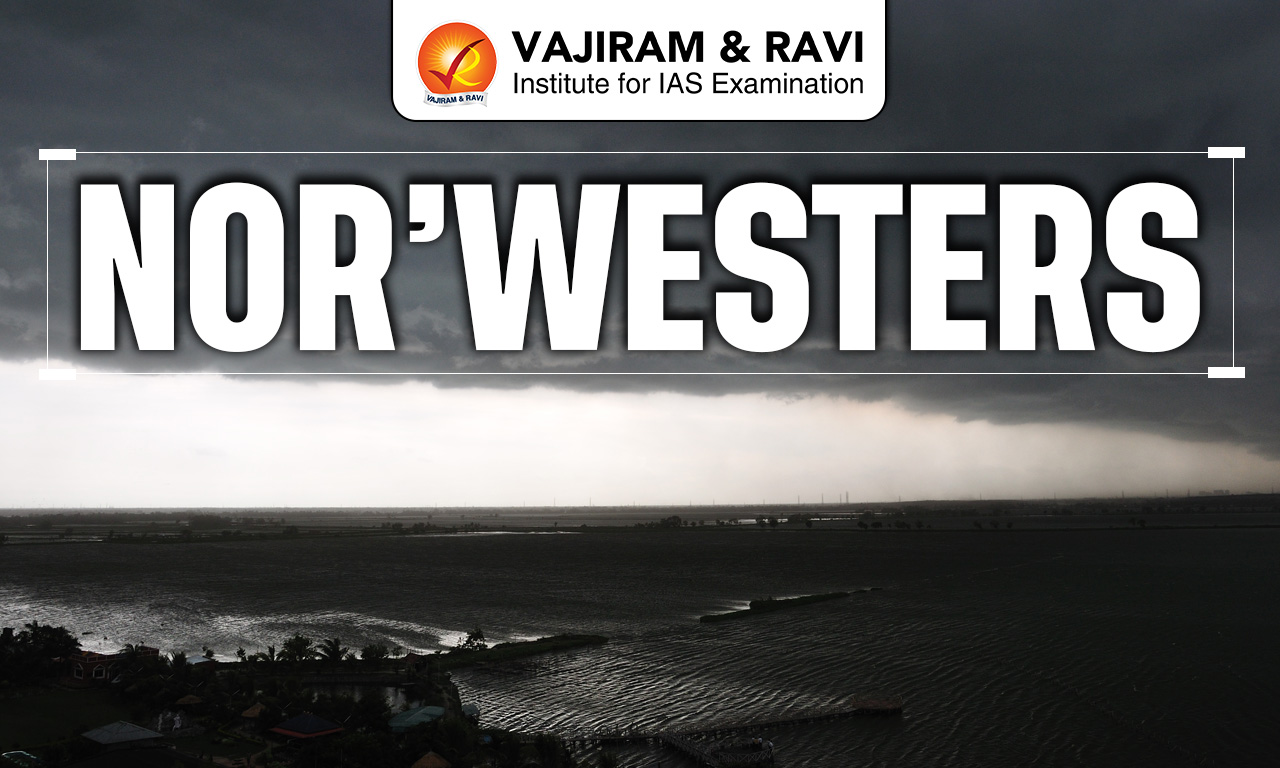
Recently, a severe Nor’wester struck the Karanjia area in Mayurbhanj district of Odisha, leaving at least two people dead and causing widespread damage.
About Nor’westers
- Nor’westers are extremely severe thunderstorms that occur in eastern and northeastern India and Bangladesh during the pre-monsoon season (March-May).
- They are most common over Gangetic West Bengal and the eastern Gangetic plain, but can also impact other parts of eastern India when conditions are favorable.
- They affect West Bengal, Odisha, Bihar, Jharkhand, Assam, Tripura, and extend into Bangladesh, southern Nepal, and Bhutan.
- They are locally called Kalbaisakhi in Bengal, meaning “the calamity of the month of Baisakh,” and Bordoisila or Bardoli Cheerha in Assam, referring to a “fierce, speedy goddess” due to their strong winds.
Nor’westers Formation
Nor’westers are formed during the pre-monsoon months due to intense daytime heating over the Chota Nagpur Plateau, which generates low-pressure areas.
Warm and humid air from the Bay of Bengal flows inland to occupy these low-pressure zones and interacts with cooler, drier air from the northwest at higher altitudes. This convergence produces strong vertical air currents, resulting in the rapid development of towering Cumulonimbus clouds. These clouds give rise to sudden and severe thunderstorms, characterized by gale-force winds, heavy rainfall, lightning, and occasional hail.


Major Characteristics of Nor’westers
Major characteristics of Nor’westers are as follows:
- Nor’westers are short-lived but very intense storms, usually lasting 1-2 hours at a place, though they can travel over long distances.
- They typically occur in the late afternoon or evening, when the land is hottest.
- These storms move from the northwest to the southeast, which is why they are called Nor’westers.
- They bring strong, gusty winds and heavy rainfall, often causing damage to trees, houses, and crops.
- The storms develop suddenly, with dark, towering clouds forming rapidly due to rising warm air.
- They are accompanied by frequent lightning and thunder.
Nor’westers Impact
Nor’westers, while short lived, have significant impacts on the environment, agriculture, infrastructure, and human life in eastern and northeastern India.
- Relief from heat: The storms bring a sudden drop in temperature, providing temporary relief from the scorching pre-monsoon heat.
- Agricultural effects: Rain helps replenish water sources and benefits crops like paddy and tea, but winds and hail can damage orchards and standing crops.
- Structural damage: Uproot trees, damage power lines, and destroy kutcha houses.
- Casualties and hazards: Lightning strikes, falling trees, and collapsing structures may lead to loss of life and injuries.
- Monsoon indicator: Signal the approach of the southwest monsoon, helping farmers and communities prepare.
Other Local Winds of India
Apart from Nor’westers, India experiences several local winds that occur in specific regions and seasons due to local heating or pressure differences:
- Loo: Hot, dry winds in northern and northwestern India during summer.
- Mango Showers: Light pre-monsoon rains in Kerala, Karnataka, and Tamil Nadu aiding early fruit ripening.
- Bharam/Mahu: Hot, dry, dusty winds in western India before monsoon onset.
- Sea Breeze: Cool wind from the sea to land during the day along coasts.
- Land Breeze: Cool wind from land to sea at night along coasts.
- Kalbaisakhi/Bordoisila: Violent pre-monsoon thunderstorms in eastern India and Assam.

 Last updated on Oct, 2026
→ UPSC 2027 Notification will be released on 13 January 2027 at upsconline.nic.in.
→ Check Nobel Prize 2026 Winners List here.
→ Download PIB PRiSM Monthly Magazine 2026 here.
→ Check UPSC Monthly Current Affairs Magazine The Recitals here.
→ Check out the latest UPSC Syllabus here.
→ Download UPSC Model Answers for Mains 2026
→ UPSC Mains Question Paper 2026 is out now for Essay & GS Paper 1, 2, 3 & 4.
→ UPSC Calendar 2027 has been released.
→ Enroll in Vajiram & Ravi’s UPSC Mains Test Series 2027 for structured answer writing practice, expert evaluation, and exam-oriented feedback.
→ Join Vajiram & Ravi’s UPSC Mentorship Program 2027 for personalized guidance, strategy planning, and one-to-one support from experienced mentors.
→ Go through the UPSC Mains Previous Year Papers to enhance your preparation.
→ UPSC has released UPSC Toppers List 2025 with the Civil Services final result on its official website.
→ Also check Best UPSC Coaching in India
Nor’westers FAQs
Q1. What are Nor’westers?+
Q2. Which regions are commonly affected by Nor’westers?+
Q3. Why are Nor’westers called Kalbaisakhi and Bordoisila?+
Q4. How are Nor’westers formed?+
Q5. What are the major characteristics of Nor’westers?+
Tags: nor’westers