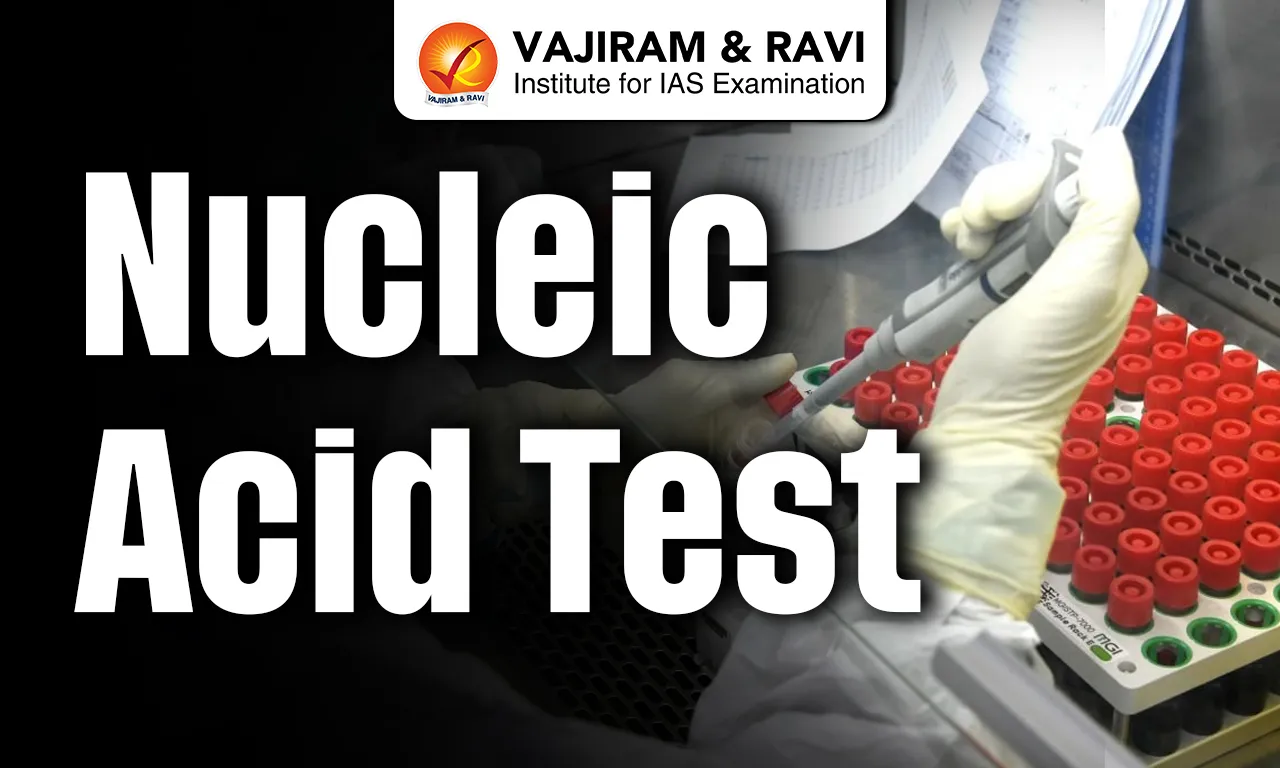
Nucleic Acid Test Latest News
- The Supreme Court has agreed to examine whether the Nucleic Acid Test (NAT) should be made compulsory in blood banks to ensure safer blood transfusion practices.
Background of the Case
- The matter came before a Bench of the Chief Justice of India and two other judges after a petition was filed by an NGO seeking mandatory implementation of NAT across blood banks in India.
- The petitioner argued that the right to safe blood transfusion forms part of the fundamental right to life under Article 21 of the Constitution.
- The plea emphasised that NAT is a safer and more sensitive testing mechanism compared to existing screening methods and is necessary to prevent transfusion-transmitted infections.
- The Court has asked the petitioner to submit additional data on cost-effectiveness, State-level implementation, and feasibility before taking a final view.


What is the Nucleic Acid Test (NAT)
- Nucleic Acid Test (NAT) is a highly sensitive molecular diagnostic technique that detects the genetic material (DNA or RNA) of viruses in donated blood.
- It is capable of identifying infections such as Human Immunodeficiency Virus (HIV), Hepatitis B, and Hepatitis C.
- Unlike traditional serological tests, NAT reduces the “window period”, the time between infection and detectability, thereby enhancing blood safety.
- Currently, many blood banks in India primarily use Enzyme-Linked Immunosorbent Assay (ELISA) tests, which are less expensive but comparatively less sensitive during early infection stages.
Constitutional Dimension and Right to Life
- The petitioner has argued that access to safe and infection-free blood is an integral component of the right to life under Article 21.
- The Supreme Court has previously interpreted Article 21 expansively to include the right to health, medical care, and dignity.
- In this context, ensuring safe blood transfusion aligns with the constitutional obligation of the State to protect public health.
- The Court’s decision to examine the issue indicates recognition of the broader public health and human rights implications.
Cost and Feasibility Concerns
- During the hearing, the Bench raised questions regarding the financial feasibility of making NAT mandatory across all States.
- The Court asked whether economically weaker States, already struggling with budgetary constraints, would be able to afford NAT in government blood banks and hospitals.
- While the petitioner argued that the costs of NAT are comparatively low, the Court highlighted that additional financial burdens could affect States with limited fiscal capacity.
- The Bench has directed the petitioner to file an affidavit detailing:
- Whether State hospitals currently use NAT
- In how many hospitals is it implemented
- The States where it is operational
- This indicates that the Court is adopting a data-driven approach before considering mandatory nationwide implementation.
Public Health Context and Recent Incidents
- The issue has gained urgency due to reported cases of children contracting HIV allegedly due to contaminated blood transfusions.
- The petition referred to cases involving Thalassemia patients, who require frequent blood transfusions and are particularly vulnerable to infected blood.
- Thalassemia is an inherited blood disorder in which the body cannot produce adequate haemoglobin. India has a high burden of Thalassemia patients, increasing the demand for safe and regular blood transfusions.
- The case assumes greater significance against the backdrop of reported incidents in Madhya Pradesh and Jharkhand, where children were found HIV-positive following allegedly contaminated transfusions.
- Such incidents have been described as “preventable tragedies” in the petition.
- These events have reignited debate over the adequacy of existing blood screening mechanisms.
Policy and Regulatory Framework
- Blood safety in India is regulated under the Drugs and Cosmetics Act, 1940, and supervised by the National Blood Transfusion Council (NBTC) and State Blood Transfusion Councils.
- Currently, mandatory screening includes tests for HIV, Hepatitis B, Hepatitis C, malaria, and syphilis using serological methods. NAT is not uniformly mandated across all blood banks.
- Introducing compulsory NAT would require:
- Infrastructure upgrades
- Skilled laboratory personnel
- Increased financial allocation
- Standardisation across public and private sectors
- The decision, therefore, has implications for both health governance and fiscal policy.
Source: TH

 Last updated on Oct, 2026
→ UPSC 2027 Notification will be released on 13 January 2027 at upsconline.nic.in.
→ Check Nobel Prize 2026 Winners List here.
→ Download PIB PRiSM Monthly Magazine 2026 here.
→ Check UPSC Monthly Current Affairs Magazine The Recitals here.
→ Check out the latest UPSC Syllabus here.
→ Download UPSC Model Answers for Mains 2026
→ UPSC Mains Question Paper 2026 is out now for Essay & GS Paper 1, 2, 3 & 4.
→ UPSC Calendar 2027 has been released.
→ Enroll in Vajiram & Ravi’s UPSC Mains Test Series 2027 for structured answer writing practice, expert evaluation, and exam-oriented feedback.
→ Join Vajiram & Ravi’s UPSC Mentorship Program 2027 for personalized guidance, strategy planning, and one-to-one support from experienced mentors.
→ Go through the UPSC Mains Previous Year Papers to enhance your preparation.
→ UPSC has released UPSC Toppers List 2025 with the Civil Services final result on its official website.
→ Also check Best UPSC Coaching in India
Nucleic Acid Test FAQs
Q1. What is Nucleic Acid Test (NAT)?+
Q2. Why is NAT considered safer than ELISA?+
Q3. Which constitutional provision is involved in this case?+
Q4. Why are Thalassemia patients central to this issue?+
Q5. What key concern did the Supreme Court raise?+
Tags: mains articles nucleic acid test upsc current affairs upsc mains current affairs