About Long Valley Caldera
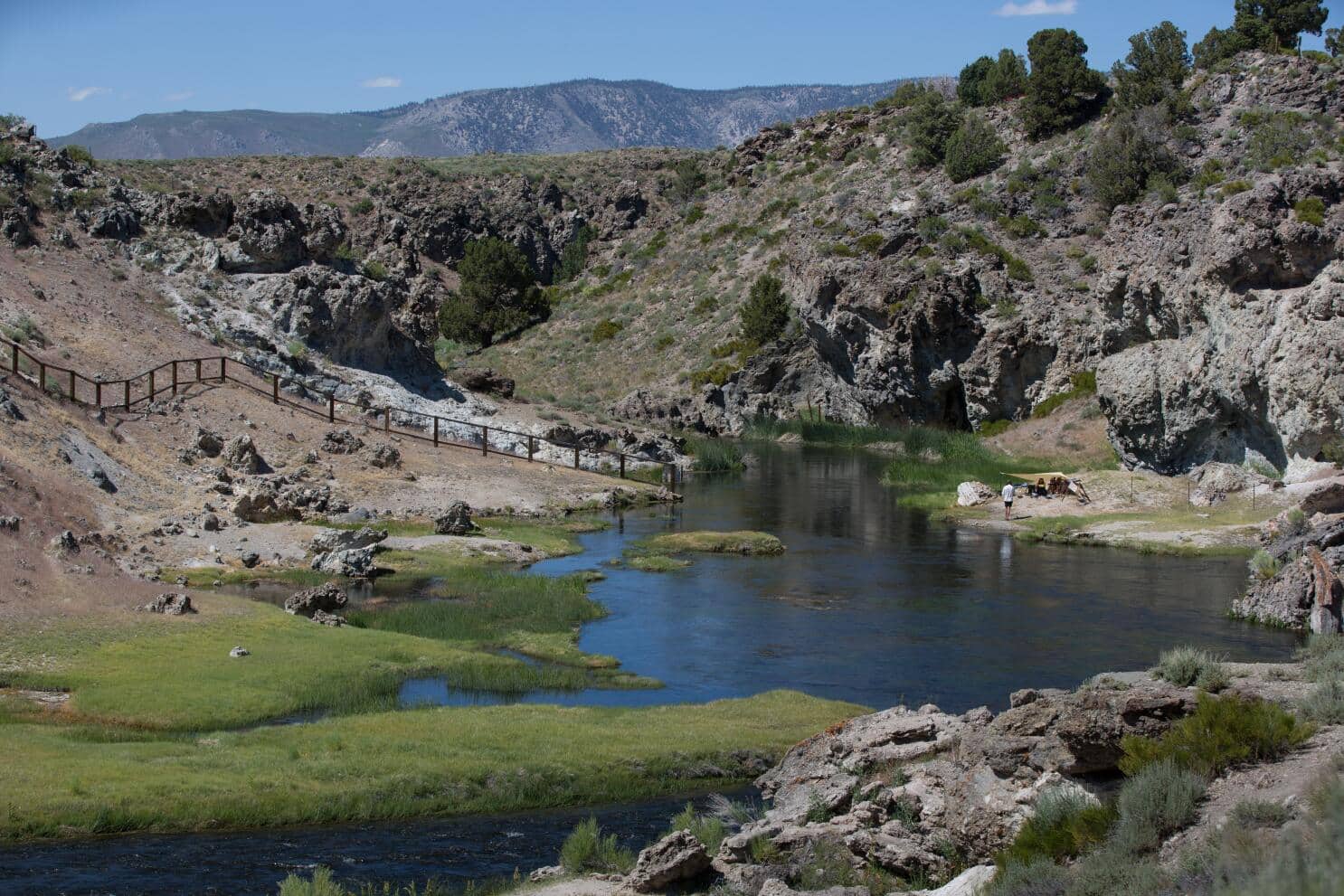
- It is located in the Eastern Sierra Nevada Mountains of California, United states of America (USA).
- It is a dormant supervolcano.
- It was formed by a super-eruption about 760,000 years ago that blasted 140 cubic miles of magma, covering much of east-central California in hot ash that was blown as far away as present-day Nebraska.
- It has been unleashing earthquake swarms on a regular basis since 1978, raising concerns that it might be at risk of erupting.
What is Caldera?
- It is a depression created after a volcano releases the majority of the contents of its magma chamber in an explosive eruption.
- Without any structural support below, the land around the erupting volcanic vent or vents collapses inwardly, creating the bowl-shaped caldera.
- A caldera-causing eruption is the most devastating type of volcanic eruption.
- These are formed by the inward collapse of a volcano.
- Calderas may have parts of their sides missing because land collapses unevenly.
- Types of Calderas
- Crater-Lake Calderas: It is a result from the collapse of a stratovolcano after a Plinian eruption, the most explosive type of volcanic eruption.
- Plinian eruptions release massive amounts of lava, volcanic ash, and rocks.
- Shield Volcano Calderas: These calderas do not result from singular explosive eruptions.
- They instead subside in gradual stages, due to the episodic release of lava. This less-explosive release of lava, known as lava fountaining, is characteristic of shield volcanoes.
- As a shield volcano periodically releases lava, it produces nested or terraced depressions rather than a large bowl-shaped caldera.
- It is composed of dormant and active shield volcanoes.
- Resurgent Calderas: These are the largest volcanic structures on Earth.
- They are not associated with one particular volcano, but instead result from the widespread collapse of vast magma chambers.
- This caldera collapse is produced by incredibly destructive eruptions known as pyroclastic sheet flows, the likes of which have not occurred in historic times.
Q1) What is a volcano?
It is a geological feature on the Earth’s surface that is characterized by the eruption of molten rock, ash, and gases from beneath the Earth’s crust. Volcanoes are a result of the Earth’s dynamic processes, primarily driven by the movement of tectonic plates.
Source: California’s supervolcano shows signs of activity, over 2,000 earthquakes rumble beneath valley


 Last updated on Oct, 2026
→ UPSC 2027 Notification will be released on 13 January 2027 at upsconline.nic.in.
→ Check Nobel Prize 2026 Winners List here.
→ Download PIB PRiSM Monthly Magazine 2026 here.
→ Check UPSC Monthly Current Affairs Magazine The Recitals here.
→ Check out the latest UPSC Syllabus here.
→ Download UPSC Model Answers for Mains 2026
→ UPSC Mains Question Paper 2026 is out now for Essay & GS Paper 1, 2, 3 & 4.
→ UPSC Calendar 2027 has been released.
→ Enroll in Vajiram & Ravi’s UPSC Mains Test Series 2027 for structured answer writing practice, expert evaluation, and exam-oriented feedback.
→ Join Vajiram & Ravi’s UPSC Mentorship Program 2027 for personalized guidance, strategy planning, and one-to-one support from experienced mentors.
→ Go through the UPSC Mains Previous Year Papers to enhance your preparation.
→ UPSC has released UPSC Toppers List 2025 with the Civil Services final result on its official website.
→ Also check Best UPSC Coaching in India