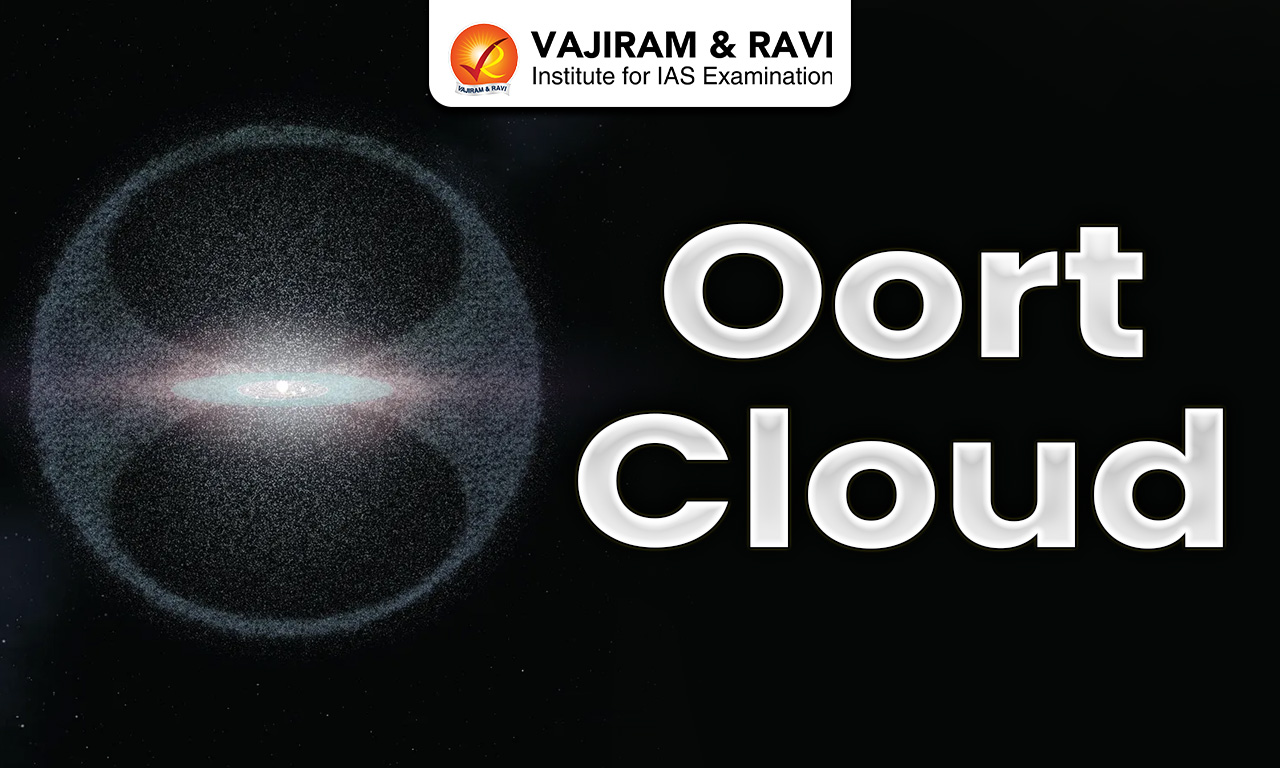
The Oort Cloud is a vast, distant reservoir of icy bodies surrounding the Sun, planets and Kuiper Belt objects in the outermost solar system. First proposed in 1950 by Jan Oort, it explains the origin of long period comets. This spherical cloud exists far beyond visible planetary regions and remains undetected directly, yet plays a crucial role in understanding solar system formation and comet dynamics.
Oort Cloud
The Oort Cloud is a distant spherical shell of icy objects supplying long period comets and shaped by gravitational forces across the Solar System.
- Distance and Scale: The cloud extends roughly from 5,000 to 100,000 astronomical units, far beyond Neptune. At such distances, sunlight can take months to reach and it lies nearly halfway to the nearest stars.
- Voyager Interstellar Mission (VIM): Voyager 1 was launched in 1977 and is currently in interstellar space as of March 2026. It travels about one million miles daily but may take nearly 300 years to enter the inner Oort Cloud and up to 30,000 years to exit its outer boundary.
- Formation Process: Formed around 4.6 billion years ago, icy planetesimals were scattered outward by giant planets like Jupiter, while galactic tidal forces stabilized them into a distant spherical distribution.
- Comet Source: It contains trillions of icy bodies under 100 km, acting as the primary origin of long period comets, often perturbed inward by stellar passages or galactic gravitational influences.
- Scientific Significance: A Harvard theory links Oort Cloud objects to the Chicxulub impactor, suggesting gravitational interactions and tidal disruption could send large bodies toward Earth, causing major extinction events.


 Last updated on Oct, 2026
→ UPSC 2027 Notification will be released on 13 January 2027 at upsconline.nic.in.
→ Check Nobel Prize 2026 Winners List here.
→ Download PIB PRiSM Monthly Magazine 2026 here.
→ Check UPSC Monthly Current Affairs Magazine The Recitals here.
→ Check out the latest UPSC Syllabus here.
→ Download UPSC Model Answers for Mains 2026
→ UPSC Mains Question Paper 2026 is out now for Essay & GS Paper 1, 2, 3 & 4.
→ UPSC Calendar 2027 has been released.
→ Enroll in Vajiram & Ravi’s UPSC Mains Test Series 2027 for structured answer writing practice, expert evaluation, and exam-oriented feedback.
→ Join Vajiram & Ravi’s UPSC Mentorship Program 2027 for personalized guidance, strategy planning, and one-to-one support from experienced mentors.
→ Go through the UPSC Mains Previous Year Papers to enhance your preparation.
→ UPSC has released UPSC Toppers List 2025 with the Civil Services final result on its official website.
→ Also check Best UPSC Coaching in India
Oort Cloud FAQs
Q1. What is the Oort Cloud?+
Q2. Who discovered the Oort Cloud?+
Q3. How far is the Oort Cloud from the Sun?+
Q4. Does Voyager 1 reach the Oort Cloud?+
Q5. Why is the Oort Cloud important?+
Tags: astronomy oort cloud space science