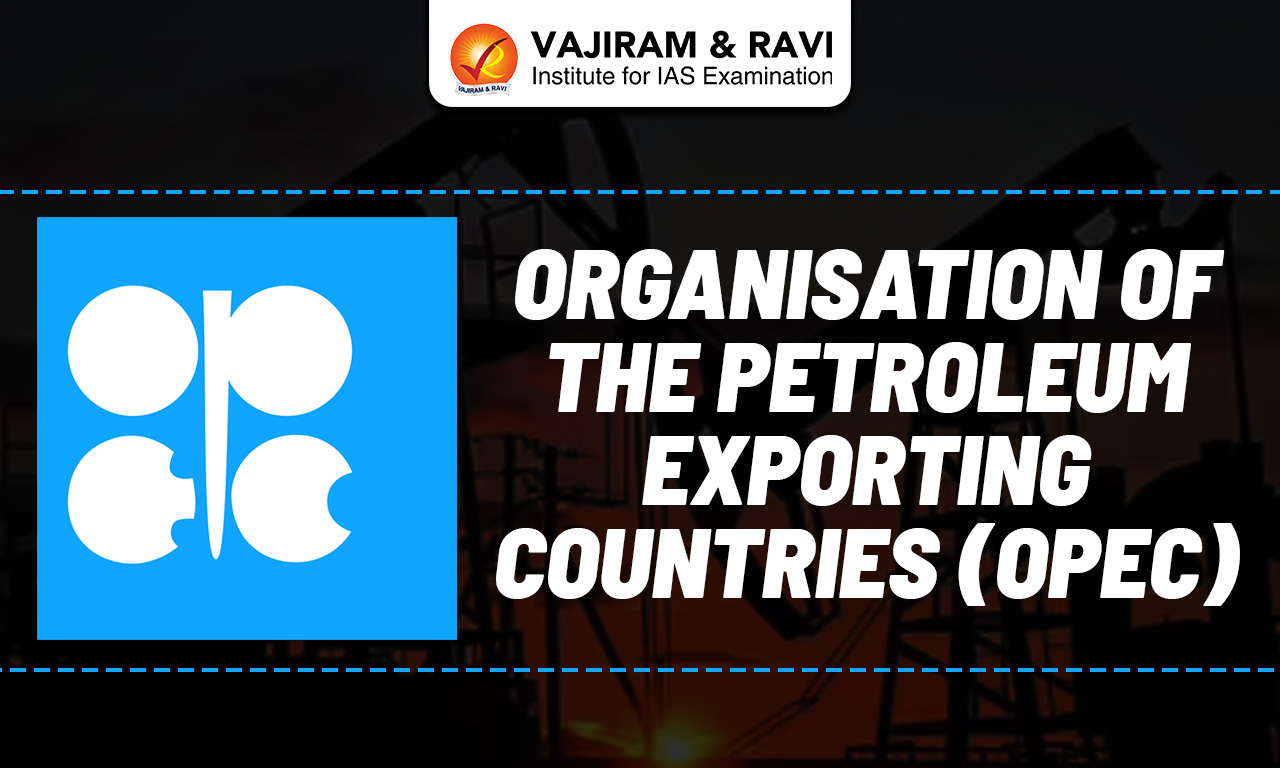
Organisation of the Petroleum Exporting Countries (OPEC) is a key global oil organization shaping petroleum supply, pricing and policies among major oil producing nations worldwide. It plays a central role in influencing global energy markets through coordinated actions.
Why is OPEC in News?
The OPEC is currently in news due to a major geopolitical development related to the exit of the United Arab Emirates from OPEC and OPEC+ as announced on 28 April 2026, with effect from 1 May 2026 after more than 50 years of membership.
UAE Exits OPEC and OPEC+
UAE Leaves OPEC and OPEC+ due to strategic, political and economic reasons amid global energy crisis and geopolitical tensions in the Gulf region. The major factors for the Exit of United Arab Emirates can be seen below:
- Strategic Policy Decision: UAE Exits OPEC after reviewing its long term energy strategy. The government wants flexibility in production decisions without being bound by OPEC quotas and restrictions.
- Production Freedom: Outside OPEC, UAE can increase oil output freely. It aims to expand production capacity from about 3.4 million barrels per day to nearly 5 million barrels by 2027.
- Saudi Arabia Factor: A major reason behind OPEC UAE Exit is disagreement with Saudi Arabia over production levels. Saudi Arabia preferred lower output, while UAE wanted higher production to maximize profits.
- Iran War Impact: The ongoing Iran conflict disrupted oil supply routes like the Strait of Hormuz. This reduced OPEC Oil Production significantly and exposed internal divisions among Gulf nations.
- Pakistan Factor: UAE showed dissatisfaction with Pakistan’s neutral stance during the Iran conflict. It also reacted to Pakistan’s close ties with Saudi Arabia, contributing to geopolitical tensions.
- Geopolitical Realignment: UAE is strengthening ties with the United States and Israel. Leaving OPEC allows it to act independently and gain strategic influence in global energy markets.
- Economic Motivation: UAE aims to capture larger global market share and benefit from rising demand. It wants to monetize its reserves before global transition to renewable energy reduces oil demand.


What is OPEC?
Organisation of the Petroleum Exporting Countries (OPEC) is an intergovernmental body coordinating oil policies among member nations. The key details related to OPEC has been listed below:
- OPEC Full Form: OPEC stands for Organization of the Petroleum Exporting Countries.
- Establishment: It was founded at the Baghdad Conference during September 10-14, 1960 and formally began functioning in 1961 with five founding countries.
- Founding Members: The original OPEC Members were Saudi Arabia, Iran, Iraq, Kuwait and Venezuela. These nations aimed to control oil pricing policies and protect their economic interests from multinational oil companies.
- OPEC Headquarters: The OPEC Headquarters was initially located in Geneva, Switzerland, but was shifted to Vienna, Austria in 1965, where it continues to function as the central administrative hub.
- OPEC Purpose: The main OPEC Purpose is to coordinate petroleum policies, ensure stable oil markets, maintain fair prices for producers and provide regular supply of petroleum to global consumers efficiently.
- OPEC Structure: The organization includes the Conference, Board of Governors and Secretariat. The Secretariat handles research, implementation of decisions and technical analysis related to OPEC Oil and global energy trends.
- Global Share: OPEC Countries collectively hold nearly four fifths of global proven oil reserves and contribute around two fifths of world oil production, making them highly influential in OPEC Oil Production decisions.
OPEC History
The History of Organisation of the Petroleum Exporting Countries (OPEC) reflects the evolution of oil politics, production control and global economic influence since its formation in 1960.
- Early Phase (1960s): OPEC Established to prevent oil price cuts by major companies. During this period, it focused on asserting control over petroleum resources and stabilizing falling oil prices globally.
- Rise in Power (1970s): OPEC gained prominence by increasing oil prices significantly during 1973 oil crisis. Prices rose sharply due to supply restrictions and geopolitical tensions, increasing its global influence.
- Market Challenges (1980s): Oil demand declined, causing price collapse below $10 per barrel. Internal conflicts like Iran-Iraq war weakened unity, forcing members to shift focus from price control to market share.
- Stabilization Phase (1990s): OPEC adopted production quotas and coordinated with non members. It managed crises like Gulf War and worked toward balancing global oil demand and supply.
- Global Integration (2000s): OPEC became more cooperative with countries like Russia and Norway. Oil prices surged before falling during the global financial crisis, increasing volatility in OPEC Oil markets.
- Modern Era (2010s-2020s): Climate concerns, COVID 19 pandemic and energy transitions shaped OPEC History. The group implemented large production cuts in 2020 to stabilize collapsing oil demand globally.
OPEC Member Countries List
Organisation of the Petroleum Exporting Countries (OPEC) Member Countries include major oil exporters with varying reserves, production capacity and geopolitical influence shaping global energy markets.
- Algeria: Algeria is a North African OPEC Member with significant natural gas and oil reserves. It plays a strategic role in supplying energy to European markets and maintaining regional energy stability.
- Congo: The Republic of the Congo joined OPEC in 2018. It has moderate oil reserves and contributes to African oil exports, supporting its economy through petroleum revenues.
- Equatorial Guinea: This small African country joined in 2017. It depends heavily on oil exports, making it a crucial part of OPEC Countries in terms of production diversification.
- Gabon: Gabon initially joined in 1975, left in 1995 and rejoined in 2016. Its economy relies significantly on oil exports despite relatively smaller production levels.
- Iran: Iran holds one of the largest oil reserves globally. It is a key OPEC Member, though its production is often affected by sanctions and geopolitical tensions.
- Iraq: Iraq has vast oil reserves and plays an important role in OPEC Oil Production. Its output levels are high due to increasing domestic demand and reconstruction needs.
- Kuwait: Kuwait has very large per capita oil reserves and often adjusts production levels strategically to stabilize oil markets within OPEC Members.
- Libya: Libya possesses significant reserves but faces instability due to internal conflicts, affecting its ability to maintain consistent OPEC Oil output levels.
- Nigeria: Nigeria is Africa’s largest oil producer in OPEC. It contributes significantly to global supply but faces challenges like infrastructure issues and oil theft.
- Saudi Arabia: Saudi Arabia is the most influential OPEC Member, controlling about one-third of OPEC reserves. It plays a leading role in setting production levels and stabilizing oil prices globally.
- United Arab Emirates: UAE joined in 1967 and has major reserves, especially in Abu Dhabi. It is one of the few countries with spare production capacity in the OPEC UAE structure. However it has announced its exit on April 28th effective from May 01st 2026.
- Venezuela: Venezuela has the world’s largest proven oil reserves. However, economic and political crises have reduced its actual production significantly over the years.

 Last updated on Oct, 2026
→ UPSC 2027 Notification will be released on 13 January 2027 at upsconline.nic.in.
→ Asian Games 2026 are being held in Aichi-Nagoya, Japan, from 19 September to 4 October.
→ Check Nobel Prize 2026 Winners List here.
→ Download PIB PRiSM Monthly Magazine 2026 here.
→ Check UPSC Monthly Current Affairs Magazine The Recitals here.
→ Check out the latest UPSC Syllabus here.
→ Download UPSC Model Answers for Mains 2026
→ UPSC Mains Question Paper 2026 is out now for Essay & GS Paper 1, 2, 3 & 4.
→ UPSC Calendar 2027 has been released.
→ Enroll in Vajiram & Ravi’s UPSC Mains Test Series 2027 for structured answer writing practice, expert evaluation, and exam-oriented feedback.
→ Join Vajiram & Ravi’s UPSC Mentorship Program 2027 for personalized guidance, strategy planning, and one-to-one support from experienced mentors.
→ Go through the UPSC Mains Previous Year Papers to enhance your preparation.
→ UPSC has released UPSC Toppers List 2025 with the Civil Services final result on its official website.
→ Also check Best UPSC Coaching in India
OPEC FAQs
Q1. What is the full form of OPEC?+
Q2. When was OPEC established?+
Q3. Where is the OPEC Headquarters located?+
Q4. Why did UAE leave OPEC?+
Q5. How does OPEC impact global oil prices?+
Tags: opec+