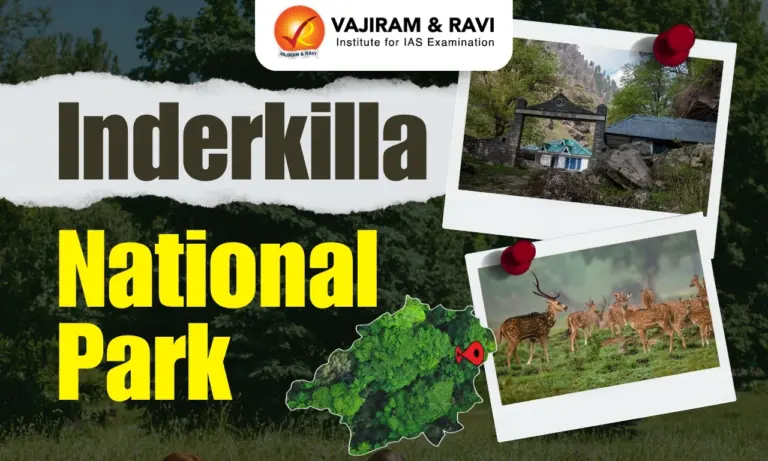
Inderkilla National Park is a protected natural area located in the mountainous region of northern India. It is known for its beautiful landscapes, dense forests, and rich biodiversity. The park includes a mix of hills, valleys, and alpine environments, which provide suitable habitats for various plant and animal species. It plays an important role in wildlife conservation and maintaining the ecological balance of the region.
Inderkilla National Park Location
- Inderkilla National Park is located in the Kullu district of Himachal Pradesh, in the beautiful Kullu Valley, which is known for its scenic mountains and pleasant climate.
- The park was established in 2010 and covers an area of about 104 square kilometres, making it a moderately sized protected area in the Himalayan region.
- It is situated very close to Manali, one of the most popular hill stations in India.
- The park lies along the route to Hampta Valley, and nearby villages like Prini, Sethan, and Hamtagarh fall within its surrounding region.
- Due to its location in the Western Himalayas, the park has a mix of different landscapes including forests, hills, and alpine areas.
- An Eco-Sensitive Zone (ESZ) of about 47.2 sq. km has been declared in 2018 around the park to protect its fragile environment from harmful human activities.
Also Read : National Parks in Himachal Pradesh
Inderkilla National Park Geography
- The park is mainly covered with hilly terrain, deep valleys, and dense forests, which create a rich and varied natural environment.
- The landscape changes with altitude, starting from lower forested areas and gradually moving towards high-altitude alpine zones.
- It includes a variety of ecosystems such as coniferous forests, alpine meadows, and subalpine regions, each supporting different types of life. The terrain is rugged and uneven.
- Landslides and soil erosion may occur in some parts due to the fragile mountain structure.
- The variation in altitude leads to different climatic conditions within the park, influencing vegetation and wildlife.
- The park’s landscape plays a key role in supporting water sources and natural drainage systems.


Inderkilla National Park River System
- The Beas River flows near the park and serves as a major water source for wildlife and vegetation.
- It originates from Beas Kund near Rohtang Pass and flows through the Kullu Valley.
- The river supports agriculture, forests, and local communities, especially in nearby villages.
- It plays a crucial role in maintaining the ecological balance and hydrological cycle of the region.
- Seasonal variations in water flow affect animal movement and plant growth.
- The riverbanks often have denser vegetation, which attracts herbivores and other wildlife.
- The river contributes to soil fertility in surrounding areas, supporting plant life.
- Smaller streams and tributaries connected to the Beas River further enhance water availability in the park.
Inderkilla National Park Vegetation (Flora)
- Inderkilla National Park has a rich variety of vegetation, ranging from dense forests to alpine meadows.
- The forests include western mixed coniferous forests, with trees like deodar, pine, fir, and spruce.
- It also has moist temperate forests with species such as oak, maple, and rhododendron, which add to the greenery.
- At higher altitudes, subalpine and alpine vegetation is found, including grasses, shrubs, and seasonal wildflowers.
- Plants like juniper and birch grow in colder regions, showing adaptation to harsh climatic conditions.
- The park is also rich in medicinal plants, which are important for traditional healing practices.
- Vegetation changes seasonally, with lush greenery in summer and snow-covered landscapes in winter.
- Forests provide food and shelter for wildlife, making them essential for ecological balance.
- Over time, human activities like grazing can affect plant diversity and forest health.
- The diversity of flora also supports pollinators, insects, and small organisms, maintaining the ecosystem.
- The diversity of plant life supports a wide range of animals and helps maintain ecological balance.
Inderkilla National Park Wildlife (Fauna)
- The park is home to a wide variety of wild animals, including leopard, Himalayan black bear, brown bear, and snow leopard.
- Herbivores such as musk deer, barking deer, ibex, goral, and mountain goats are commonly found in different habitats.
- Smaller mammals like civets, martens, porcupines, flying squirrels, and jungle cats also contribute to biodiversity.
- The park supports many bird species (over 250), including Himalayan monal, western tragopan, and other migratory birds, making it a paradise for birdwatchers.
- Reptiles and insects are also present, though they are less visible due to the cooler climate.
- Many animals here are rare or endangered, and the park plays an important role in their protection.
Ecological and Conservation Importance
- Inderkilla National Park plays an important role in protecting Himalayan biodiversity and maintaining ecological balance.
- It serves as a habitat for many endangered and rare species, especially large mammals like the snow leopard.
- The Eco-Sensitive Zone helps in reducing human pressure and preserving the natural environment.
- Forests in the park help in soil conservation, climate regulation, and water management.
- Conservation efforts focus on balancing tourism and environmental protection.
- The park is also important for research and environmental education, helping people understand mountain ecosystems.

 Last updated on Oct, 2026
→ UPSC 2027 Notification will be released on 13 January 2027 at upsconline.nic.in.
→ Asian Games 2026 are being held in Aichi-Nagoya, Japan, from 19 September to 4 October.
→ Check Nobel Prize 2026 Winners List here.
→ Download PIB PRiSM Monthly Magazine 2026 here.
→ Check UPSC Monthly Current Affairs Magazine The Recitals here.
→ Check out the latest UPSC Syllabus here.
→ Download UPSC Model Answers for Mains 2026
→ UPSC Mains Question Paper 2026 is out now for Essay & GS Paper 1, 2, 3 & 4.
→ UPSC Calendar 2027 has been released.
→ Enroll in Vajiram & Ravi’s UPSC Mains Test Series 2027 for structured answer writing practice, expert evaluation, and exam-oriented feedback.
→ Join Vajiram & Ravi’s UPSC Mentorship Program 2027 for personalized guidance, strategy planning, and one-to-one support from experienced mentors.
→ Go through the UPSC Mains Previous Year Papers to enhance your preparation.
→ UPSC has released UPSC Toppers List 2025 with the Civil Services final result on its official website.
→ Also check Best UPSC Coaching in India
Inderkilla National Park FAQs
Q1. Where is Inderkilla National Park located?+
Q2. When was Inderkilla National Park established and what is its area?+
Q3. What type of landscape is found in Inderkilla National Park?+
Q4. Which river is associated with Inderkilla National Park?+
Q5. What kind of vegetation is found in Inderkilla National Park?+
Tags: environment environment notes inderkilla national park