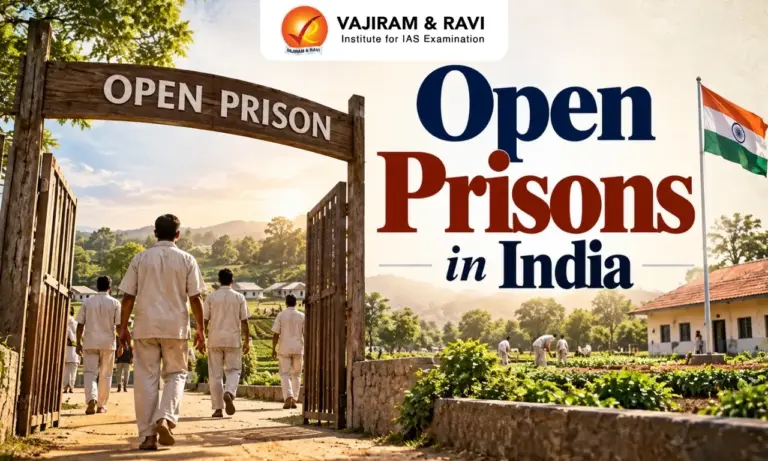
Open Prisons in India are an important part of the prison reform system, focusing on the rehabilitation and reintegration of prisoners into society. They provide a more flexible environment with fewer security restrictions, encouraging self-discipline, responsibility and personal development.
Open Prisons in India Features
Open Prisons in India have minimal security restrictions and provide eligible prisoners with greater freedom and responsibility. Their key features focus on rehabilitation, skill development, self-discipline and social reintegration.
- No walls, bars or armed guards: Open prisons are semi-open or open correctional facilities that rely on inmate self-discipline and community involvement. The Rajasthan Open Air Camp Rules, 1972 describe them as “prisons without walls, bars and locks.”
- Freedom to work outside: Inmates can leave during fixed hours to earn a living and support their families. In Rajasthan there is a 6 a.m. roll call and a 7 p.m. roll call, and inmates must return before the second one.
- Earnings stay with the family: Inmates spend their wages on their families. Only a small administrative charge goes to the jail.
- Family life is possible: In open colonies, families can live with the inmate. At Sanganer (Jaipur), convicts build their own houses, pay for water and electricity, and send their children to nearby schools.
- Based on the reformative theory of justice: The thinking is that a convict can change. It rests on the idea of “trust begets trust” and on Sir Alexander Paterson’s view that a person is sent to prison as punishment, not for punishment.
- Only for convicts, and only selected ones: Transfer is never automatic. A screening committee checks good conduct, physical and mental fitness and reform potential. Most states also require a minimum time in a closed prison: one-third of the sentence in Rajasthan, two-thirds at Anantapur, and five years in some states.
- A State subject: Prisons fall under Entry 4, List II (State List) of the Seventh Schedule. They are governed by the Prisons Act, 1894, the Prisoners Act, 1900 and each state’s own rules and manuals.
- A strong track record: Open prisons have run in India for nearly eight decades with almost no reports of prisoners escaping.
- Key dates in history:
- The first open prison was set up in 1905 in the Bombay Presidency, initially using prisoners as unpaid labour for public works.
- Uttar Pradesh was the first state in independent India to establish an open-air prison camp, attached to the Model Prison in Lucknow in 1949.
- A full camp followed in 1953, where inmates helped build the Chandraprabha dam near Varanasi.
- Rajasthan’s first camp opened at Sanganer in 1963. These camps were popularly called Sampurnanand camps, after the reformist leader who promoted them.
- How many exist: According to the World Prison Brief, based on National Crime Records Bureau (NCRB) data, India had 103 open jails as of 31 December 2024. These were spread across the country, with open prisons operating in 17 states, according to earlier reports.
Open Prisons in India Objectives
Open prisons aim to reform prisoners, develop skills and support their reintegration into society.
- Reform, not just punishment: The main aim is to turn prisoners into law-abiding citizens through self-discipline, work and community contact.
- Gradual return to society (re-socialisation): Long years behind bars cut people off from the outside world. Open prisons help inmates reconnect slowly before release. In India, this is the main reason convicts are sent to open jails.
- Ease prison overcrowding: Moving suitable convicts to open facilities lowers the load on closed, high-security prisons.
- Protect dignity and human rights: The Supreme Court has held that a person in prison does not become a “non-person” and keeps all human rights within the limits of imprisonment.
- Build skills and independence: Farming, animal husbandry, factory work and vocational training help inmates earn a living after release.
- Keep families together: Staying close to relatives reduces the damage long sentences do to families, especially when the inmate was the sole breadwinner.
- Cut costs: Open prisons need far less security staff and infrastructure than closed ones.
- Follow global standards: The UN’s Nelson Mandela Rules (2015) support rehabilitation, employment and contact with the outside world. The idea of open penal institutions was discussed at the first UN Congress on crime prevention in Geneva (1955), and the All India Jail Manual Committee (1957-59) recommended them for India.


Types of Open Prisons in India and Their Functioning
Open Prisons in India vary in their security levels and degree of freedom, offering prisoners opportunities for work, skill development and rehabilitation.
- The Model Prison Manual classifies open institutions into three types, arranged in rising order of freedom.
- Semi-open training institutions:
- They are attached to closed prisons, just beyond the enclosed perimeter, with moderate security.
- Inmates who show reform potential are prepared here for transfer to fuller open facilities.
- Open training institutions / work camps:
- They are set up where public work is needed, such as digging canals, building dams, roads and government buildings, land reclamation, afforestation and soil conservation.
- Inmates learn vocational skills while doing useful work.
- Open colonies:
- This is the most liberal type. Family members can live with inmates.
- Inmates and families work in agriculture or cottage industries, with wages at par with outside rates. Inmates must support themselves and their families from these wages.
- Common rules across types:
- Every institution has a clearly marked boundary that inmates cannot cross.
- Minimum standards for accommodation, sanitation, hygiene, food and medical care must match those of closed prisons.
- Inmates usually earn higher wages and get extra concessions like remission, leave and review. They can read freely and study through open universities.
- Selection in Maharashtra (Maharashtra Open Prison Rules, 1971):
- A committee of the Inspector General, Deputy Inspector General and the Superintendents of the closed and open prisons decides.
- It looks at good behaviour, mental and physical fitness and period of imprisonment, and can consider special cases even if a prisoner is technically ineligible.
- Selection in Rajasthan:
- The Jail Superintendent sends a list to the Open Air Camp Advisory Committee, which decides.
- Each camp has its own panchayat of 5 to 7 inmates, chosen by the prisoners, who handle daily management. This builds communication and leadership.
- Himachal Pradesh works much like Rajasthan but also bars rape convicts and those with other heinous offences.
- Well-known open prisons:
- Sanganer (Rajasthan): about 25 km from Jaipur, run by very few guards. Convicts live with their families and work within a 10 km radius.
- Anantapur (Andhra Pradesh): a 1,427-acre campus where inmates grow crops and a medicinal herb supplied to a pharma company.
- Nettukaltheri (Kerala): around 300 acres, where even murderers work on a rubber plantation for wages. Inmates get regular home leave, and rubber sales cover the running costs.
- Others: Yerwada, Akola, Kolhapur, Paithan, Sangamner and Bikaner. The Tihar Semi-Open Jail (Delhi) is also seen as a good example.
- Where open jails fit in the wider system:
- India has sub-jails, district jails and central jails, plus special jails, women’s jails, Borstal schools (for juveniles) and open jails.
- Central jails usually hold long-term convicts, often those serving more than two years.
Open Prisons in India Advantages and Disadvantages
Open prisons promote prisoner rehabilitation, reduce overcrowding and help inmates develop skills for successful reintegration into society.
Advantages of Open Prisons in India
- Much cheaper to run: A Rajasthan State Legal Services Authority (RSLSA) study found a closed prison cost about ₹7,094 per prisoner per month (Jaipur Central), against about ₹500 at Sanganer open prison, roughly 78 times cheaper. Only one staff member was needed per 80 prisoners, and the Supreme Court has also noted a similar gap of over ₹3,000 versus about ₹50 per inmate.
- Less overcrowding: On 31 December 2018, India’s prisons held 4,66,084 inmates against a capacity of 3,96,223, an occupancy rate of 117.6%. Open prisons take some of this load and improve living conditions in closed jails.
- Lower chance of reoffending (recidivism): Stigma, lack of skills and failure to reintegrate push many ex-prisoners back to crime. Open prisons tackle this through work, training and family contact.
- Better mental health and real life skills: Gainful work builds self-confidence and self-esteem, while farming, dairy, rubber tapping, factory work and teaching give inmates a livelihood after release.
- Support for families and vulnerable groups: Visits, family stays and home leave let families share the burden of reform. In Dharmbir v. State of UP (1979), the Supreme Court saw benefits for young offenders, and elderly prisoners can also ease back into normal life.
- Safe, trusted and useful to society: Studies found inmates did not escape even without a security barricade, and open prisons also lower the health risk of epidemics like COVID-19 in crowded jails. Inmates can work on rural public works and conservation, which benefits the community too.
Disadvantages of Open Prisons in India
- Under-use despite overcrowding: As of 2015, open prisons had room for 25,776 inmates but held only 3,786, and many states have an open prison with no inmates at all.
- Uneven spread across states: Rajasthan and Maharashtra hold around 60% of open-prison inmates, while states like Goa, Haryana, Jharkhand, Manipur, Mizoram, Nagaland and Telangana had none. Because prisons are a State subject, standards differ widely.
- Strict and sometimes arbitrary eligibility rules: Exclusions can cover women, narcotics convicts, people with a history of mental illness and those convicted of sedition or crimes against the army, and Rajasthan adds limits on age and marital status. Such rules shut out many who need rehabilitation.
- No accountability in selection: Committees are not required to give reasons, which can lead to bias and corruption. Undertrials and fresh convicts are also left out of the system.
- Land shortage and social stigma: Open prisons need large areas of land, which is hard to find today, and society is slow to accept ex-convicts, making jobs and rehabilitation harder.
- Weak laws and political will: The Prisons Act, 1894 has colonial roots and puts custody ahead of reform. Without strict screening and supervision, open prisons may also turn into poorly monitored work camps.
Role of Open Prisons in Prison Reforms and Rehabilitation of Prisoners
- A shift from punishment to reform: Prison thinking has moved from confinement to training, restriction to re-education and retribution to rehabilitation. Open prisons are the clearest form of this change in India.
- Long-standing support from committees and courts: The All India Prison Reforms Committee (1980) recommended open prisons across states, and the NHRC pushed for them in its reports of 1994-95 and 2000-01. In Ramamurthy v. State of Karnataka (1996/1997), the Supreme Court called them one of the most successful uses of individualisation of penalties for social readjustment.
- Tied to the Constitution: Article 14 (equality), Article 15 (non-discrimination) and Article 21 (life and dignity) apply inside prison walls too.
- Latest Supreme Court directions on access and inclusion in Suhas Chakma v. Union of India, WP (C) No. 1082/2020, by Justices Vikram Nath and Sandeep Mehta: States and UTs without OCIs must study feasibility and frame procedures, or arrange transfers to nearby states. Barracks and capacity for women inmates must be created within three months, and broad security concerns cannot justify excluding women.
- Latest Supreme Court directions on fairness and monitoring: Eligibility criteria must be reviewed using the nature of the offence, reform potential and conduct, so OCIs do not become mere labour camps, and states should learn from Maharashtra and Rajasthan. Transfer back to a closed prison cannot be a routine punishment, every state must set up grievance redressal systems, and monitoring committees headed by the State Legal Services Authority chair will oversee compliance, with High Courts starting suo motu cases as continuing mandamus.
- A global and Gandhian model: Norway, Finland, the UK (Category D prisons) and Spain run open or semi-open systems with low reoffending, with early examples like Switzerland’s Witzwill (1891) and the UK’s New Hall Camp (1936). In India, open prisons also resemble Gandhian ashrams, built on shared work and character building.
- What success needs: Strong screening, supervision and trained staff, along with legal aid, tie-ups with welfare agencies, community support and regular data on reoffending, jobs and costs. With uniform rules, fairer selection and wider coverage, open prisons can make Indian prisons more humane and effective.

 Last updated on Oct, 2026
→ UPSC 2027 Notification will be released on 13 January 2027 at upsconline.nic.in.
→ Check Nobel Prize 2026 Winners List here.
→ Download PIB PRiSM Monthly Magazine 2026 here.
→ Check UPSC Monthly Current Affairs Magazine The Recitals here.
→ Check out the latest UPSC Syllabus here.
→ Download UPSC Model Answers for Mains 2026
→ UPSC Mains Question Paper 2026 is out now for Essay & GS Paper 1, 2, 3 & 4.
→ UPSC Calendar 2027 has been released.
→ Enroll in Vajiram & Ravi’s UPSC Mains Test Series 2027 for structured answer writing practice, expert evaluation, and exam-oriented feedback.
→ Join Vajiram & Ravi’s UPSC Mentorship Program 2027 for personalized guidance, strategy planning, and one-to-one support from experienced mentors.
→ Go through the UPSC Mains Previous Year Papers to enhance your preparation.
→ UPSC has released UPSC Toppers List 2025 with the Civil Services final result on its official website.
→ Also check Best UPSC Coaching in India
Open Prisons in India FAQs
Q1. What are open prisons in India?+
Q2. What are the main objectives of open prisons in India?+
Q3. What are the different types of open prisons in India?+
Q4. Which state has the largest number of open prisons in India?+
Q5. What are the major benefits of open prisons?+
Q6. What are the major challenges faced by open prisons in India?+
Q7. Which laws govern open prisons in India?+
Tags: open prisons in india