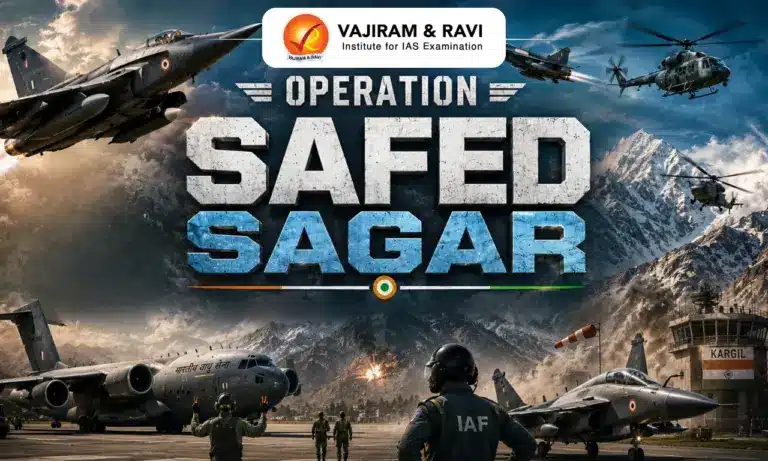
Operation Safed Sagar was the Indian Air Force’s air campaign during the 1999 Kargil War, launched in support of the Indian Army’s Operation Vijay. It involved reconnaissance, intelligence gathering, precision air strikes, close air support, air defence and helicopter operations to help recapture strategic heights occupied by Pakistani forces.
Operation Safed Sagar
Operation Safed Sagar was launched in May 1999 to support the recapture of Indian territory in the Mushko Valley, Drass, Kaksar, Batalik and Turtok areas.
- It was conducted in the extremely difficult high-altitude terrain of the Kargil region, where several enemy positions were located above 16,000-18,000 feet.
- It was the first time the Indian Air Force (IAF) undertook live combat missions at such extreme altitudes.
- A major operational constraint was that Indian aircraft had to conduct missions without crossing the Line of Control (LoC)
Operation Safed Sagar Background and Objective
In 1999, Pakistani soldiers and armed personnel occupied strategic heights on the Indian side of the Line of Control (LoC) in the Kargil sector. These positions provided them with a tactical advantage over important routes, particularly the Srinagar-Leh National Highway.
India launched Operation Vijay to recapture the occupied positions, while the Indian Air Force conducted Operation Safed Sagar to support the ground offensive. Its primary objective was to weaken the intruders’ military position through air strikes against enemy positions and supply lines, while providing intelligence and close air support to Indian troops.


Operation Safed Sagar Conduct and Features
Operation Safed Sagar was conducted through a coordinated combination of reconnaissance, precision strikes and air support.
- Reconnaissance and intelligence: Aerial reconnaissance and ELINT missions identified enemy positions, movements, supply routes and logistic concentrations.
- Targeted air strikes: Fighter aircraft, particularly Mirage-2000s, conducted precision strikes against identified enemy positions using Laser-Guided Bombs and Laser Designator Pods.
- Support to ground operations: Air strikes weakened enemy positions and disrupted their supply lines, thereby supporting the Army’s advance in difficult mountainous terrain.
- Air defence and escort: Escort and air-defence missions protected aircraft operating in the conflict zone.
- Helicopter support: Helicopters were used mainly for casualty evacuation, air transport and logistical support.
- Large-scale operations: The IAF conducted around 5,000 strike missions, 350 reconnaissance/ELINT missions and approximately 800 escort flights, besides more than 2,000 helicopter sorties.
- Operational restraint: Indian aircraft were strictly directed not to cross the Line of Control, requiring careful route planning and precision targeting.
Also Read:- Kargil War
Operation Safed Sagar Challenges
Operation Safed Sagar was conducted under exceptionally difficult operational conditions, which imposed significant limitations on air operations.
- High-altitude terrain: Enemy positions located at heights of around 16,000-18,000 feet made targeting and air operations extremely difficult.
- Limited aircraft performance: Thin air at high altitudes affected aircraft payload, manoeuvrability and operational effectiveness.
- Difficult target identification: Mountainous terrain, camouflage and limited visibility made accurate identification of enemy positions challenging.
- Air defence threats: The loss of a Mi-17 helicopter to a Stinger missile on 28 May 1999 highlighted the vulnerability of helicopters operating against shoulder-fired surface-to-air missiles.
Significance of Operation Safed Sagar
Operation Safed Sagar provided important lessons for air power and high-altitude warfare.
- Air-ground integration: Close coordination between the IAF’s air operations and the Army’s Operation Vijay supported the recapture of enemy-held heights.
- Precision warfare: Mirage-2000 aircraft, equipped with Laser-Guided Bombs and Laser Designator Pods, enabled accurate strikes against fortified positions in mountainous terrain.
- Technological adaptability: The IAF adapted its tactics and weapon employment to overcome the challenges of high-altitude operations.
- Intelligence-led operations: Reconnaissance and ELINT missions improved target identification and supported more effective air strikes.
- Operational support: Over 2,000 helicopter sorties were undertaken for casualty evacuation and air transport, highlighting the vital role of aviation in sustaining high-altitude operations.
- Strategic restraint: Operations were conducted without crossing the LoC, demonstrating the use of calibrated military power while limiting the risk of wider escalation.

 Last updated on Oct, 2026
→ UPSC 2027 Notification will be released on 13 January 2027 at upsconline.nic.in.
→ Check Nobel Prize 2026 Winners List here.
→ Download PIB PRiSM Monthly Magazine 2026 here.
→ Check UPSC Monthly Current Affairs Magazine The Recitals here.
→ Check out the latest UPSC Syllabus here.
→ Download UPSC Model Answers for Mains 2026
→ UPSC Mains Question Paper 2026 is out now for Essay & GS Paper 1, 2, 3 & 4.
→ UPSC Calendar 2027 has been released.
→ Enroll in Vajiram & Ravi’s UPSC Mains Test Series 2027 for structured answer writing practice, expert evaluation, and exam-oriented feedback.
→ Join Vajiram & Ravi’s UPSC Mentorship Program 2027 for personalized guidance, strategy planning, and one-to-one support from experienced mentors.
→ Go through the UPSC Mains Previous Year Papers to enhance your preparation.
→ UPSC has released UPSC Toppers List 2025 with the Civil Services final result on its official website.
→ Also check Best UPSC Coaching in India
Operation Safed Sagar FAQs
Q1. What was Operation Safed Sagar?+
Q2. When and where was Operation Safed Sagar conducted?+
Q3. What were the key features of Operation Safed Sagar?+
Q4. What were the major challenges of Operation Safed Sagar?+
Q5. What was the significance of Operation Safed Sagar?+
Tags: operation operation safed sagar operations of india