Ottawa Convention Latest News
Poland’s withdrawal from the Ottawa Convention, as announced by the Prime Minister recently, is a strategic maneuver that allows the country to deploy anti-personnel mines swiftly along its eastern borders if necessary.
About Ottawa Convention
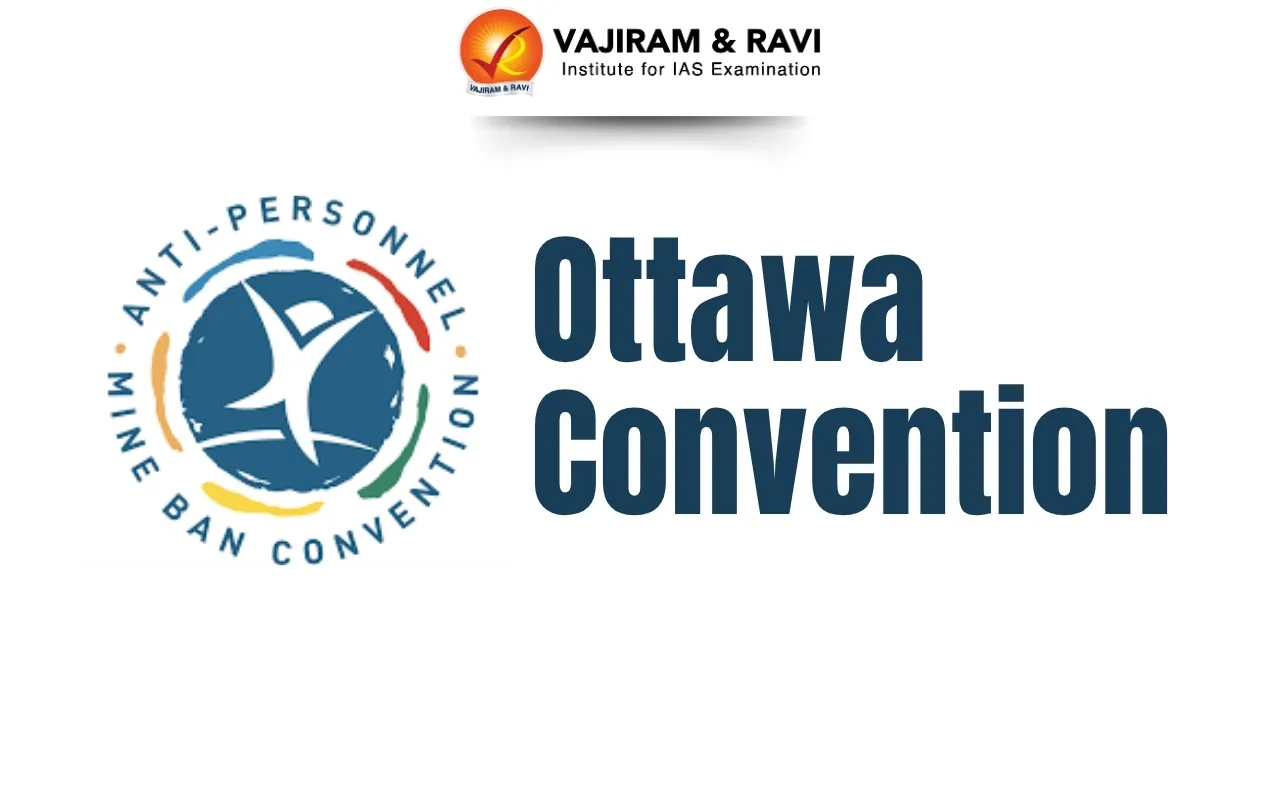
- The Ottawa Convention, also referred to as the “Mine Ban Treaty,” prohibits the use, stockpiling, production, and transfer of anti-personnel landmines (APLs).
- It requires states-parties to destroy their stockpiled APLs within four years and eliminate all APL holdings, including mines currently planted in the soil, within 10 years.
- Countries may request a renewable extension, which can be up to 10 years long, to fulfill their destruction obligations.
- States-parties are also required annually to report their total APL stockpiles, the technical characteristics of their APLs, the location of all mined areas, and the status of APL destruction programs.
- The convention, which is of unlimited duration and open to all nations, entered into force on March 1, 1999.
- The Treaty has 164 States Parties, including 34 out of the 50 States that produced mines before 1997, and 33 Signatories.
- However, six major countries remain outside the Convention: China, India, Pakistan, Republic of Korea, Russian Federation and United States.
- States Party to the Ottawa Treaty commit to
- Never use APLs, nor “develop, produce, otherwise acquire, stockpile, retain, or transfer” them;
- Clear mined areas in their territory within 10 years;
- In mine-affected countries, conduct mine risk education and ensure that mine survivors, their families, and communities receive comprehensive assistance;
- Offer assistance to other States Parties, for example, in providing for survivors or contributing to clearance programs;
- Adopt national implementation measures (such as national legislation) in order to ensure that the terms of the treaty are upheld in their territory.
Source: DEVD


 Last updated on Oct, 2026
→ UPSC 2027 Notification will be released on 13 January 2027 at upsconline.nic.in.
→ Asian Games 2026 are being held in Aichi-Nagoya, Japan, from 19 September to 4 October.
→ Check Nobel Prize 2026 Winners List here.
→ Download PIB PRiSM Monthly Magazine 2026 here.
→ Check UPSC Monthly Current Affairs Magazine The Recitals here.
→ Check out the latest UPSC Syllabus here.
→ Download UPSC Model Answers for Mains 2026
→ UPSC Mains Question Paper 2026 is out now for Essay & GS Paper 1, 2, 3 & 4.
→ UPSC Calendar 2027 has been released.
→ Enroll in Vajiram & Ravi’s UPSC Mains Test Series 2027 for structured answer writing practice, expert evaluation, and exam-oriented feedback.
→ Join Vajiram & Ravi’s UPSC Mentorship Program 2027 for personalized guidance, strategy planning, and one-to-one support from experienced mentors.
→ Go through the UPSC Mains Previous Year Papers to enhance your preparation.
→ UPSC has released UPSC Toppers List 2025 with the Civil Services final result on its official website.
→ Also check Best UPSC Coaching in India
Ottawa Convention FAQs
Q1. What is the Ottawa Convention?+
Q2. What activities related to anti-personnel landmines are banned under the Ottawa Convention?+
Q3. When did the Ottawa Convention enter into force?+
Q4. Is India part of the Ottawa Convention?+
Tags: ottawa convention