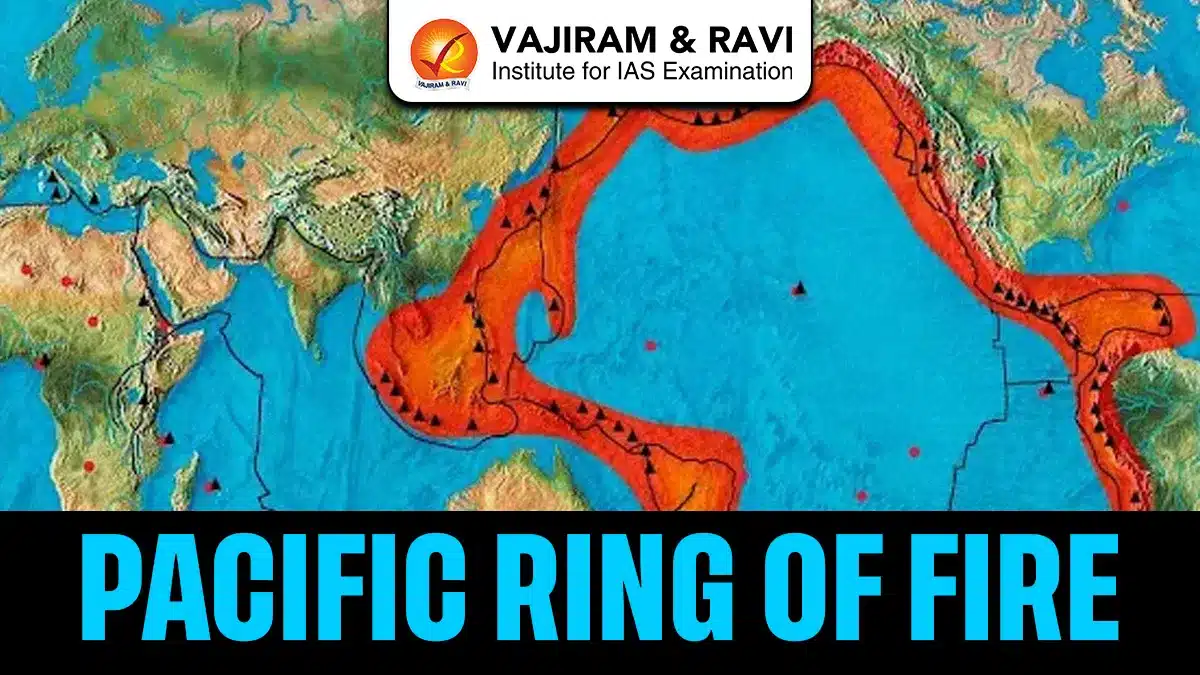
The Pacific Ring of Fire, also called the Circum-Pacific Belt, is a 40,000 km long ring-shaped zone around the Pacific Ocean. It is the most seismically and volcanically active region on Earth, accounting for about 75% of the world’s active volcanoes and nearly 90% of global earthquakes.
Pacific Ring Of Fire Geographical Extent
The Pacific Ring of Fire encircles the Pacific Ocean, stretching from New Zealand, along Indonesia, Japan, Philippines, and then along the Rockies and Andes.
Antarctica, Bolivia, Chile, Ecuador, Peru, Costa Rica, Guatemala, Mexico, the United States, Canada, Russia, Japan, Philippines, Australia, Papua New Guinea, Indonesia, New Zealand, and are among the major regions situated along the Ring of Fire.
Pacific Ring of Fire Formation
The Pacific Ring of Fire was formed mainly due to convergent plate boundaries where the denser oceanic plate subducts the lighter continental plate.
- Major Oceanic Plates involved are Pacific Plate (main plate), Nazca Plate, Cocos Plate, Philippine Sea Plate, Juan de Fuca Plate.
- Major Continental Plates involved are North American Plate, South American Plate, Eurasian Plate, Indo-Australian Plate, Antarctic Plate.
- The Oceanic Pacific plate is subducting beneath the Indo-Australian, Eurasian, North and South American, and Antarctic plates. As the oceanic plate goes deeper, it melts due to heat, significantly increasing the amount of magma. The increased magma pressure leads to violent volcanic eruptions as magma finds its way through the weakest parts of the mountain, typically the top.
- The zone of subduction is known as the Benioff zone, which forms trenches (ocean deeps) – the deepest points on Earth.
- Continuous plate movement causes friction and stress accumulation along plate boundaries. When the accumulated stress exceeds the strength of rocks, it is released abruptly in the form of seismic waves, producing frequent and powerful earthquakes.


Pacific Ring of Fire Geological Features
Major geological features of Pacific Ring of Fire are:
- Fold Mountains / Continental Volcanic Arcs: Formed parallel to oceanic trenches due to compression and Volcanism.
- Examples: Andes (South America), Rockies (North America).
- Deep-sea trenches: Formed at subduction zones where oceanic plates bend downwards.
- Example: Mariana Trench – deepest point on Earth.
- Frequent and violent volcanic eruptions.
- Earthquakes due to plate collision, subduction, and magma movement.
- Tsunamis, when strong earthquakes occur under the ocean.
Pacific Ring of Fire Major Volcanoes
Subduction of oceanic plates below the continental increases the magma pressure which leads to violent volcanic eruptions. Major volcanoes located in the region are:
- Mount Fuji (Japan)
- Mount Krakatoa (Indonesia)
- Mount Mayon (Philippines)
- Mount Shasta (USA)
- Mount Ruapehu / Cook region (New Zealand)
Pacific Ring of Fire Major Trenches
- Mariana Trench, the deepest in the world, located in western Pacific Ocean near Philippines
- Peru–Chile (Atacama) Trench located off the west coast of South America
- Aleutian Trench located south of Alaska
- Kuril–Kamchatka Trench located off eastern Russia
- Japan Trench located east of Japan
- Philippine Trench located east of the Philippines
- Java (Sunda) Trench located south of Indonesia
- Tonga–Kermadec Trench located north of New Zealand

 Last updated on Oct, 2026
→ UPSC 2027 Notification will be released on 13 January 2027 at upsconline.nic.in.
→ Check Nobel Prize 2026 Winners List here.
→ Download PIB PRiSM Monthly Magazine 2026 here.
→ Check UPSC Monthly Current Affairs Magazine The Recitals here.
→ Check out the latest UPSC Syllabus here.
→ Download UPSC Model Answers for Mains 2026
→ UPSC Mains Question Paper 2026 is out now for Essay & GS Paper 1, 2, 3 & 4.
→ UPSC Calendar 2027 has been released.
→ Enroll in Vajiram & Ravi’s UPSC Mains Test Series 2027 for structured answer writing practice, expert evaluation, and exam-oriented feedback.
→ Join Vajiram & Ravi’s UPSC Mentorship Program 2027 for personalized guidance, strategy planning, and one-to-one support from experienced mentors.
→ Go through the UPSC Mains Previous Year Papers to enhance your preparation.
→ UPSC has released UPSC Toppers List 2025 with the Civil Services final result on its official website.
→ Also check Best UPSC Coaching in India
Pacific Ring of Fire FAQs
Q1. What is the Pacific Ring of Fire?+
Q2. Why is it called the Ring of Fire?+
Q3. Explain the formation of the Pacific Ring of Fire.+
Q4. Pacific Ring of Fire is also known as?+
Q5. Name major volcanoes present in the Pacific Ring of Fire.+
Tags: pacific ring of fire