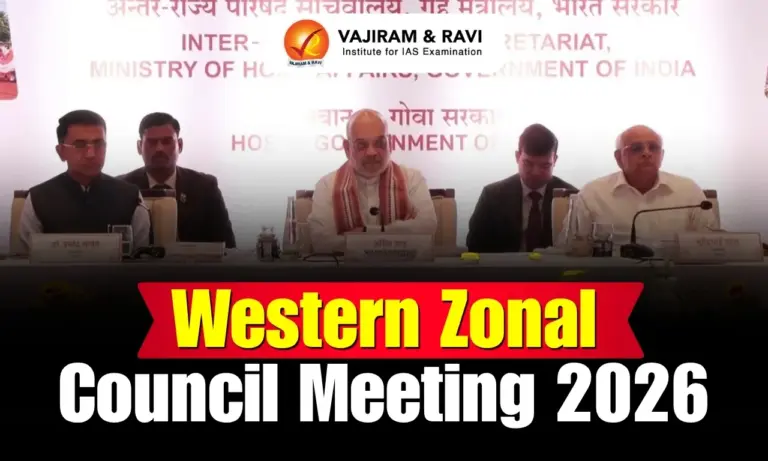
Recently, the 28th Western Zonal Council Meeting was held in Panaji, Goa. The meeting brought together representatives of the Centre, member States and the Union Territory to discuss issues affecting the western region and strengthen institutional mechanisms for inter-state cooperation.
About Western Zonal Council Meeting 2026
Recently, the 28th Western Zonal Council Meeting was held on 7 September 2026 in Panaji, Goa. The meeting deliberated on inter-state coordination, cooperative governance and sharing of best practices among the participating States and Union Territory.
- Chairman: Union Home Minister Amit Shah.
- Vice-Chairman: Chief Minister of Goa, with the position rotating annually among the Chief Ministers of member States.
- Members: Goa, Gujarat, Maharashtra and the Union Territory of Dadra and Nagar Haveli and Daman and Diu.
- Participants: Chief Ministers of Goa, Maharashtra and Gujarat, the Administrator of Dadra and Nagar Haveli and Daman and Diu, and senior officials from the Union and State Governments.
- Organised by: Inter-State Council Secretariat, Ministry of Home Affairs, Government of India.
- Hosted by: Government of Goa.
- Standing Committee: A committee at the level of Chief Secretaries examines issues proposed by the States before unresolved matters are placed before the Zonal Council.
- Nature: The Zonal Council is advisory and provides a platform for mutual understanding and cooperation on issues involving two or more States or the Centre and States.
Western Zonal Council Meeting 2026 Key Highlights
The Western Zonal Council Meeting 2026 focused on strengthening inter-State coordination, cooperative governance and sharing of best practices, while addressing key issues related to security, justice, welfare, cooperatives, financial inclusion and infrastructure.
- WEST Engine: The western region was highlighted as the “WEST Engine” of India’s growth, covering wealth and finance, exports and ports, start-ups and semiconductors, and tourism and blue economy.
- Coastal security: The meeting emphasised strengthening coastal security in the western region, with further measures planned over the next two years.
- Narcotics control: The participating States were urged to strengthen the national fight against narcotics through coordinated action.
- New criminal laws: Western States were encouraged to take the lead in implementing the three new criminal laws and strengthen coordination among police, prosecution and justice-delivery institutions.
- Fast-track justice: The implementation of Fast Track Special Courts (FTSCs) was reviewed to ensure speedy investigation and disposal of cases involving rape and offences against women and children.
- Emergency response: The meeting also reviewed the Emergency Response Support System (ERSS-112) to strengthen emergency response mechanisms.
- Cybercrime and digital fraud: Greater coordination was emphasised to combat cybercrime and digital financial fraud, including integration of cooperative banks with CFCFRMS and I4C, along with the use of MuleHunter AI to identify mule accounts.
- PACS computerisation: The meeting stressed strengthening Primary Agricultural Credit Societies (PACS) through computerisation, with Maharashtra and Gujarat reporting computerisation levels of around 98% and 92%, respectively.
- Gobardhan model: States were encouraged to adopt the Gobardhan model of Banas Dairy, Gujarat, to promote waste-to-wealth activities and strengthen the rural cooperative economy.
- Financial inclusion: The need to ensure brick-and-mortar banking facilities within the prescribed radius of every village was highlighted.
- Health and nutrition: Discussions covered Ayushman Bharat–PMJAY, Poshan Abhiyaan, child malnutrition and food safety standards, along with measures to strengthen healthcare delivery.
- Public hospitals: Greater participation of public hospitals in Ayushman Bharat–PMJAY was emphasised to expand access to healthcare services.
- Education: The meeting called for stronger measures to reduce school dropout rates.
- Infrastructure and urban development: The meeting discussed railway development, environmental clearances, urban master planning and electricity supply as areas requiring effective coordination.
- Green energy: The western States were encouraged to leverage their leading position in green energy and contribute to India’s clean-energy transition.
- Data centres: States were encouraged to make greater use of opportunities arising from data-centre policies and investments.


About Zonal Councils
Zonal Councils are statutory and advisory bodies established under Part III of the States Reorganisation Act, 1956. The idea of Zonal Councils was proposed by Jawaharlal Nehru in 1956 during discussions on the reorganisation of States.
- Objective: They were created to promote cooperation among States, strengthen Centre-State relations, reduce regional and linguistic tensions, and facilitate balanced socio-economic development.
Composition of Zonal Councils
The composition of Zonal Councils is provided under the States Reorganisation Act, 1956.
- Chairman: Union Home Minister.
- Vice-Chairman: Chief Minister of a member State, with the position rotating annually among the member States.
- State representation: Chief Ministers and two senior Ministers from each member State form part of the Council.
- Union Territory representation: Representatives of member Union Territories participate in the Council.
- Other Participants: Senior officials such as Chief Secretaries and other advisers participate in meetings to assist the Council in examining various issues.
- Standing Committee: Each Zonal Council has a Standing Committee comprising Chief Secretaries of the member States, which examines issues and facilitates their consideration before the Council.
- Secretariat: The Inter-State Council Secretariat under the Ministry of Home Affairs provides administrative and institutional support for the functioning of Zonal Councils.
Five Zonal Councils in India
India has five Zonal Councils, established under the States Reorganisation Act, 1956.
- Northern Zonal Council: Covers States and Union Territories of the northern region.
- Central Zonal Council: Uttar Pradesh, Uttarakhand, Madhya Pradesh and Chhattisgarh.
- Eastern Zonal Council: Bihar, Jharkhand, Odisha and West Bengal.
- Western Zonal Council: Goa, Gujarat, Maharashtra and Dadra and Nagar Haveli and Daman and Diu.
- Southern Zonal Council: Andhra Pradesh, Karnataka, Kerala, Tamil Nadu and Telangana, along with Puducherry, Andaman and Nicobar Islands and Lakshadweep.
The North Eastern Council, established under the North Eastern Council Act, 1971, is a separate statutory body and should not be confused with the five Zonal Councils.
Zonal Councils and the Inter-State Council
Both Zonal Councils and the Inter-State Council are important institutional mechanisms for promoting cooperative federalism, but they differ in their constitutional basis, composition and scope of functioning.
|
Basis |
Zonal Councils |
Inter-State Council |
|
Nature |
Statutory body |
Constitutional body |
|
Legal Basis |
States Reorganisation Act, 1956 |
Article 263 of the Constitution |
|
Establishment |
Created in 1956 |
Established in 1990 by Presidential Order |
|
Scope |
Regional and inter-State issues within specific zones |
Wider Centre-State and inter-State issues |
|
Chairman |
Union Home Minister |
Prime Minister |
|
Main Purpose |
Promote cooperation among States within a region |
Promote coordination and cooperation between the Union and States |
|
Nature of Recommendations |
Advisory and non-binding |
Advisory and non-binding |
|
Number |
Five Zonal Councils |
One Inter-State Council |
|
Secretariat |
Inter-State Council Secretariat, Ministry of Home Affairs |
Inter-State Council Secretariat, Ministry of Home Affairs |
|
Focus |
Regional cooperation, common issues and inter-State disputes |
Broader issues concerning Centre-State and inter-State relations |
Zonal Councils Significance
Zonal Councils provide an institutional mechanism for translating the principle of cooperative federalism into regular inter-governmental dialogue.
- Strengthen Centre-State relations: They provide a structured platform for the Centre and States to discuss issues requiring joint action.
- Facilitate inter-state cooperation: Neighbouring States can coordinate on issues such as transport, infrastructure, water resources and public services.
- Support dispute resolution: Dialogue through Zonal Councils can help address inter-state disputes before they escalate into prolonged conflicts.
- Improve welfare delivery: Joint monitoring helps States identify implementation gaps in welfare schemes and social-sector programmes.
- Promote best practices: Successful State-level initiatives can be shared and adapted by other States facing similar challenges.
- Strengthen internal security: Issues such as cybercrime, narcotics, coastal security and emergency response increasingly require coordinated action across State boundaries.
- Promote balanced development: Regional discussions on infrastructure, economic development and social planning can help address common developmental constraints.
- Strengthen national integration: Regular interaction among governments can reduce regional tensions and foster mutual understanding.
Zonal Councils Challenges
The effectiveness of Zonal Councils remains dependent on sustained political cooperation and effective implementation of their recommendations.
- Advisory nature: Since their recommendations are not legally binding, implementation ultimately depends on the willingness of the concerned governments.
- Political differences: Differences between the Centre and States or among States can make consensus difficult on politically sensitive issues.
- Implementation gap: Resolution of an issue at the Council level does not automatically ensure timely implementation on the ground.
- Follow-up limitations: Delays in monitoring unresolved issues can reduce the effectiveness of the mechanism.
- Institutional overlap: The existence of multiple forums dealing with Centre-State and inter-state issues can sometimes lead to duplication and fragmented coordination.

 Last updated on Oct, 2026
→ UPSC 2027 Notification will be released on 13 January 2027 at upsconline.nic.in.
→ Check Nobel Prize 2026 Winners List here.
→ Download PIB PRiSM Monthly Magazine 2026 here.
→ Check UPSC Monthly Current Affairs Magazine The Recitals here.
→ Check out the latest UPSC Syllabus here.
→ Download UPSC Model Answers for Mains 2026
→ UPSC Mains Question Paper 2026 is out now for Essay & GS Paper 1, 2, 3 & 4.
→ UPSC Calendar 2027 has been released.
→ Enroll in Vajiram & Ravi’s UPSC Mains Test Series 2027 for structured answer writing practice, expert evaluation, and exam-oriented feedback.
→ Join Vajiram & Ravi’s UPSC Mentorship Program 2027 for personalized guidance, strategy planning, and one-to-one support from experienced mentors.
→ Go through the UPSC Mains Previous Year Papers to enhance your preparation.
→ UPSC has released UPSC Toppers List 2025 with the Civil Services final result on its official website.
→ Also check Best UPSC Coaching in India
Western Zonal Council Meeting 2026 FAQs
Q1. Where was the Western Zonal Council Meeting 2026 held?+
Q2. Which States and Union Territory are part of the Western Zonal Council?+
Q3. Under which law were Zonal Councils established?+
Q4. Who is the Chairman of the Western Zonal Council?+
Q5. Are Zonal Councils constitutional or statutory bodies?+
Tags: 28th western zonal council meeting western zonal council meeting western zonal council meeting 2026