


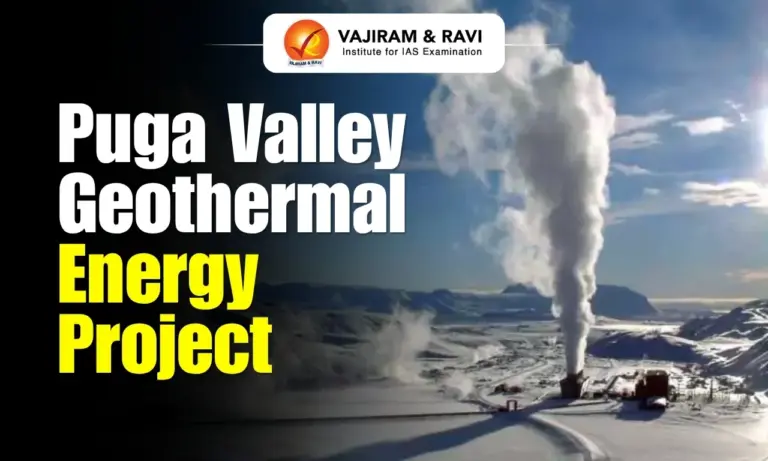
Puga Valley Geothermal Energy Project in Ladakh is an important step towards harnessing India’s geothermal energy potential. Located at an altitude of more than 14,000 feet, Puga Valley is known for its hot springs and strong geothermal activity. The project is being developed by the ONGC Energy Centre and aims to demonstrate electricity generation using heat stored beneath the Earth’s surface.
What is Geothermal Energy?
Geothermal energy is the energy obtained from the natural heat present inside the Earth. This heat warms underground rocks and water, which can be brought to the surface and used for electricity generation, heating, agriculture and other purposes. It is a renewable and relatively low-carbon source of energy that can provide power continuously.
- Source: Heat stored deep inside the Earth’s crust.
- Renewable: It is considered a renewable energy source because Earth’s internal heat is continuously generated.
- Electricity generation: Hot water or steam from underground can be used to drive turbines and generate electricity.
- Direct heating: Geothermal heat can be used directly for space heating, greenhouses and industrial processes.
- 24×7 availability: Unlike solar and wind energy, geothermal energy can provide continuous power and is less dependent on weather.
- Low emissions: Geothermal power generally produces lower greenhouse-gas emissions than fossil-fuel-based power.
- Geothermal hotspots: Areas with hot springs, geysers and volcanic activity often have significant geothermal potential.
- India’s potential: India has several promising geothermal regions, including Ladakh, Himachal Pradesh, Uttarakhand and Gujarat.
- Puga Valley: Puga Valley in Ladakh is one of India’s important geothermal sites and is being developed for geothermal power generation.
How Will the Puga Valley Geothermal Energy Project Generate Electricity?
Puga Geothermal Project will use the natural heat stored beneath the Earth’s surface to generate electricity. Geothermal fluids heated by underground rocks will be brought to the surface through production wells. The heat or steam will then be used to run a turbine connected to a generator, while the cooled water can be reinjected underground to support sustainable use of the geothermal reservoir. The project is being developed as a 1 MW pilot geothermal power project.
Step-by-Step Process
- Drilling Geothermal Wells: Deep wells are drilled into the Earth’s crust to reach the hot geothermal reservoir. At Puga, two wells have been developed to around 1,000 metres depth.
- Bringing Hot Fluid to the Surface: Underground water absorbs heat from hot rocks and becomes extremely hot. The production well brings this geothermal fluid towards the surface.
- Producing Steam or Heat: Due to the high temperature, the geothermal fluid can produce steam, which can be used to drive a turbine.
- Running the Turbine: The steam or geothermal heat is used to rotate a turbine. The turbine is connected to a generator.
- Generating Electricity: As the turbine rotates, the generator converts mechanical energy into electrical energy.
- Reinjecting Water: After the heat is extracted, the cooled geothermal fluid can be reinjected into the underground reservoir through an injection well. This helps maintain the geothermal system and reduce water wastage.


National Policy on Geothermal Energy
National Policy on Geothermal Energy, notified by MNRE in September 2025, provides a framework to promote the exploration, development and utilisation of geothermal energy in India and supports the country’s goal of achieving Net Zero emissions by 2070.
- Promotes geothermal energy for electricity generation and direct-heat applications.
- Identifies promising areas, including 42 geothermal manifestations for further development.
- Encourages research, innovation and technology development in geothermal energy.
- Supports international cooperation and technology transfer.
- Promotes the possible repurposing of abandoned oil and gas wells for geothermal energy.
- Supports clean-energy transition and Net Zero by 2070 by diversifying India’s renewable energy mix and reducing dependence on fossil fuels.

 Last updated on Oct, 2026
→ UPSC 2027 Notification will be released on 13 January 2027 at upsconline.nic.in.
→ Check Nobel Prize 2026 Winners List here.
→ Download PIB PRiSM Monthly Magazine 2026 here.
→ Check UPSC Monthly Current Affairs Magazine The Recitals here.
→ Check out the latest UPSC Syllabus here.
→ Download UPSC Model Answers for Mains 2026
→ UPSC Mains Question Paper 2026 is out now for Essay & GS Paper 1, 2, 3 & 4.
→ UPSC Calendar 2027 has been released.
→ Enroll in Vajiram & Ravi’s UPSC Mains Test Series 2027 for structured answer writing practice, expert evaluation, and exam-oriented feedback.
→ Join Vajiram & Ravi’s UPSC Mentorship Program 2027 for personalized guidance, strategy planning, and one-to-one support from experienced mentors.
→ Go through the UPSC Mains Previous Year Papers to enhance your preparation.
→ UPSC has released UPSC Toppers List 2025 with the Civil Services final result on its official website.
→ Also check Best UPSC Coaching in India
Puga Valley Geothermal Energy Project FAQs
Q1. What is the Puga Valley Geothermal Energy Project?+
Q2. Where is Puga Valley located?+
Q3. Why is Puga Valley suitable for geothermal energy?+
Q4. Who is developing the Puga Geothermal Project?+
Q5. What is the proposed capacity of the Puga geothermal project?+
Tags: puga valley geothermal energy project











