About Pallas fish eagle
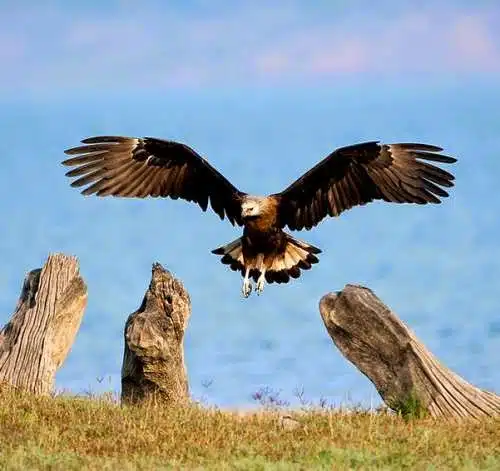
- It is also known as Pallas’s sea eagle or band-tailed fish eagle, is a large, brownish sea eagle.
- It can be seen near lakes, marshes and large rivers, from lowlands to 5,000 metres of elevation.
- It feeds primarily on fish, but many other preys are part of its diet.
- It breeds usually near water in a large nest placed in a tall tree.
- Distribution: It is found in the east Palearctic in Kazakhstan, Russia, Tajikistan, Turkmenistan, Uzbekistan, Mongolia,China, India, Nepal, Bangladesh and Myanmar.
- It is partially migratory.
- Conservation status
- IUCN Red List: Endangered
- Threats: Humans contribute to the decline of this species through habitat degradation, pollution, and draining or overfishing lakes.
Key facts about the Chilika lake
- It is a brackish water lake and a shallow lagoon with estuarine character spread across the districts of Puri, Khurda and Ganjam in the state of Odisha.
- It is connected to the Bay of Bengal by a wide channel that mostly runs parallel to the Bay separated by a narrow spit.
- It is located at the mouth of the Daya River, flowing into the Bay of Bengal.
- It can be broadly divided into four ecological sectors based on salinity and depth, namely the southern zone, the central zone, the northern zone and the outer channel.
- It is the largest wintering ground for migratory waterfowl found anywhere on the Indian sub-continent.
- The Nalaban Island within the lake is notified as a Bird Sanctuary under Wildlife (Protection) Act, 1972.
- In 1981, Chilika Lake was designated the first Indian wetland of international importance under the Ramsar Convention.
Q1) What is the aim of the Ramsar convention?
The aim of the Ramsar convention is to develop and maintain an international network of wetlands which are important for the conservation of global biological diversity and for sustaining human life through the maintenance of their ecosystem components, processes and benefits.
Source: Pallas fish eagle sighted in Chilika after 10 years


 Last updated on Oct, 2026
→ UPSC 2027 Notification will be released on 13 January 2027 at upsconline.nic.in.
→ Check Nobel Prize 2026 Winners List here.
→ Download PIB PRiSM Monthly Magazine 2026 here.
→ Check UPSC Monthly Current Affairs Magazine The Recitals here.
→ Check out the latest UPSC Syllabus here.
→ Download UPSC Model Answers for Mains 2026
→ UPSC Mains Question Paper 2026 is out now for Essay & GS Paper 1, 2, 3 & 4.
→ UPSC Calendar 2027 has been released.
→ Enroll in Vajiram & Ravi’s UPSC Mains Test Series 2027 for structured answer writing practice, expert evaluation, and exam-oriented feedback.
→ Join Vajiram & Ravi’s UPSC Mentorship Program 2027 for personalized guidance, strategy planning, and one-to-one support from experienced mentors.
→ Go through the UPSC Mains Previous Year Papers to enhance your preparation.
→ UPSC has released UPSC Toppers List 2025 with the Civil Services final result on its official website.
→ Also check Best UPSC Coaching in India