Pangolin Trafficking Key Highlights
- Historical data: This is the third pangolin scale seizure in Nigeria this year involving the NCS and WJC.
- Cumulative impact: Since July 2021, 16 operations have led to 35 arrests, 12 convictions, and seizures of 21.582 tonnes of pangolin scales and 1.065 tonnes of ivory.
- Contribution: The partnership accounts for 95% of pangolin scale seizures in Nigeria during this period.
Pangolins: Species and Characteristics
- Species: There are eight species of pangolins, found across two continents:
- Africa: Black-bellied pangolin, White-bellied pangolin, Giant Ground pangolin, and Temminck’s Ground pangolin.
- Asia: Indian pangolin (Manis crassicaudata), Chinese pangolin (Manis pentadactyla), Philippine pangolin, and Sunda pangolin.
- Features:
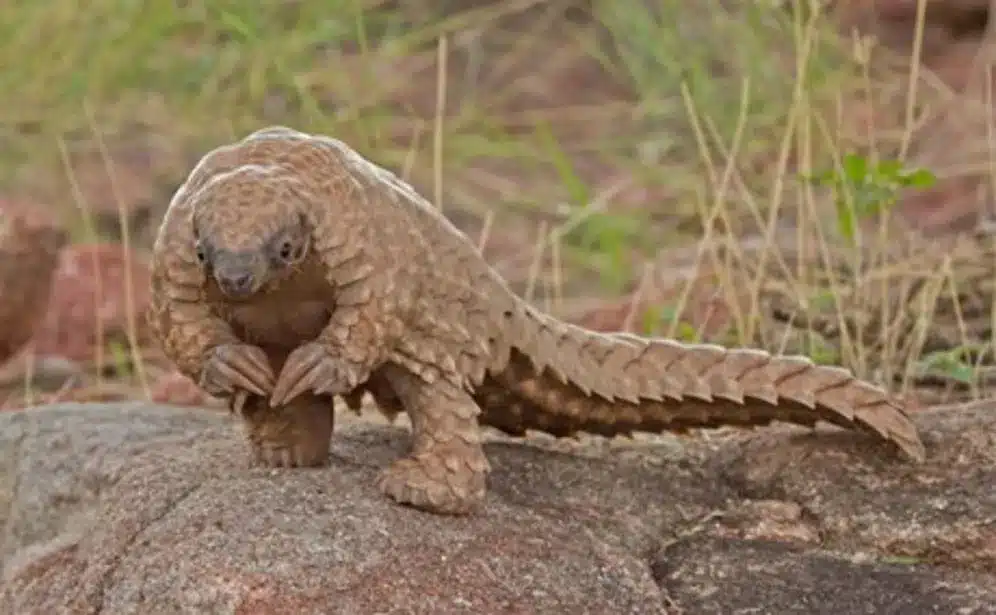
- Armour: Pangolins have large keratin scales covering their skin, which serve as armour.
- Behaviour: They are solitary, nocturnal, and primarily feed on ants and termites.
- Self-Defense: Pangolins can curl into a ball to protect themselves from predators.
- Habitat: They inhabit a variety of environments, including tropical forests, grasslands, and areas close to human settlements.
Indian Pangolin
- Distribution: Found in India, Bangladesh, Southern Nepal, Sri Lanka, and parts of Pakistan.
- Habitat: Adapted to various environments including deserts, tropical forests, and near human settlements.
- Physical traits: The Indian pangolin has 13 rows of sharp, overlapping scales that vary in colour depending on its surroundings.
- Conservation status:
- IUCN Red List: Endangered
- Wildlife (Protection) Act, 1972: Listed under Schedule I
- CITES: Appendix I
Q1: What is the primary law for wildlife protection in India?
The Wildlife Protection Act, 1972 is the primary legislation aimed at safeguarding wildlife in India. It provides for the protection of wild animals, birds, and plants, and establishes schedules classifying species based on the level of protection they require. It also sets up protected areas like National Parks and Wildlife Sanctuaries.
News: Nigerian authorities seize 2.179 tonnes of pangolin scales


 Last updated on Oct, 2026
→ UPSC 2027 Notification will be released on 13 January 2027 at upsconline.nic.in.
→ Check Nobel Prize 2026 Winners List here.
→ Download PIB PRiSM Monthly Magazine 2026 here.
→ Check UPSC Monthly Current Affairs Magazine The Recitals here.
→ Check out the latest UPSC Syllabus here.
→ Download UPSC Model Answers for Mains 2026
→ UPSC Mains Question Paper 2026 is out now for Essay & GS Paper 1, 2, 3 & 4.
→ UPSC Calendar 2027 has been released.
→ Enroll in Vajiram & Ravi’s UPSC Mains Test Series 2027 for structured answer writing practice, expert evaluation, and exam-oriented feedback.
→ Join Vajiram & Ravi’s UPSC Mentorship Program 2027 for personalized guidance, strategy planning, and one-to-one support from experienced mentors.
→ Go through the UPSC Mains Previous Year Papers to enhance your preparation.
→ UPSC has released UPSC Toppers List 2025 with the Civil Services final result on its official website.
→ Also check Best UPSC Coaching in India