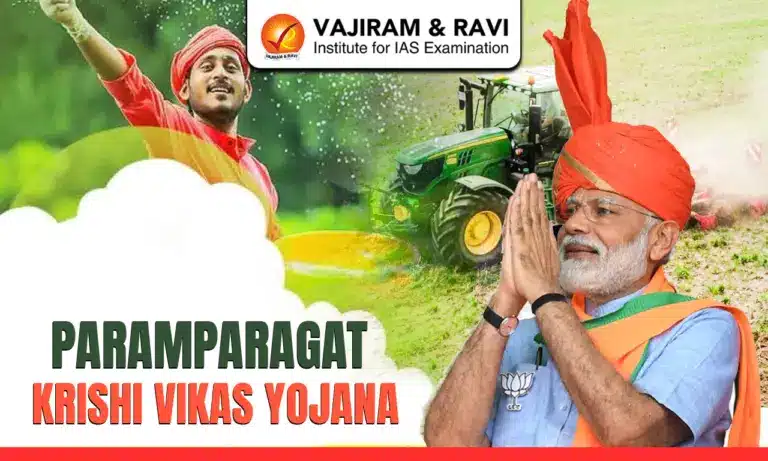
Paramparagat Krishi Vikas Yojana (PKVY) is a government scheme that promotes organic farming in India in a simple and sustainable way. It encourages farmers to adopt traditional and eco-friendly agricultural practices instead of using chemical fertilizers and pesticides.
About Paramparagat Krishi Vikas Yojana
- PKVY is a government scheme launched in 2015 to promote organic farming in India in a natural and traditional way.
- It is a part of the Soil Health Management (SHM) component under the National Mission on Sustainable Agriculture (NMSA).
- The main aim of the scheme is to encourage farmers to adopt chemical-free farming, which helps in improving soil health and fertility.
- It supports farmers by promoting the use of natural inputs like compost, bio-fertilizers, and organic manure instead of harmful chemicals
- The scheme focuses on creating a sustainable farming system that is safe for both the environment and human health.
- Key Features
- Follows a cluster-based approach, where farmers are grouped into 20-hectare clusters for better management.
- Provides complete support from production to marketing, ensuring farmers benefit at every stage.
- Promotes Participatory Guarantee System (PGS-India), a simple and low-cost organic certification system.
- Encourages group farming, which reduces costs and improves efficiency.
- Focuses on building a strong organic supply chain in non-North Eastern states.
- Financial Assistance
- Farmers receive ₹31,500 per hectare for 3 years for organic farming activities.
- ₹15,000 per hectare is directly transferred to farmers through DBT for organic inputs like compost and bio-fertilizers.
- Around ₹4,500 per hectare is provided for marketing, branding, packaging, and value addition.
- About ₹3,000 per hectare is given for certification and quality testing.
- Nearly ₹9,000 per hectare is allocated for training, awareness, and capacity building.
- Financial support helps farmers reduce input costs and shift easily to organic farming.
- Funding Pattern
- Funded jointly by Central and State Governments in 60:40 ratio.
- For North Eastern and Himalayan states, the ratio is 90:10.
- For Union Territories, it is 100% funded by the Central Government.
- Coverage and Achievements
- Since 2015-16, about 14.99 lakh hectares have been brought under organic farming.
- More than 52,000 clusters have been formed across the country.
- Over 25 lakh farmers have been included under the scheme.
- The scheme has helped in increasing awareness and adoption of organic farming practices.
- Support through FPOs
- Linked with Farmer Producer Organizations (FPOs) to support farmers collectively.
- Helps farmers in getting inputs, accessing credit, and better marketing opportunities.
- Provides support through equity grants, credit guarantee funds, and business assistance.
- As of December 2024, over 9,000 FPOs have been registered under the related scheme.
- Strengthens collective bargaining power and reduces dependency on middlemen.
- Marketing and Digital Support
- The Jaivik Kheti Portal helps farmers sell organic products directly to consumers.
- Improves market access, transparency, and fair pricing.
- Encourages branding and value addition of organic products.
- Supports farmers in reaching local, national, and even export markets.
- Eligibility
- All farmers and institutions can apply under the scheme.
- Mainly targets small and marginal farmers.
- The maximum eligible landholding is 2 hectares.
- Promotes inclusive growth by supporting weaker sections of farmers.
- Significance
- Promotes chemical-free and sustainable agriculture practices.
- Improves soil fertility, biodiversity, and environmental health.
- Reduces cost of cultivation and increases farmers’ income.
- Supports climate-resilient agriculture and long-term food security.
- Encourages a shift towards eco-friendly and healthy food systems.


 Last updated on Oct, 2026
→ UPSC 2027 Notification will be released on 13 January 2027 at upsconline.nic.in.
→ Check Nobel Prize 2026 Winners List here.
→ Download PIB PRiSM Monthly Magazine 2026 here.
→ Check UPSC Monthly Current Affairs Magazine The Recitals here.
→ Check out the latest UPSC Syllabus here.
→ Download UPSC Model Answers for Mains 2026
→ UPSC Mains Question Paper 2026 is out now for Essay & GS Paper 1, 2, 3 & 4.
→ UPSC Calendar 2027 has been released.
→ Enroll in Vajiram & Ravi’s UPSC Mains Test Series 2027 for structured answer writing practice, expert evaluation, and exam-oriented feedback.
→ Join Vajiram & Ravi’s UPSC Mentorship Program 2027 for personalized guidance, strategy planning, and one-to-one support from experienced mentors.
→ Go through the UPSC Mains Previous Year Papers to enhance your preparation.
→ UPSC has released UPSC Toppers List 2025 with the Civil Services final result on its official website.
→ Also check Best UPSC Coaching in India
Paramparagat Krishi Vikas Yojana FAQs
Q1. What is Paramparagat Krishi Vikas Yojana (PKVY)?+
Q2. What is the main objective of Paramparagat Krishi Vikas Yojana?+
Q3. What is the Participatory Guarantee System (PGS-India)?+
Q4. How does Paramparagat Krishi Vikas Yojana support farmers financially?+
Q5. What is the cluster approach in Paramparagat Krishi Vikas Yojana?+
Tags: economy economy notes paramparagat krishi vikas yojana